Canadian and Latvian troops are conducting NATO’s first large-scale exercise with ground drones, operating in Latvia under what is formally referred to as Crystal Arrow 2026. This operation is emblematic of the rapidly accelerating technological advancement of uncrewed systems, vehicles that can conduct data-collection missions and operations independent of any onboard human presence. NATO is committed to harnessing this innovation to defend against adversaries such as Russia. In collaboration with Ukrainian soldiers who have faced the pervasive threat posed by Uncrewed Aerial Systems (UASs), these Latvian and Canadian troops are navigating the integration of technology into warfare. The use of Uncrewed Ground Vehicles (UGVs) has the capacity to complement UASs, as vehicle fleets may soon become operated by remote technicians. Uncrewed systems are increasingly proving themselves to be invaluable on the modern battlefield; as no price will exceed that of the human lives which remote warfare can preserve. As in any other field, however, introducing technology can adjust existing frameworks for conducting military operations. However, these technological developments are not independent of human gender, psychology, and morale. Rather, Mariia Berlinska, a Ukrainian drone pilot, posits that these technologies are major equalizers, ushering in new types of warfare where women may prove more adept operators than men. By reshaping the dynamics of the frontlines, uncrewed systems rewrite traditional conceptions of warfare in which combat effectiveness has been linked with physical strength. As NATO Allies increasingly embed drone warfare into their militaries, the mistake of measuring combat effectiveness through these physical indicators becomes more apparent. Remote warfare prioritizes precision, emotional resilience, and analytical thinking. These qualities are particularly salient among women, explaining why they often prove to be strong drone operators. Integrating gendered perspectives into the assessment of technological advancement and remote warfare is thus imperative to adapting NATO’s framework to the realities of contemporary military operations. NATO and its adversaries are both rapidly arming themselves with these new remote warfare technologies, and in order to maximize the leverage produced by these technologies, NATO must explore the role of gender in their deployment and impacts.
Mariia Berlinska is one of almost 70,000 women in the Security Forces of Ukraine (SFU). She has been named a leader in Ukraine’s drone warfare for her deep knowledge of the technology’s implications. This allows her Victory Drones Group to deliver comprehensive training courses, including a 33-day course on attack drone piloting. She notes an important trend: her top graduates are women. This observation does not come as a surprise, as she notes qualities like teamwork and composure under pressure are critical to remote warfare, and that women are more likely to display these qualities. Hand-to-hand combat is growing increasingly obsolete, and these adjustments produce social implications already being felt by the Ukrainian military. In this new landscape of warfare, technical skills defy physical proficiency, and the top aces may prove to be women drone operators.
Many of the social implications of drone warfare have likewise become evident in Ukraine’s resilient response to Russia’s 2022 invasion. In 2024, NATO officials developed a preliminary framework for investigating the implications of drone warfare on soldiers and civilians. As a result, they uncovered the negative portrayals of women’s growing involvement in drone warfare. For instance, the gendered language used to describe drone pilots differs greatly from that which is used to describe fighter pilots; emphasizing the reduced physical risk of drone operation, diminishing the heroism of drone operators and trivializing their emotional challenges. The framing of drone warfare as less masculine than conventional warfare in turn risks portraying female drone operators as emotionally unstable. These depictions produce consequences, including the continued misogyny faced by women in militaries, alongside the reluctance to seek psychological support out of fear of appearing weak.
Similarly, despite the minimized hand-to-hand interaction permitted by drone warfare, civilian harm remains a risk with remotely piloted systems. NATO’s pattern-to-life analysis revealed women and children are more likely to be deliberately placed in harm’s way as a tactic of deception for UASs. Diverse perspectives, including those informed by gender, are essential to preventing the targeting errors produced by cultural misunderstandings, psychological biases, and behavioural misinterpretations. A pathway to doing this involves the integration of Gender Advisors (GENADs) into targeted decisions made by the Commander and Legal Advisor (LEGAD). Expanding viewpoints could support LEGADs in anticipating the gender disparate and potential secondary impacts of targeting; for instance, by targeting water supplies, they can understand the impact of a disrupted water supply on vulnerable groups. This NATO workshop ultimately indicated that as technology advances, so too must the ethical frameworks and social awareness that governs how it is used. The need to organize the gendered dimensions of drone warfare is urgent, and is essential to recognizing the full spectrum of impacts on both combatants and civilians.
There are several trajectories that NATO allies including Canada can pursue to ensure a socially sound yet effective embrace of military drone technology. In Ukraine’s ongoing struggle against Russia, Berlinska attests to women’s unique composure and precision as uncrewed systems operators. By replicating mentorship programs such as Berlinska’s Victory Drone Group, Canada and NATO can continue to promote women as leaders in remote warfare, locating new opportunities for women’s recruitment and retention in military institutions. These programs can also generate research on the gender-based outcomes of remote warfare, assessing the gendered implications to inform the development of evidence-based recruitment frameworks. To avoid negative outcomes, NATO allies can subsequently formally instate the inclusion of GENADs into targeting decisions to anticipate gender-disparate harms for both combatants and civilians. Remote warfare presents the unique opportunity for technological advancement and gender awareness to progress in tandem; recognizing the gendered dimensions for remote warfare is fundamental to this and to NATO’s doctrine of protecting civilians and combatants in the face of adversaries.
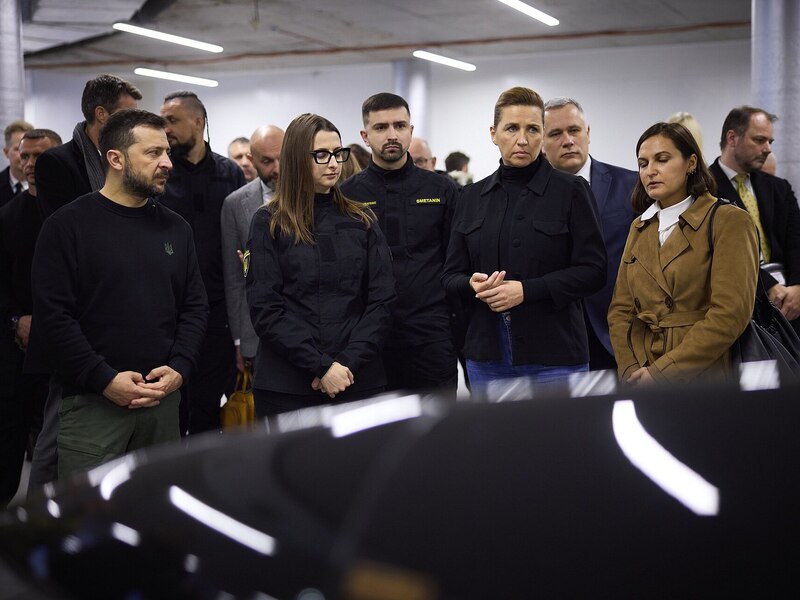
Photo: President of Ukraine Volodymyr Zelenskyy and Prime Minister of Denmark Mette Frederiksen meet to inspect long-range drones procured with Denmark’s support in November 2024. Source: Public Domain, via Wikimedia Commons.
Disclaimer: Any views or opinions expressed in articles are solely those of the authors and do not necessarily represent the views of the NATO Association of Canada.