Amidst a growingly volatile and uncertain international arena, Canada’s Arctic resilience is of utmost importance. Arctic defence posture, however, differs from traditional defence architecture, as the region represents a unique environment for emerging weapons systems that threaten NATO security. Geographic assessments reveal a series of potential threats including Russia’s activity in Canadian air approaches, China’s deployment of military surveillance vessels, growing activity in Canada’s Arctic Northwest Passage, and threats towards Canada’s sovereignty in the region. Beyond international adversaries, climate change is also increasing interest in the Arctic, as the region possesses the critical minerals needed for the transition to low-carbon sources of energy.This landscape of both risk and opportunity in the Arctic illustrates why the Canadian Armed Forces (CAF) have accelerated operations to “detect, deter and…defend,” Canadian sovereignty. These operations aim to strengthen the CAF’s position in the North; with goals to detect potential threats early, prepare to respond effectively, and operate cohesively among NATO allies.
The Gender Equality in the Arctic Pan-Arctic Report Phase 3 (GEA3 Report) is a central tool for examining gender inequality in the Arctic region. Canadian defence projects must consider these inequalities to bolster their resilience. This necessitates close collaboration with Arctic peoples, as the CAF aims to consolidate a meaningful and enduring presence that safeguards Canadian security by working in collaboration with Inuit and Northern Indigenous governments and communities. By integrating women’s leadership in particular, Arctic defence planning can alleviate existing inequalities in the Arctic while instilling Canada’s northern security strategy with the nation’s broader commitment to the Women, Peace and Security (WPS) agenda.
Canada’s recent projects in the Arctic are largely concerned with hard security, which utilizes military means to protect territorial and political interests. Although the GEA3 report does not reference hard security in particular, its investigation of human security in the Arctic can be utilized to inform how addressing gender inequities can advance Canada’s Arctic defence strategy . The report found that gendered security perspectives are imperative to propelling Arctic resilience and stability; highlighting how gender inequalities deepen insecurity, given that most Arctic regions are omitted from political goals and government services. Issues such as insufficient housing, limited health infrastructure, and reduced job opportunities contribute to insecurity. These issues are disproportionately borne by women, as the exclusion of gender from policy discourse incites women’s unique lived experiences to remain peripheral in planning and policy. It is therefore essential that the accelerating focus on the Arctic region to protect Canada’s broader hard security, absorbs a gendered security perspective as highlighted in the GEA3 Report.
Towards this end, female leaders are already addressing gender inequalities that affect Arctic security. Sarah Cox, the Director of Circumpolar Affairs at Northern Affairs Canada and a key member of the Arctic Council reflected on the Arctic Council’s strategic plan and framework, stressing the importance of non-discrimination in the Arctic. As a Canadian representative, she expressed how Canada is particularly proud to be involved in Arctic initiatives and uplifts inclusive understandings of Arctic security. Canada’s leadership in integrating this gender-based analysis into Arctic defence is essential for setting an example on international levels for how defence policy can be cognizant of the unique conditions presented by the Arctic. By neglecting the interests of Indigenous communities living in the Arctic, the CAF risks forfeiting knowledge from those with the greatest situational awareness of the North. Moreover, military activities can contribute to an improved living standard for Northern communities by propelling multi-use infrastructure that meets military requirements while also benefiting local communities.
This sentiment is mirrored in a news release from the Governor General of Canada aiming to amplify the rising voices of Indigenous women leading Arctic transformation. Nakurmiik, the spokesperson of this release, discussed the vital role Inuit women play in empowering Canadian defence systems in the Arctic. Indigenous women’s deep knowledge of the Arctic is essential to guiding Canada’s military and security efforts. By aiding in cultivating trust between the CAF and communities across the vast territory of Canada’s Arctic, mothers, artists, teachers, and Indigenous women are the catalysts of these fundamental relationships. As leaders in local politics and diplomacy, Indigenous women in the Arctic bring real issues to the forefront, ultimately initiating the progress which leads to better decision making; Indigenous women drive transformative change.
It is notable that Canada’s current efforts to strengthen Arctic security, including through active empowerment of women in the security sector, is itself being led by Canada’s female Chief of Defence Staff, Jennie Carignan. Carignan has stressed that continuous operation in the Arctic is vital to strengthening the nation’s sovereignty and that by enhancing domain awareness, the CAF is able to defend Canadian interests in the region alongside allies and partners. Her leadership is emblematic of a shift toward embedding the gendered methods, as presented in the GEA3 Report and by the Arctic Council, within hard security institutions. Arctic defence cannot be separated from the region’s human security concerns, and women’s leadership is essential to operationalizing these more inclusive security frameworks.
For Canada to fully realize the strategic advantages of Arctic security, the CAF must cooperate with women and Indigenous knowledge-holders to guide its northern operations. The insights advanced by the Arctic Council and the GEA3 Report demonstrate how gender equality is particularly relevant to the Arctic context and is constitutive of the region’s resilience. CAF operational planning must similarly enact gender-responsive frameworks, which empower and are inclusive of Indigenous Arctic women’s perspectives as presented by Nakurmiik and Cox. Strengthening Arctic resilience demands deepening institutional and personal partnerships with Indigenous communities, a pathway which Nakurmiik highlighted as mutually beneficial to the CAF through the enlightening capacities of Indigenous women as knowledgeable champions of diplomacy. By elevating women’s leadership, Canada can materially embed its operational strategy with gendered realities that will strengthen Arctic security and subsequently, Canada’s defence posture.
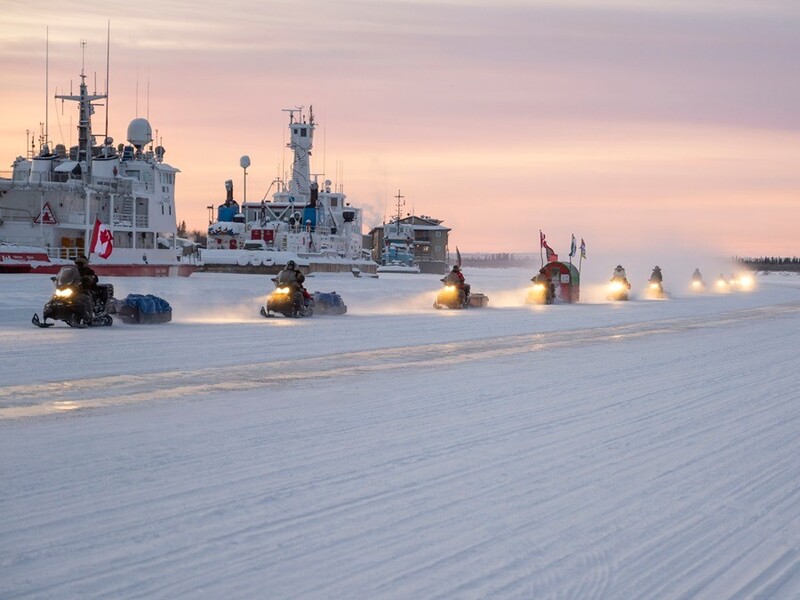
Photo: A scene from Operation NANOOK‑NUNALIVUT 2025. Source: Photo by Cpl Jacob Hanlon, Canadian Forces Photo.
Disclaimer: Any views or opinions expressed in articles are solely those of the authors and do not necessarily represent the views of the NATO Association of Canada.