Espionage and intelligence have recently absorbed centre stage in national headlines, which is ironic for professions whose very nature depends on remaining in the shadows. This is primarily due to the recent arrest of a Canadian NATO Intern, accused of spying on the Alliance on behalf of an enemy state. While the allegations are deeply serious, the case offers a rare glimpse into the otherwise opaque world of intelligence, and despite its particularities, the episode has brought a traditionally obscure element of national security into public view. While shifting the focus away from the case itself, the conversation surrounding espionage and intelligence invites a unique opportunity to reflect on Canada’s own history with espionage, among other covert practices in the field of national security, and the women who paved paths in these practices. Espionage has historically been viewed as a male-dominated field, but women have long made essential contributions to Canadian intelligence and security. Wartime spies leveraged mobility, social networks, and related gender stereotypes to gather intelligence. These skills evolved, and women now absorb leadership roles at the Canadian Security Intelligence Service (CSIS), Canada’s formal spying agency, more than they do in other Canadian intelligence and security institutions. The increasing representation of women in intelligence warrants a reflection on women’s history in spying, and an investigation of why women make good spies.
CSIS was born in 1984 in replacement of the Royal Canadian Mounted Police’s (RCMP) acting security service. This transition created an initial environment which veterans of the organization described as, “strong on testosterone” in its early days. Nearly four decades later, gender equality is one of the organization’s leading capabilities, with women making up 48 per cent of CSIS’s workforce as of 2018. Not only do the baseline numbers point to strong female participation, but five out of ten members of CSIS’s most senior executive team are also women; the agency is one of the most women-dominated security and defence institutions in Canada.
This is, in part, a product of the deeply intentional efforts made by women in the field to uplift one another. For instance, in 2018, CSIS created a service-wide Women’s Network, serving as the first formal mentorship scheme that would improve the internal work environment and allow women to excel as leaders. A senior leader at CSIS stressed the importance of programs like this, noting that the organization would be unable to deliver on its mandate without diversity and equity; she stated the impossibility of protecting Canadians without leveraging the skills that can only be offered by a diverse workforce. She elaborated on this by describing the gendered dynamics of counterintelligence; women are not immune to recruitment and enlistment into terrorist organizations, and agencies such as CSIS would not be as successful in deploying counterintelligence efforts if they were to only hire and recruit one type of person.
The excellence of women in intelligence can also be explained by their specialized skill sets that are identifiable through gendered analyses. Female intelligence agents are capable of displaying specific forms of femininity as appropriate to their situations, and these gender performances often make it more seamless for them to fit into civilian society. This improves their ability to pass as non-combatant women for longer periods of time and gather intelligence. Women also have stronger socioemotional skills, through which qualities such as self-control, empathy, problem-solving and others, are adaptable to the various populations intelligence agents may need to embed themselves in. Women are thus afforded unique access to networks and more likely to be granted information of strategic value. They are, all around, less likely to attract suspicion and enjoy greater freedom of movement, ultimately making them better spies.
As seen through the evolution of CSIS, Canada maintains its own history of women in intelligence worth celebrating. Much of the literature dissecting this history agrees that the First and Second World Wars served as pivotal moments for women to ascend into the field of intelligence. While men were increasingly unavailable due to combat, intelligence granted women a non-combatant route to advance the Allies’ armed struggle. Over half a century later, in 2024, Vanessa Lloyd became the first woman ever to lead CSIS. Her appointment represents not only an individual achievement, but is rather symbolic of how substantially the composition and leadership of Canada’s intelligence community has evolved since women began displaying their espionage capabilities. Joining the Service as an intelligence officer in 1998, Lloyds quickly excelled as a field investigator and then in counterintelligence. In 2020, she became CSIS’ first Chief Information Officer, leading efforts to modernize the organization’s operational model and strengthen its capabilities in response to the rapidly evolving security landscape. By 2023, she was the Deputy Director of Operations, and was named as the organization’s interim Director in 2024.
Canada and the Alliance must continue to treat women’s participation in intelligence as a strategic necessity in an evolving security environment. As adversaries adapt recruitment practices and increasingly exploit women as proxies, allied agencies must leverage women’s capabilities. A diverse intelligence agency is better positioned to recognize the varied ways in which threats emerge, especially when adversaries continue to weaponize differences in gender, culture, and social networks. Intelligence institutions cannot rely on a single demographic or professional profile; otherwise, they risk approaching highly nuanced threats through a narrow lens, while women’s leadership is an operational asset that cannot be overlooked.
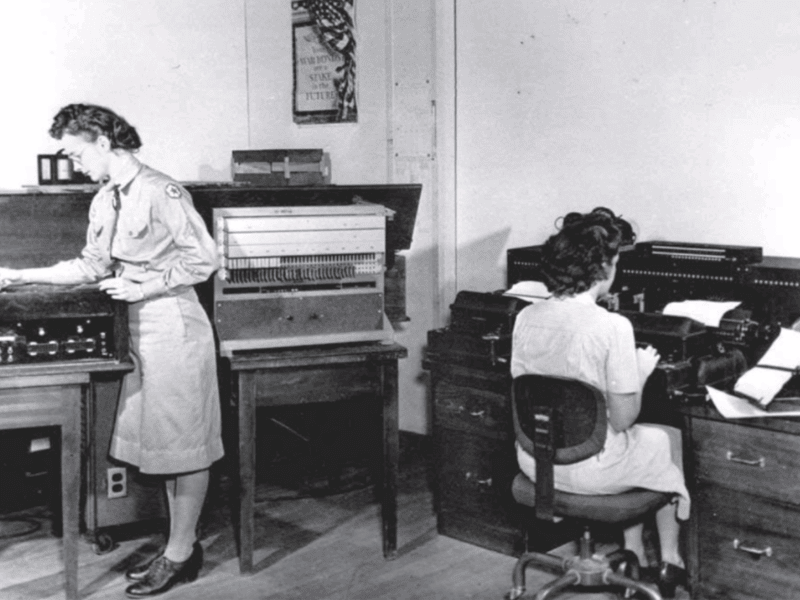
Photo: Two women at work at the U.S. Army Signal Intelligence Service during World War II, 1944-1945. Source: Wikimedia commons, Public Domain.
Disclaimer: Any views or opinions expressed in articles are solely those of the authors and do not necessarily represent the views of the NATO Association of Canada.