At a time when defence and security has become an ongoing conversation, the global energy landscape is undergoing a profound structural realignment. NATO member states are driven by the imperative need to diversify vital supply chains away from adversarial, revisionist regimes such as Iran and Russia. Western allies, including Canada, are increasingly looking to the Western Hemisphere, specifically European partners like Germany, to anchor their long-term economic resilience. Such can be seen with the recent agreement signed by Brazil for energy partnerships and ongoing negotiations with the United States on critical minerals. At the epicentre of this shift is the Co-operative Republic of Guyana and Bolivarian Republic of Venezuela whose latent territorial dispute has been reignited after the discovery of abundant resources in the area, this time a critical energy resource in this case, oil. Modern sovereignty is about operational strength, not just territory. As national security expands to include supply chains and strategic alliances, state power is increasingly defined by functional capacity rather than geographical territory. This shift is clearer in the Caribbean Basin. By unlocking massive, world-class offshore oil reserves, Guyana has fundamental potential to disrupt traditional global dependencies.
The International Court of Justice (ICJ) is currently considering the landmark Guyana–Venezuela territorial dispute. The conflict highlights how traditional territorial claims collide directly with modern strategic assets, critical supply routes, and offshore economic capacity. This territorial dispute and the fight for ownership of economic assets is part of a broader conversation that can immensely impact NATO and its member States. It is key, now more than ever, for NATO to consider strategic allyship with non-NATO members.
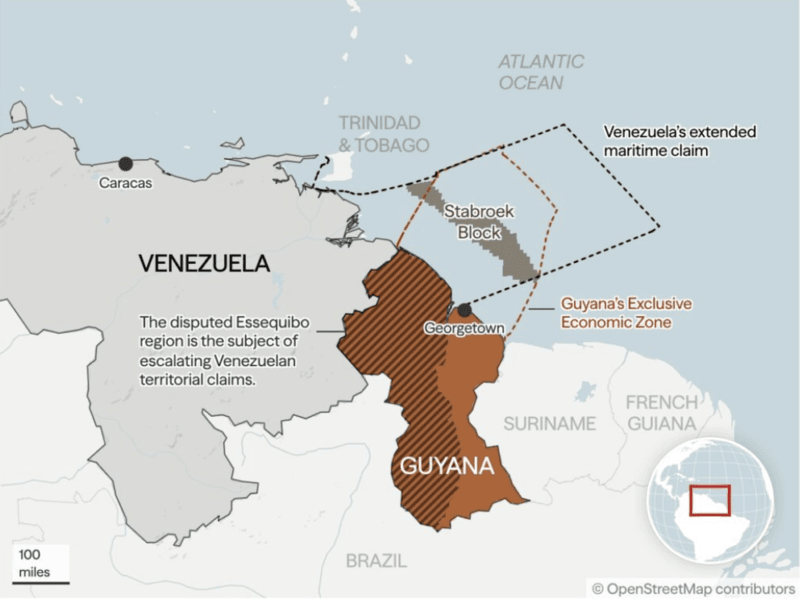
Driven by unprecedented deepwater discoveries within the 6.6 million acre Stabroek Block, Guyana’s production has surged past 900,000 barrels per day from its active floating production, storage, and offloading (FPSO) vessels. With the accelerated startup of its latest developments, output is rapidly scaling past the one million barrel milestone. They are currently en route to an anticipated 1.5 million barrels per day by the turn of the decade. For a nation with a population of under 800,000 people, this represents the highest per capita resource wealth explosion in modern history, rightfully positioning Guyana to become the new Qatar or “Saudi Arabia of the Caribbean.” However, this sudden transformation from a minor regional player into a critical pillar of EuroAtlantic energy security has simultaneously rendered Guyana a high-stakes geopolitical target. Meanwhile, Venezuela has aggressively revived a colonial-era claim over the Essequibo region, a vast territory that comprises two-thirds of Guyana’s landmass and hydrocarbon-rich offshore waters. Venezuela is claiming that the land and waters where the offshore oil has been found are bound by ancient colonial boundaries of the Spanish Empire, characterizing the 1899 Arbitral Award as a historical fraud. From Caracas’s perspective, controlling Essequibo’s oil wealth offers a lucrative lifeline to fund its own national reconstruction; however, an authoritarian seizure of this territory would unleash catastrophic instability across the Western Hemisphere and shatter the rules-based international order.
Consequently, the Essequibo dispute is no longer a localized territorial friction; it has graduated into a vital theatre of global security. Protecting Guyana and stabilizing this critical corridor requires a sophisticated framework, such as acknowledging the Caribbean basin as a core node of Western resource independence, vindicating international institutionalism through the ICJ, and proactively addressing the domestic human security vulnerabilities. Of equal importance, NATO should consider expanding partnerships with CARICOM nations, in particular Guyana, as they can be the key to NATO’s energy security future.
Resource Dependency and Western Energy Security
To fully comprehend why Guyana has evolved into a vital strategic partner whose security matters for broader alliance strategy, its output must be contextualized within the acute vulnerabilities of the global energy transit. The strategic weight of Guyana’s offshore energy resources becomes clear when evaluated against the structural fragility of traditional maritime chokepoints, most notably evidenced by the Strait of Hormuz and the ongoing war in Ukraine. Because the Strait routes roughly 20 percent of the world’s seaborne crude, any severe bottleneck, blockade, or asymmetric threat by hostile state actors ripples across the globe. The resulting economic shockwaves trigger immediate inflationary spikes, skyrocketing freight insurance, and industrial stagnation that devastate not only the United States but Canada and its European NATO partners alike. Guyana’s rapid emergence as a major oil producer offers a potential antidote to this persistent vulnerability. Producing premium, low carbon intensity crude completely outside the political orbit and production quotas of Organization of the Petroleum Exporting Countries (OPEC+), Guyana provides a highly reliable alternative to Middle Eastern oil located securely within the Western Hemisphere. Free from the physical constraints of narrow, contested chokepoints, this supply is uniquely positioned to insulate Western industrial supply chains from Middle Eastern volatility and Russian energy coercion. Control over and access to this resource is in an era defined by great power competition. The arrival of a major new energy player in the Caribbean basin opens unprecedented opportunities for defence and security partnerships. With offshore production scaling rapidly, safeguarding maritime territory and critical energy assets is no longer a localized concern, it is a regional imperative. Guyana’s strategic positioning allows it to serve as an anchor for multilateral defence collaboration. By deepening ties with neighbouring CARICOM states and key NATO allies, including Canada, the United Kingdom, and the United States, the region can build a resilient, multi-layered security architecture. This goes far beyond traditional defence agreements. Practical, high-impact collaboration could include joint maritime and coast guard patrols, shared surveillance networks to combat illicit trafficking, and targeted capacity-building programs for local security forces. In an era where security is increasingly defined by supply chain resilience and domain awareness, strengthening maritime defence partnerships in the Caribbean ensures both regional stability and global energy security.
At the same time, Guyana’s vulnerability to Venezuelan irredentism risks not only foreclosing this opportunity for improving western energy security, but also handing greater leverage over global energy supply chains to the revisionist powers of which Venezuela is allied with, namely Iran and Russia. Venezuela’s strategic partnership with Russia in particular is a direct security concern. When evaluating the situation in the Middle East, and the ongoing war in Ukraine; for NATO, Guyana’s oil is not just an economic asset. It is a critical security vulnerability. Without active maritime deterrence, legal protections, and regional defence frameworks, the region risks becoming a focal point for asymmetric disruption by Western adversaries.
International Law and the Enforcement Limits of the ICJ
Attempting to legitimize its aggressive posturing, Caracas claims that Guyana’s newly unlocked offshore resources sit on stolen land. In response to this combined legal and military pressure, Guyana has firmly anchored its national defence within the structures of international institutionalism, bringing the dispute before the ICJ to affirm the absolute validity of the 1899 Arbitral Award. Guyana has garnered robust international backing for this legal pathway. Canada, in particular, has committed vital legal expertise and diplomatic support to reinforce Guyana’s sovereign rights at the Peace Palace, championing the core principle that international borders cannot be unilaterally rewritten through aggressive domestic referendums or sabre rattling.
However, the legal proceedings simultaneously expose a glaring “enforcement gap” inherent to global governance structures. Following the conclusion of the high-stakes public hearings on the merits, with a final binding judgment expected between late 2026 and early 2027, Venezuela has routinely denied the court’s jurisdiction. Instead, Caracas demands a return to the 1966 Geneva Agreement, a framework it selectively interprets as requiring a bilateral, political compromise that would effectively dismember Guyana’s sovereign territory. Venezuela’s open defiance underscores a dangerous reality: international law provides absolute moral and legal legitimacy, but it possesses no native enforcement mechanism. If the ICJ rules in Guyana’s favor and Venezuela chooses noncompliance, the preservation of international order depends entirely on the political will of Guyana’s Western allies to back diplomatic legalism with credible deterrence.
The United States has stepped into this enforcement gap, historically playing the role as a “peacekeeper”. However, their role has now shifted to committing military resources, joint overflight drills, and regional security initiatives like Operation Southern Spear to deter a Venezuelan invasion. Yet, this sudden, intense American interest sparks profound concern regarding the true price of a superpower’s protection. As Washington tightens its defensive embrace and integrates its defence architectures into Guyana, the line between a defensive shield and an assertive, asymmetric resource overseer can begin to blur raising concerns in Georgetown that absolute, asymmetric dependency on the American military umbrella could leave Guyana highly vulnerable to Washington’s strategic whims. Given that Guyana does not have a well-developed military presence, like the other CARICOM or NATO nations, their protection remains heavily conditional on the U.S. This in turn raises the concern any future domestic attempts by Guyana to enact resource nationalism or diversify its corporate partners could be interpreted by Washington as a threat to Western economic stability. Guyana thus finds itself in something of a strategic dilemma in shielding itself from Venezuelan aggression, Guyana risks trading its sovereign autonomy for an American supervisor that prioritizes securing the resource over respecting the nation’s independence.
United States Foreign Policy and Intervention
While neither Guyana nor Venezuela are NATO members, partners or allies, the discovery of and access to Guyana’s oil resources has been identified as a special interest to the US, which is the most significant military power within the Alliance. There has been growing interest from the US in relation to the discovery and development of these Guyanese resources. Major Western energy conglomerates such as ExxonMobil, Chevron, and TotalEnergies lead extraction operations, binding the U.S. and European commercial interests directly to the territorial stability of the region. Furthermore, these companies have infrastructure across the region, including Guyana. Both China and the US have significant investments in the stocks of these companies, as NATO’s position on China remains cautious.
The combination of Venezuela’s humanitarian crisis and the contest over energy resources places the United States in a pivotal position within this dispute. The history of U.S. involvement in the Essequibo dispute spans over 130 years, originating during the 1895 border crisis when Washington invoked the Monroe Doctrine to compel Great Britain into international arbitration. After, American legal representatives advocated for Venezuela in the 1899 Paris tribunal. The Paris Arbitral Award was an international tribunal in Paris, awarding roughly 90% of the disputed territory to British Guiana. American lawyers represented Venezuela during the proceedings, and both nations initially accepted the ruling as a full and final settlement. In 1949, the Mallet-Prevost Note was published. A posthumous memorandum written by Severo Mallet-Prevost, who was an American lawyer on Venezuela’s 1899 legal team, alleged that the Paris decision was the result of political collusion between Great Britain and the Russian tribunal president.
The relationship with the US, Venezuela, and Guyana became slightly complicated with the Cold War Neutrality and Geneva Agreement. Between 1962 to 1966, Venezuela used the 1949 memorandum to declare the 1899 award null and void at the UN. As Guyana approached independence from the British Empire in 1966, the U.S. urged restraint under the Geneva Agreement, seeking to prevent military escalation while ensuring independent Guyana remained politically stable. Ultimately, the U.S. later shifted to managing Cold War political stability as Guyana later gained independence in 1966. 2015 was a significant year for the region as headlines shared the news of a Stabroek Block Energy discovery. ExxonMobil, which is a US corporation, made a massive world-class offshore oil discovery in Guyana’s Stabroek Block. U.S. strategy shifted dramatically from diplomatic neutrality to active security alignment to safeguard commercial investments and diversify non-OPEC energy supplies.
Between 2018 to 2020, UN Secretary-General António Guterres referred the territorial controversy to the ICJ. The ICJ confirmed its jurisdiction in December 2020 to decide the legal validity of the 1899 boundary award. The case is currently ongoing with a decision set to be made in 2027.
In 2023, Venezuela put forward a referendum posing the question on whether or not sovereignty should be claimed on Guyanese territory. As Venezuelans voted in favour, military measures and plans started to ramp up on both sides. As previously mentioned, the U.S. has invested interest in the region and this newly accessed resource. Following a Venezuelan referendum claiming authority to annex Essequibo, the U.S. Department of Defense and U.S. Southern Command (SOUTHCOM) expanded joint military flight operations, intelligence sharing, and defence training with the Guyana Defence Force.
Before energy became a key subject for NATO at their most recent summit in July 2026, NATO member involvement, particularly the U.S., or further expression of interest in energy assets, this dispute attracted diplomatic interests from Canada and the United Kingdom and attention from Spain. The territorial dispute is now before the International Court of Justice.
In summary, Washington’s deep interest in this asset is driven by a desire to secure non-OPEC energy diversification, protect billions of dollars in American corporate investments, and establish a stable maritime security node in the Western Hemisphere to counter both Venezuelan political volatility and rival foreign influence.
Most recently, the US has held several diplomatic meetings with the President of Guyana to discuss opportunities for future partnerships, including energy and defence. As Guyana continues to improve its infrastructure and, in turn, quality of life for its citizens, there remains immense opportunities for foreign investments. The United States has committed military resources to Guyana to defend itself from Venezuela, prior to U.S. involvement in the extraction of Venezuela’s leader. The United States has shared a long history in the mediation between these two countries, in addition to the current management and protection of the asset in question.
To break this cycle, Guyana should leverage its elevated diplomatic standing, specifically its prominent tenure on the United Nations Security Council (UNSC). By utilizing its UNSC seat, Guyana can internationalize the dispute, framing any Venezuelan defiance of the ICJ not as a regional territorial issue, but as a direct challenge to Article 2(4) of the UN Charter. This institutional leverage allows Guyana to appeal to international enforcement mechanisms under Article 94, inviting alternative, multilateral NATO allies such as the United Kingdom and France to share the security burden; both countries have territories around the Caribbean. The UK in response has sent military support in solidarity to Guyana. Broadening the defensive coalition ensures that the protection of this critical energy corridor remains a legitimate, rules-based international stabilization effort rather than a unilateral American resource occupation. At the recent NATO summit that took place in early July, securing new energy partnerships was a key agenda item. As NATO countries like Canada are pursuing new partnerships and signing agreements, it is clear that NATO members need to step up in acquiring energy sources and assets.
Conclusion
Guyana is stuck in the middle of a global tug of war because it has the oil the West needs, a neighbour trying to steal it, and a society trying to survive its own economic boom. Guyana is thus directly in the crosshairs of 21st century geopolitics. Its rapid ascent toward producing 1.5 million barrels of oil per day makes it an irreplaceable pillar of Western energy diversification, breaking the historical leverage held by volatile, adversarial chokepoints like the Strait of Hormuz. Yet, as Venezuela continues to challenge these assets based on imperial-era claims, the crisis tests the very fabric of international law and institutionalism at the ICJ. Ultimately, hard military deterrence and legal victories will not suffice if human security is ignored. To build genuine resilience in this vital energy corridor, Western allies and NATO members must expand the scope of their strategy beyond just the North Atlantic to consider a global energy security perspective . A compelling case can be made for the merger of hard power deterrence protection in the Caribbean Basin with an unwavering commitment to international legal precedents, and a robust reliance on multilateral frameworks like the UN Security Council. Only by balancing military deterrence with sovereign autonomy and human security can Guyana safely navigate its path as the newest titan of global energy.
To prevent this critical energy corridor from becoming either an unprotected liability or a sole dependency on the United States, other NATO allies ought to recognize the relevance of Guyana to their own energy security needs and expand economic and security ties. The Alliance should consider the Caribbean Basin not as a peripheral, postcolonial backwater, but as an essential node of Euro-Atlantic economic resilience. By shifting this strategic framework, NATO allies can ensure that collective diplomatic, economic, and security measures are proactively deployed to safeguard Guyana’s sovereignty, thereby guaranteeing that the wealth of the Stabroek Block remains open to international markets rather than vulnerable to authoritarian annexation. In securing critical energy partnerships in the Caribbean, Western allies must balance the immediate demands of resource security with long-term regional stability, which relies as heavily on strong governance, social equity, and economic inclusion as it does on hard military deterrence.
Photo: Competing claims for rich oil reserves [Map]. Source: Council on Foreign Relations via OpenStreetMap, Licensed under CC BY-SA 2.0.
Disclaimer: Any views or opinions expressed in articles are solely those of the authors and do not necessarily represent the views of the NATO Association of Canada.