Though a two-week ceasefire by the warring parties was announced on April 7, the ongoing war launched by the US and Israel on Iran has created major strategic consequences for NATO members including Canada. For NATO, missile strikes expanding into NATO territory, resource depletion within military theatres, and divergent responses of member states challenges the alliance’s collective security architecture. Canada’s response reveals a strained balancing act between its solidarity within the alliance and its national security imperatives. This is because Canada must reconcile its collective defence obligations and allied burden-sharing expectations with its own distinct threat assessments, defence priorities and the political necessity of demonstrating sovereign decision-making. How does Canada’s evolving position function within NATO; and, how does the alliance adapt and react to a rapidly changing strategic and operational environment?
When the US and Israel launched their initial strikes on February 28, Canadian Prime MinisterMark Carney’s initial statement was unequivocal: “Canada supports the United States acting to prevent Iran from obtaining a nuclear weapon and to prevent its regime from threatening international peace and security.” He articulated a framework entailing political support for preventing Iran’s nuclear program, explicit military non-participation, and calls for de-escalation. This “support without participation” framework aimed to navigate strategic balancing. As the crisis continues to unfold, Canada faces intense real-time stretches and strains.
By March 3, Canada qualified its initial position significantly. In Sydney, Carney asserted: Canada’s support comes “with some regret, because the current conflict is another example of the failure of the international order.” He notes that the US and Israel “acted without engaging the United Nations or consulting with allies, including Canada.” At first glance, Carney noted a procedural inconsistency with international law which was a cautious observation rather than a formal condemnation. Speaking in Canberra on March 5, Carney further refined Canada’s position, “We want to see a broader de-escalation of these hostilities with a broader group of countries than just the direct belligerents involved.” By March 6, speaking in Tokyo, Carney stated, “We’re not engaged in the conflict. We do not intend to engage.” However, he reiterated that Canada could envision providing defensive assistance to a NATO ally. On March 8, Defence Minister David McGuinty delivered Canada’s most definitive statement to date, “Canada was not consulted, did not participate, and has no plans to participate in the offensive actions against Iran that are being undertaken by the U.S. and Israel,” This stance is a calculated attempt to align with US objectives without the political or material cost of boots on the ground. This position shows how Canada’s dynamic and calibrated policy adapts to operational developments which continue to test its sustainability.
Ballistic missiles launched from Iran on March 3 and March 8 entered NATO airspace, in Turkiye, were subsequently intercepted by NATO air defense systems and neutralised over the eastern Mediterranean. The incident marked the first time since the US-Israel strikes began that NATO’s missile defence shield was activated to protect a member state’s territory. NATO affirmed that it “stands firmly with all Allies, including Turkey.” NATO Secretary General Mark Rutte reiterated that the alliance “will defend every inch of NATO territory,” while emphasizing the alliance itself is not involved in the U.S.-Israeli campaign. Rutte described Iran as an exporter of chaos and warned that its nuclear and ballistic missile capabilities pose a threat not only to the Middle East but to Europe, calling on allies to increase defence spending and boost production to meet capability targets as NATO formally elevated its “alliance-wide ballistic missile defense posture”.
The spectrum of varying responses within NATO imply absence of a unified singular NATO position. This spectrum provides Canada a complex environment for its “support without participation” framework. Spain’s refusal to allow the US its bases at Rota and Moron l demonstrates that NATO solidarity has operational limits. The deployment of HMS Dragon, and likely deployment of its aircraft carrier by the UK following an Iranian drone strike on RAF Akrotiri shows how alliance members can support US operations while maintaining distinct operational control. Canada’s stance, however, explicitly rejects this model. France has deployed the Charles de Gaulle aircraft carrier to the eastern Mediterranean. President Emmanuel Macron announced the deployment, stating operations would remain “strictly defensive”. The carrier was pulled from NATO exercises, demonstrating how Middle East commitments directly compete with European defence resources. This diversion risk applies equally to US assets Canada depends upon in Latvia. Germany has signalled cautious support, with German Chancellor Friedrich Merz visiting Washington and acknowledging that escalating oil and gas prices damage European economies—a remark that underscores the tension between European economic vulnerability and desires to keep Washington on side. How these positions might adjust as the crisis deepens remains an open question. Canada’s position sits between these poles, political endorsement without military participation, but with an acknowledged openness to future NATO-related defensive assistance should the conflict expand.
One of the significant challenges to the alliance is the interruption of energy supplies. The Strait of Hormuz remains a chokepoint for one-fifth of the world’s oil supply. Shipping disruptions are already affecting markets, and for European NATO members diversifying away from Russian hydrocarbons,the Strait of Hormuz instability adds a new layer of vulnerability. Canada, as a major energy producer, may have a potential role to play in allied energy resilience. Germany’s economic vulnerability, in particular to energy price spikes, parallels Canada’s opportunity. Canada, as a major LNG producer, can potentially alleviate European supply constraints. Canada can leverage its “defensive assistance” into tangible alliance resilience through energy exports and convert its economic capacity into strategic goodwill. However, no explicit policy fusion between Canadian energy exports and European alliance resilience has been concluded so far. How the Canadian role takes shape, and what Europe and Canada seek in reciprocity are significant decisions that have not been made yet.
The reported Russian intelligence-sharing with Iran on U.S. military positions has direct implications for NATO’s resource calculus. Defence Minister McGuinty confirmed that NATO military leadership was monitoring the Iran war’s impact on the alliance’s military readiness and ammunition supplies, especially for the war in Ukraine. The same logic applies to the Baltic states, where Canada leads the NATO brigade in Latvia. If US high-end air defence systems are diverted to the Middle East, Canada’s ability to protect its forward-deployed forces could face new pressures: a scenario the Department of National Defence has not publicly addressed. Significantly, the US attention and resources are now divided between two theatres. For Canada, which depends on US enablers for its Latvia commitment, this division creates strategic uncertainty.
What distinguishes Canada’s position is its particular combination: a North American ally in the neighborhood of the Arctic, with deep European responsibilities, a framework nation in Latvia, an energy producer with strategic reach, and a partner choosing political support without military participation. This “support without participation” framework allows Canada to maintain alliance cohesion without entanglement. It preserves diplomatic flexibility and protects forces from overextension. Yet it also creates dependency on US capabilities which exposes Canada to pressure should the conflict’s consequences reach NATO territory directly.
When does alliance solidarity require strategic choice? For Canada, the answer remains in motion. Carney has called for “rapid de-escalation” and insisted that “diplomatic engagement is essential.” This reflects practical positioning: maintaining relations with the US while preserving options with allies with different postures.
The Tehran precedent is still being written. Carney, and other NATO allies have welcomed the temporary ceasefire; however, in the longer run and if conflict resumes in escalation, the test for Canada is whether political solidarity without its military participation will satisfy alliance’s expectations with mounting operational pressures.
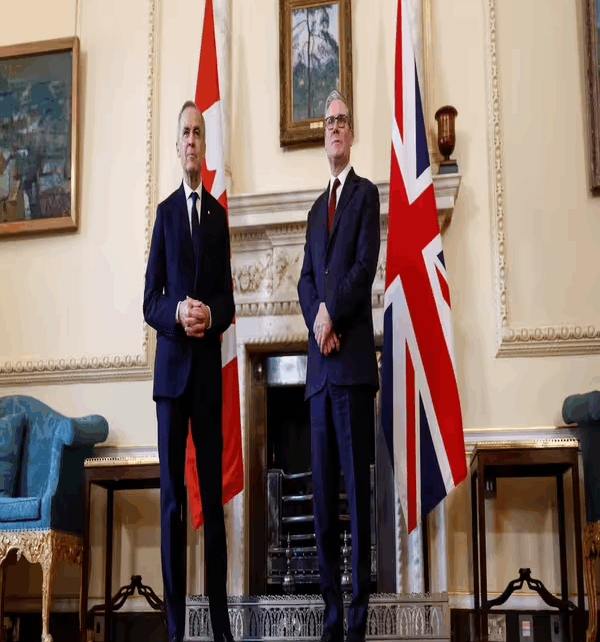
Photo Credits: Britain’s Prime Minister Keir Starmer, right, and Prime Minister Mark Carney attend their meeting at 10 Downing Street, London, Monday, March 16, 2026. (Brook Mitchell/Pool Photo via AP)
https://www.ctvnews.ca/politics/article/carney-starmer-share-deep-concern-over-iran-war-as-conflict-disrupts-shipping-routes/
Disclaimer: Any views or opinions expressed in articles are solely those of the authors and do not necessarily represent the views of the NATO Association of Canada.