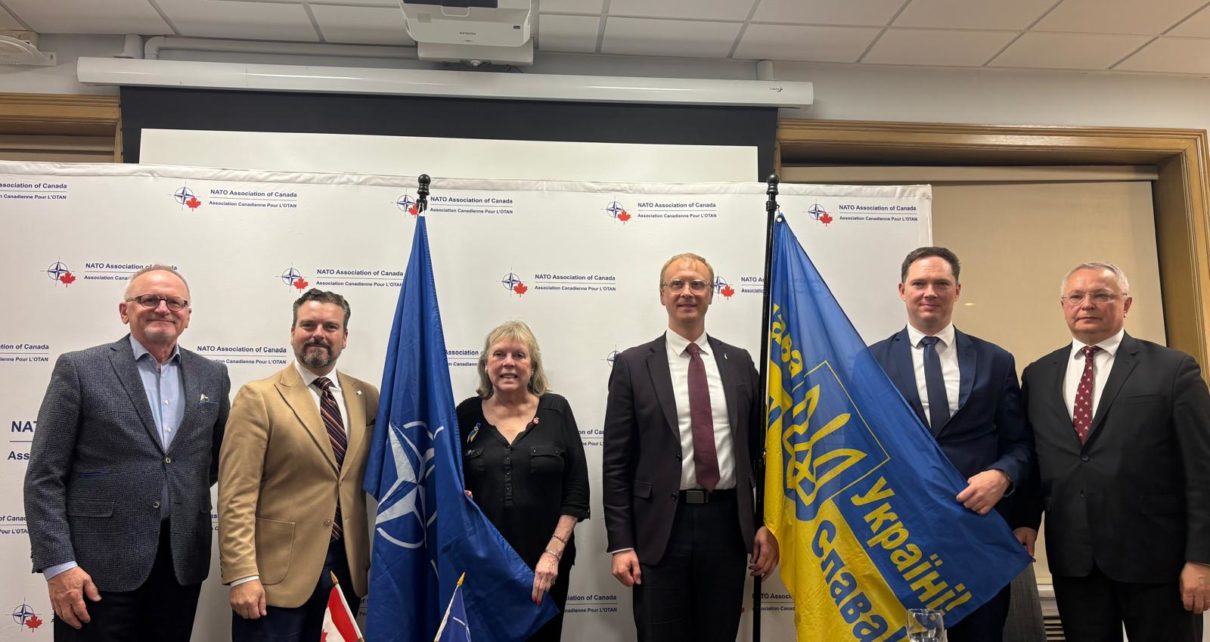
On October 21, 2026, the NATO Association of Canada hosted the Lithuanian Vice Minister of Foreign Affairs and the Consul General of Ukraine to Toronto at Trinity College for a discussion on Ukraine’s Victory and the Future of Transatlantic Security. This event brought together diplomatic representatives, policy professionals, academics and members of the public for a discussion on Russia’s ongoing war against Ukraine and its implications for European and transatlantic security. The conversation examined the broader significance of the conflict for Canada and its allies, Lithuania’s evolving defence priorities and opportunities to strengthen the international support for Ukraine.
The discussion opened by focusing on how Russia’s full-scale invasion of Ukraine represents more than just a regional conflict. It also challenges the principles of sovereignty, territorial integrity, international law and the rules-based international order that underpin collective security. Allowing territorial borders to be altered through military aggression could establish a dangerous precedent for other authoritarian states and undermine international stability.
The panel addressed that supporting Ukraine is both a moral responsibility and a strategic investment in the security of Canada and its allies. If Russia achieves its objectives, more aggression could follow. Moreover, the discussion highlighted the importance of countering Russian disinformation and influence operations, which aim to weaken public support for Ukraine and deepen political divisions within allied countries.
Lithuania’s experience as a NATO member bordering Russia showed how the war has fundamentally reshaped national security priorities. The country has significantly increased defence spending, strengthened military capabilities and achieved more energy independence to reduce its vulnerability to Russian pressure. Furthermore, they emphasized the importance of adapting to emerging battlefield technologies, particularly drones and strengthening cooperation between defence industries.
Lithuania’s experience offers lessons for Canada, including the need to invest in domestic defence capabilities, diversify strategic partnerships and recognize that economic interdependence does not necessarily prevent aggression. Hybrid threats, including propaganda, cyber-related disruption and the instrumentalization of migration, continue to show that the security challenges extend beyond just conventional military confrontation.
The discussion identified several areas where Canada and its allies could provide meaningful support. Strengthening Ukraine’s air defence capabilities was presented as an urgent priority, particularly to protect civilians and critical infrastructure from missile and drone attacks. Participants also focused on the need for continued financial assistance, humanitarian support and reconstruction efforts, particularly as attacks on energy infrastructure threaten civilian access to essential services during the winter. The event also included discussion on proposals to use frozen Russian state assets to help finance Ukraine’s reconstruction, while acknowledging the legal and political challenges involved.
Defence-industrial cooperation was a significant focus of opportunity for Canada and Ukraine. Joint drone production and the exchange of battlefield expertise could strengthen Ukraine’s immediate defensive capabilities while helping Canada develop technologies relevant to its own national security.
The final portion of the discussion examined the challenges of maintaining public support for Ukraine throughout political polarization, economic pressures and growing populist movements. The discussion was concluded by reinforcing the importance of sustained international cooperation, credible defence capabilities and continued diplomatic engagement. While diplomacy remains necessary to achieve a peaceful resolution, any durable settlement must address Ukraine’s sovereignty and territorial integrity.
Disclaimer: Any views or opinions expressed in articles are solely those of the authors and do not necessarily represent the views of the NATO Association of Canada.
Photo: LinkedIn, NATO Association of Canada