Russian-backed disinformation has appeared in many forms across the globe. These campaigns seek to exploit existing political divisions, weaken public trust, and undermine confidence in democratic institutions. In Europe, their significance extends beyond any single election. By deepening domestic divisions, Russian disinformation can make Western cooperation slower, more difficult, and more politically costly. Russia has increasingly amplified existing frustrations related to economic insecurity, immigration, national sovereignty, and assistance to Ukraine. Many of these themes overlap with messaging promoted by far-right and Eurosceptic parties, allowing Russia to strengthen the very narratives that challenge European unity. Russian information operations are then able to exploit existing grievances and make these narratives appear more credible, urgent, and widespread.
One of the clearest examples of this strategy is the Russian-backed “Doppelganger” disinformation campaign. Doppelganger campaigns refer to operations where fake websites are created to resemble legitimate news outlets to present false or misleading stories under the appearance of credible journalism. A strong example of these campaigns can be seen in the lead-up to the 2024 European Parliament elections; they included copying known sites such as Le Parisien, Die Welt, the French Ministry of Foreign Affairs, as well as NATO. By using household names in online news, these campaigns were able to amplify far-right narratives showcasing a clear threat to democratic resilience, EU cohesion, NATO unity, and the ability of Western countries to respond collectively to Russian aggression.
Doppelganger websites copy the appearance, branding, and writing style of established news sources. Some use domain names that closely resemble those of real news outlets, while others rely on intentional spelling differences that users may not notice. The goal of these campaigns is to make propaganda appear as though it comes from an established independent source, rather than an unfamiliar blog, anonymous account, or state-sponsored outlet. The very appearance of legitimacy is what makes these campaigns so dangerous. Doppelganger campaigns are able to provide misleading claims with greater reach and the appearance of independent confirmation.
By taking advantage of pre-existing divisions and intensifying them, Russia uses narratives that often align with those of the far right, such as being anti-immigration, discrediting European renewable energy initiatives, and opposing foreign aid to Ukraine. Some examples of the campaigns convey a need to stop the increase in immigration in France or allege that the EU is trying to destroy the Italian economy. The constant use of these types of claims as well as using trusted media names and logos creates the impression that an argument or a false fact is true or widely supported by evidence, when in reality it’s not, which can help increase the visibility of political issues that benefit far-right parties,
The 2024 European Parliament (EP) elections provide an important case study on the potential effects of Doppelganger disinformation campaigns. The European Union External Action Service (EEAS), which is the EU’s diplomatic service, released a report titled Doppelganger Strikes Back, highlighting Russian foreign information manipulation surrounding the weeks before the EP election. Based on 657 articles across 20 inauthentic news sites, the report found 65 election-related articles in the two weeks prior to the elections. In the final week before voting, that number increased to 103.
Since election results are shaped by many factors, the report was unable to establish a measurable link between the Doppelganger articles and a change in voting behaviour. However, it does emphasize that the strategic targeting employed by Doppelganger campaigns is one example of the ways Russia targets electorates and political environments that are vulnerable to polarization. An example of this is that Germany and France were two of the campaign’s key targets during the 2024 EP elections; both countries are among the most influential in the EU and contain deep political divisions that Russian campaigns could easily exploit. Thus, deploying these campaigns in information environments more susceptible to far-right narratives allows them to thrive, reinforcing claims and themes that benefit parties already campaigning against political elites, European integration, and foreign assistance in key EP countries.
During the 2024 EP elections, far-right parties received approximately one-quarter of the seats, although they remained divided among several political groups; their number rose from their previous 17% of the seats in the parliament. While Russian disinformation efforts cannot be attributed as the cause of the rise of the far-right bloc of the EP, the growth of parties whose rhetoric questions European unity still serves Russian interests, especially when they pressure governments to reduce sanctions or support for Ukraine.
Therefore, even if causality cannot be established, Russian disinformation efforts are nonetheless a threat to European and Western collaboration efforts. Not everyone needs to believe every false story, nor does every country need to try to elect an openly pro-Russian government or party. Russia is able to benefit whenever European or Western governments disagree over sanctions, defence spending, Ukraine, or the future of European integration. By strengthening narratives that present cooperation as a threat to national interests, disinformation makes collective action more controversial, which also slows down decision-making processes in parliament and makes policy harder to become law.
The consequences also extend to NATO. While the European Parliament does not determine NATO policy, most EU members are also NATO allies. Therefore, claims that Ukraine is undeserving of support, that defence spending is wasteful, or that Western alliances serve only political elites can influence national debates over collective security. Since NATO’s effectiveness depends not only on military capabilities but also on political commitment, if citizens distrust their governments or question allied commitments, governments may become less willing to act together.
The 2024 election should therefore be treated as an early warning. As generative artificial intelligence advances, foreign actors will be able to produce articles that are more and more convincing, create images, videos, and social media posts more quickly and in more languages. Future campaigns can be tailored more closely to local communities, allowing Russia to exploit different concerns while pursuing the same goal of weakening Western cooperation. This threat is not limited to elections. Similar tactics could be used during debates over sanctions, NATO deployments, military spending, energy security, or assistance for Ukraine. When anti-EU, anti-NATO, and anti-Ukraine arguments become more common, mainstream parties may begin to adopt parts of this rhetoric to compete for voters.
The 2024 European Parliament elections highlight that the success of disinformation should not be measured only by whether it determines electoral winners. Its influence can also be seen in the narratives it normalizes, the institutions it discredits, and the divisions it deepens. The central danger is not that Russia created Europe’s far right, but that it can exploit legitimate frustrations to strengthen political forces whose positions may divide Western allies and weaken their cooperation with one another. Protecting Europe and the West, however, will require more than removing fake websites after they have been identified. EU and NATO members will need stronger systems for detecting coordinated operations, better information-sharing among governments and media organizations, and greater public awareness of how foreign manipulation works. Without a coordinated and forward-looking response, Russia may continue turning Europe’s internal political disagreements into vulnerabilities that weaken EU unity and NATO’s ability to respond collectively.
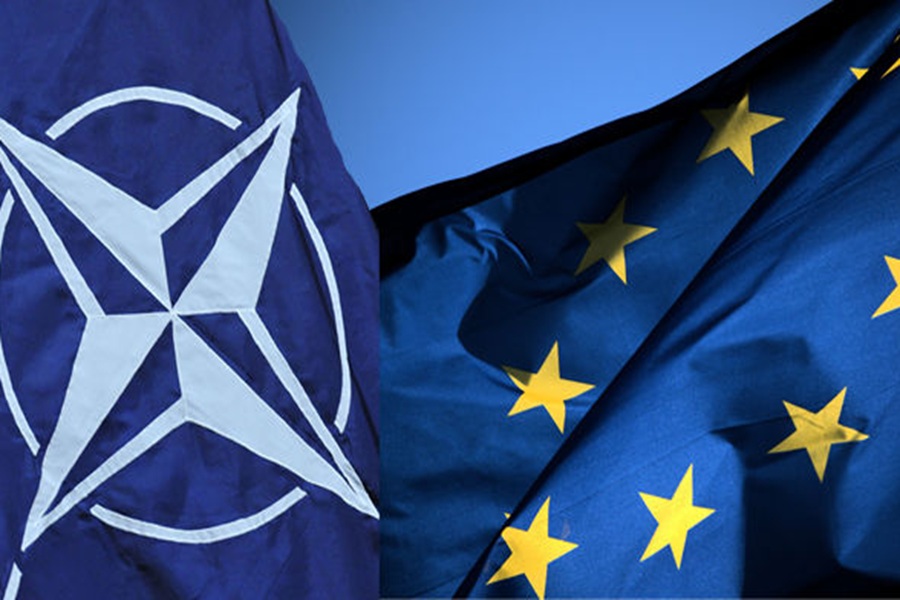
Image: “Flags of NATO and the EU” (2024), via NATO.
Disclaimer: Any views or opinions expressed in articles are solely those of the authors and do not necessarily represent the views of the NATO Association of Canada.