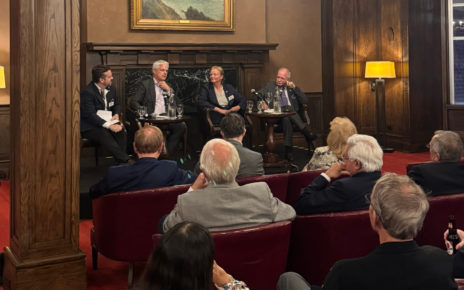
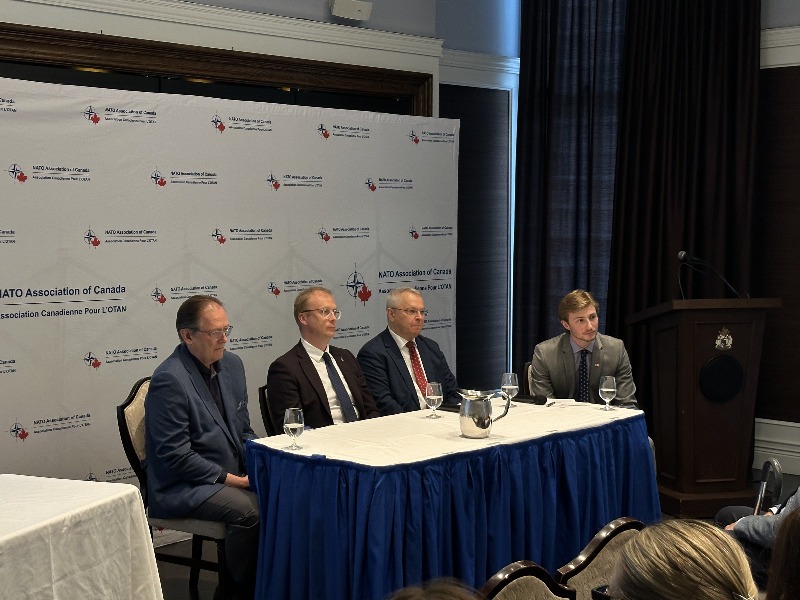
On May 13, 2026, the NATO Association of Canada (NAOC), the Canadian Lithuanian Youth Association, and the Embassy of Lithuania to Canada co-hosted a panel at the Royal Canadian Military Institute titled “Baltic and Ukrainian Youth on Security and Solidarity.” The discussion addressed the role of youth in supporting Ukraine’s resistance against Russia’s full-scale invasion, countering Russian disinformation, and maintaining public interest in and solidarity with Ukraine across Western societies in the war’s fifth year.
The Honourable David Collenette P.C., Chair of the NAOC, provided opening remarks of the evening. He emphasized that Ukraine’s resistance against Russia’s war is also ensuring lasting security in Europe for future generations of youth. Mr. Collenette shared his personal reaction to Russia’s full-scale invasion of Ukraine in 2022, which reminded him of his experiences growing up in post-Second World War London and witnessing the human damage of conflict. He emphasized that Ukrainian victory is the only acceptable outcome, as Ukraine fights alone on behalf of the entire democratic world, whose values Russia directly opposes. Mr. Collenette reminded the audience that despite the financial cost of providing aid to Ukraine, Ukraine is paying by far the highest price by doing the fighting and continues to prove its strength in the face of aggression.
The event proceeded thence to the panel discussion, held under the Chatham House Rule, featuring His Excellency Mr. Edigijus Meilūnas, Ambassador of Lithuania to Canada; Mr. Oleh Nikolenko, Consul General of Ukraine in Toronto; and Mr. Petro Schturyn, President of the Ukrainian Canadian Congress (UCC) – Toronto Branch. Joris Meiklejohn of the Canadian Lithuanian Youth Association moderated the panel.
The panellists first discussed the fundamental facts of the conflict, including Russia’s decision to launch the full-scale invasion, Russia’s atrocities in Bucha, and the International Criminal Court arrest warrant for Russian President Vladimir Putin, have become less salient in public discussion about the war. Panellists recognized the difficulty of competing for attention in a rapid media environment and an age of increased conflict and disruption, bringing up the challenge of new conflicts that shift global attention away from Ukraine. Speakers also pointed out Russia’s long history of massive spending on online disinformation, which has contributed to public confusion surrounding the basic facts of the conflict. The speakers recognized the importance of civil society organizations like the UCC in countering such disinformation. They reminded the audience that the onus is on supporters of Ukraine to publicly challenge false narratives, as the truth is easily verifiable and easy to spread.
The panel then turned towards exploring and dismantling specific disinformation messages. Panellists identified narratives which claim that Ukraine is “not our war” and therefore deny the strategic necessity of Western aid to Ukraine as especially dangerous. Such narratives are at odds with the collective statements of NATO leaders at consecutive NATO summits, which have consistently affirmed that Russia is the most significant and acute threat to all NATO allies. The panellists called for increased NATO assistance to Ukraine, citing the 2008 Bucharest NATO summit, where Ukraine could have been granted accession negotiations, as a missed opportunity which should not be repeated. They reiterated that supporting Ukraine is not a charitable endeavour, but an investment in all NATO partners’ security. Given Ukraine’s rapid advancements and innovations in military technology, founded on Ukrainian forces’ experiences in the field, future NATO accession for Ukraine would prove beneficial for maintaining all allies’ technological edge. It is also less resource intensive for NATO to provide materiel and funding to Ukraine, which has the strongest and largest military in Europe, than for NATO to fight Russia with its own troops.
The discussion then turned to informational resilience and the lessons smaller NATO states like Lithuania can offer for the whole alliance. The panellists pointed out that there is a constant barrage of Russian disinformation narratives, highlighting deceptive and contradictory statements made by Russian leaders over the years which affirmed Ukrainian sovereignty over Crimea and denied any hostile intent towards Ukraine. To counter the challenge of Russia’s ubiquitous disinformation, the speakers called for supporting and maintaining strong independent national media landscapes, while introducing classroom education on informational literacy.
Panellists then discussed the role of youth in countering Russian disinformation within a fast-paced online atmosphere. They reminded the audience that opinion polls today still indicate a very high level of public support for Ukraine in Canada and the US, indeed higher than in 2022, perhaps partly in response to Russian interference in domestic politics in both countries. The speakers called for youth to promote books and social media channels of Ukrainians sharing their lived experience of the invasion, and to proactively confront disinformation while being mindful of the pervasive Russian bot presence on social media. Panellists also underlined the importance of tailoring messages and narratives toward a specific audience base.
In response to an audience question on how youth can respond to Russian disinformation, speakers stressed that coordinated civil society advocacy against propaganda is often effective. More specifically, they discussed the example of the screening of Russians at War at Toronto International Film Festival (TIFF) and pointed out that Ukrainian peaceful protests against the film eventually convinced TIFF to cancel the screening. Panellists argued that such protests do not infringe upon institutions’ freedom of speech, as they are directed towards hate speech and propaganda from a hostile foreign power. This also set a powerful precedent that artistic projects which further Russian propaganda narratives and receive official support from the Russian government are unacceptable.
In closing, panellists offered words of encouragement for youth who support Ukraine. The overarching message remained that youth should act proactively in defence of human rights, freedom, democracy, and the rule of law. Speakers shared examples of young Ukrainians who actively contribute to societal resilience by founding businesses producing defence technologies, getting involved in political advocacy, and taking up arms in defence of their country. Panellists encouraged youth to speak up for Ukraine at any given opportunity and continue to highlight Ukraine’s role in defending NATO’s security. The event provided valuable reflections and advice for youth in support of Ukraine, while also providing insights for what Canadian youth – and indeed youth across NATO – can learn from Ukraine about resilience and solidarity.