On May 30, 2026, the Canadian International Council hosted its 2026 Virtual Policy Hackathon, in partnership with the University of Toronto’s Munk School of Global Affairs and Public Policy, the NATO Association of Canada, CIC Vancouver, and Venford Technologies. Participants were assigned a scenario that combined escalating United States tariffs on Canadian exports with the broader question of Canada’s critical minerals posture and were asked to develop an integrated policy response.
Seven teams took part in the Hackathon, one of which included Ilaha Ibrahimova, Vladimir Choi, and Kayona Karunakumar. Ibrahimova recently completed a Master of Public Policy and Global Affairs at the University of British Columbia. Her professional experience in women’s economic empowerment at international organizations led to a broader interest in energy and resource governance, which she identified as closely tied to the live policy debates surrounding critical minerals and shifting geopolitical alignments. Choi, based in Berlin, is pursuing a doctorate at the intersection of medicine, public health, digital health, and governance; he noted that critical minerals are foundational to the technology underpinning his field, as semiconductor chips and the data centers that train and store digital health models depend on them. Karunakumar studied public policy at the University of Toronto and completed a graduate certificate in government relations at Seneca College, with experience in international development and an interest in foreign policy and global health.
The participants approached the policy challenge by combining qualitative judgment with available quantitative tools, including a data-driven simulation that projected long-term outcomes across thousands of market and political conditions, providing a structured avenue to test and refine the team’s policy proposal.
Over the course of the event, the team developed a policy brief addressing a 50 percent United States tariff on Canadian exports not compliant with the Canada-United States-Mexico Agreement (CUSMA), with particular attention to the steel, aluminum, and lumber sectors, alongside the question of how Canada should position its critical minerals exports in response. Their submission, which focused on helping Canada restart CUSMA negotiations, set out a layered set of recommendations spanning immediate diplomatic measures, intermediate economic and resource-strategy responses, and longer-term structural reforms.
Scope of the Scenario
To assess the severity of the hypothetical tariff shock, the team drew on Canadian export data organized by Harmonized System chapters and the North American Product Classification System. They found that the majority of Canadian exports to the United States are CUSMA-compliant and would therefore be exempt from it. Only a comparatively small share of exports, likely in the single digits as a percentage of total trade, would be directly affected.
This finding shaped the team’s overall framing: the tariff applied to non-compliant goods represents a meaningful but contained economic shock, rather than a comprehensive one. At the same time, they noted that the political signal sent by a unilateral tariff increase, particularly in a sector such as softwood lumber where disputes have persisted for decades, carries weight independent of the dollar figures involved. The team also noted that no authoritative breakdown of compliant versus non-compliant exports exists, since classification depends on product-specific rules of origin.
Working With the Simulation Platform
A central feature of the hackathon was a policy simulation and digital twin software provided by Venford Technologies to stress test their model across 100,000 simulated conditions.
Earlier test runs on less granular data produced confidence levels around 40 to 45 percent; a later run on more detailed CUSMA trade data reached roughly 60 percent, by which point the brief was largely complete. The team described the simulation as confirming rather than directing its conclusions.
Policy Recommendations
The team organized its policy recommendations across three time horizons.
In the first 72 hours, the team recommended that Canada pursue diplomatic engagement with the Office of the United States Trade Representative through both informal channels and direct communication to determine whether the tariff reflected a genuine trade grievance, a domestic political signal, or an opening position for renegotiation. They also called for an emergency meeting of the Council of the Federation to present a unified position among the provinces and territories and proposed reinstating the Digital Services Tax as a measure of economic leverage.
Within one to three weeks, the brief advised that Canada consider nationalising foreign-owned steel and aluminum facilities operating in Canada. The team framed this measure primarily as a domestic resilience strategy rather than a retaliatory signal toward Washington, noting that many of the affected facilities are owned by European or Australian firms rather than American ones. The brief acknowledged that nationalisation risks discouraging future private and foreign investment.
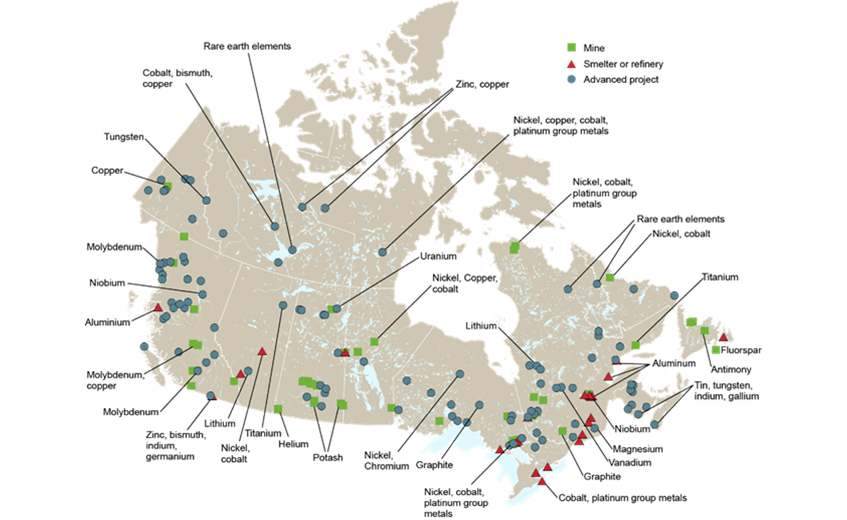
On critical minerals, the brief urged Canada to signal to U.S. trade officials that the tariff escalation compels a fundamental reassessment of its current open-export posture, without moving to an outright ban. The team pointed to Canada’s outsized role in supplying the United States: it supplied close to half of total U.S. aluminum imports in 2025, contributed to roughly one-third of the fuel used in US nuclear reactors in 2024, and produces 10 of the 12 minerals designated as critical to NATO defence, including gallium and germanium, for which the US has effectively no domestic production. Rather than restricting these exports to the United States, the team recommended that Canada accelerate diversification of critical minerals with the European Union, Japan, and the United Kingdom under existing trade frameworks and pursue legislative amendments to strengthen the federal government’s legal authority to restrict exports in future emergencies.
As a longer-term structural measure, the brief proposed that Canada establish a Royal Commission to examine a Guaranteed Basic Income for workers affected by trade shocks, to consolidate existing workforce support programs and strengthen the social safety net.
Ultimately, the team shifted focus from the tariff, which they found contained since most Canadian exports already meet CUSMA rules, to how Canada should position itself in a world where the basic inputs of technology have become strategic assets. As Choi put it, “Critical minerals are very much an arena in which states are now competing. If you don’t have the minerals, you can’t make the chips or the data centers you need to store and train the data for your models.” Their policy response engaged with a real and increasingly urgent challenge: Canada’s place in the global digital economy. Through the CIC Policy Hackathon, participants were able to grapple directly with that question, one that reaches well beyond the simulation.