Launched in May 2026, the Virtual Policy Hackathon, co-organized by the Canadian International Council (CIC) Vancouver branch, the NATO Association of Canada (NAOC), Venford Technologies, and the Munk School of Global Affairs & Public Policy, gathered emerging leaders and experts to tackle four of the major crises Canada currently faces. Participants split into teams of four to six to take on one of these challenges, then build and present proposals from scratch.
Among these crises is Canada’s defence capability problem. Defence Policy Team 3 tackled this challenge in their brief, titled Calibrating Canada’s Defence Posture Against Comparable NATO Allies, exposing a critical flaw in the current military spending system: Canada is structurally inefficient in converting its spending into modern, ready, and deployable military capability.
After reaching NATO’s target of spending 2% of GDP on defence in March 2026, Canada pledged a new goal of achieving 5% by 2035, with 3.5% allocated to core defence and 1.5% to defence-adjacent investments. Under core defence are main military equipment such as F-35 fighter jets, Arctic patrol ships, and military personnel training and readiness. Defence-adjacent spending covers the broader defence ecosystem, which includes aerospace manufacturing, cybersecurity and AI firms, shipyards, and critical mineral supply chains. While it is notable that Canada achieved its 2% target, as it has a history of falling short of NATO benchmarks, more information is needed about whether or not that money is producing actual deployable capability. The distinction between spending on core defence and defence-adjacent industries is crucial because Canada’s military assets remain thin and old. With the new pledge of 5%, Canada needs to reevaluate how it should budget its dollars efficiently and effectively, given its circumstances and the rapidly changing geopolitical landscape.
Although Canada already spends a lot on defence, its current system often struggles to translate that investment into modern capability. Canada’s defence financing is often shaped by political cycles and slow procurement, leaving equipment that struggles to keep pace with rapidly evolving technologies. An interviewee noted that Canada’s fear of spending reinforces its risk-averse procurement culture, and its bespoke buying system further delays readiness. The question is not whether to spend more, but what posture Canada should pursue in light of its geography, threats, and areas of underspending.
To address these structural flaws of Canada’s military spending, Team 3 comparatively analyzed Canada with three other NATO members — Poland, Norway, and Germany — based on four key variables: Per-capita spending to prevent obscurity in calculating exact amounts of spending per-citizen; Equipment holdings by relevant category to avoid listing inflated inventories; Procurement cycle to expose where bureaucratic dysfunction slows down the modernization and delivery process; and Capability outcomes that indicate whether each country’s military and defence holdings are deployable, available, modern, and serviceable.
Defence Policy Team 3’s Data
Canada spends US$1,052 per capita, fields 74 tanks, 66 fighters, 12 frigates, and 4 submarines, operates on bespoke procurement cycles exceeding a decade, and has 42% of its aerospace fleet serviceable.
Poland spends US$948 per capita, fields 600+ tanks, ~100 fighters, 2 frigates, and 1 submarine, relies on fast, off‑the‑shelf procurement, and is rapidly fielding new equipment.
Norway spends US$3,191 per capita, fields ~36 tanks, 52 fighters, 4 frigates, and 6 submarines, maintains moderate, mature procurement cycles, and sustains high‑readiness, modern fleets.
Germany spends ~US$1,041 per capita, holds ~300 tanks, ~130 fighters, ~10 frigates, and 6 submarines, operates with slow but reforming procurement, and manages a large force constrained by readiness.
What the Data Shows and Takeaways For Canada
Despite Poland’s spending per capita being the least among the comparators at US$948, it has become one of NATO’s fastest-modernizing and most rapidly expanding militaries because of its off-the-shelf procurement cycle. By acquiring major systems such as K2 tanks, K9 howitzers, and HIMARS within one to two years, compared to Canada’s decade-plus bespoke delivery process, Poland can field 600+ tanks, ~100 fighters, new artillery, and missile systems far more quickly than Canada, even though Canada spends more per citizen. Driven by a long history of frequent invasions, Poland had to learn to prioritize speed, adaptability and military readiness instead of bureaucratic processing, as demonstrated through their efficient contracts with Asia-Pacific countries like South Korea. While Canada does not share Poland’s history, the lesson is clear: mature, off‑the‑shelf procurement dramatically improves capability, reduces vulnerability to shifting political priorities, and prevents long procurement timelines from outlasting political cycles.
Norway demonstrates how a wealthy Arctic, maritime state can maintain credible military power by prioritizing modernity and readiness rather than overall size, standing in sharp contrast to Canada’s current thin and old defence posture. Norway fields a compact but technologically advanced force — modern frigates, submarines, and a fully integrated F‑35 fleet — supported by procurement cycles that are moderate and efficient rather than bespoke and decade‑long, allowing them to sustain consistently high readiness across its platforms, something Canada struggles with given that only 42% of its aerospace fleet was serviceable in 2024-25. Similar to Poland, its force is built around advanced technology, modern fleets, efficient procurement, and consistently high readiness that are aligned with its geography and threat environment, which Canada should take note of.
Germany was historically an underspender like Canada; however, unlike Canada, which is still vulnerable to political shifts, Germany fixed part of their underspending by ring-fencing modernization capital. By adopting this system, Germany puts their defence money in a protected fund where governments cannot easily redirect it, ensuring long‑term military projects continue even when political priorities change. This demonstrates that credible capability requires not only spending, but protected, stable financing structures, a structural reform Canada can replicate through the C$25 billion Canada Strong Fund, and the proposed Defence, Security and Resilience Bank.
Conclusion and Strategic Recommendations
Overall, Canada should adopt Germany’s ring-fenced financing model to protect defence spending from political meddling, Norway’s modern force model to ensure spending translates to effective capability, and Poland’s pragmatic off-the-shelf spending culture to quicken procurement cycles.
Concretely, Team 3 recommends Canada to:
- Judge capability outcomes not based on percentage of GDP or how many billions are written on paper towards military spending, but to focus on reaching specific targets of 85% air, 80% land, and 75% maritime key-fleet serviceability;
- Adopt Germany’s ring-fence modernization capital model system through the $25 billion Canada Strong Fund and the Defence, Security and Resilience Bank;
- Institutionalize the “Build-Partner-Buy” framework and the Defence Investment Agency to speed up decision-making and procurement processes, and default to relying on mature, off-the-shelf allied platforms instead of bespoke programs;
- Prioritize military spending on equipment suited for Canada’s natural geography such as Arctic and maritime domain awareness (radar, satellites, uncrewed systems), submarines and surface combatants, F-35, and improve spare‑parts supply and personnel retention for Canada’s existing equipment to be fully deployable.
The same interviewee highlighted that Canadians have been too comfortable with the idea of being safe forever, which has reduced public urgency around defence, unlike states such as Poland or Ukraine, which have a visceral sense of urgency to rapidly drive mobilization. As Canada is often distant from major conflicts, many citizens, especially younger generations, have limited exposure and education to how global instability affects domestic security. Strengthening public understanding of global security, paired with institutional reforms such as adopting Germany’s ring-fenced financing model, would improve the delivery of Canada’s defence capability.
About the Team
Defence Policy Team 3 consists of Dr. Sung-Mi Kim, Igor Sljukic, Laura Wallace, and Emma Zhang.
Dr. Sung-Mi Kim is a Toronto-based geopolitical expert with 20+ years of experience supporting strategic policy and business in NATO and Asia-Pacific contexts. She is Program Director at Ridgeway Information, a Cambridge University PhD, and a former Chatham House fellow.
Igor Sljukic is a Founder, Reservist, and Engineering Student. Igor leads Uncrewed Systems Inc., a Canadian drone and counter-UAS defence company developing interceptor platforms and sovereign unmanned capability, with partnerships spanning Canada and Europe. He serves as a Canadian Armed Forces reservist at Denison Armoury and is a Mechatronics Engineering student at TMU, focusing on autonomous systems and robotics.
Laura Wallace is an Investigator and an Analyst. Laura is a Claims Adjuster at ICBC. She investigates vehicular accidents, analyzes evidence, and makes ethical, evidence-based liability decisions to maintain public confidence. Laura is completing a Graduate Certificate in Intelligence Analysis at the Justice Institute, where she is building expertise in structured analytical techniques, financial crime analysis, and anti-money laundering.
Emma Zhang is a rising senior at Minerva University and the author of nine books. Having studied abroad in Taipei, Seoul, and Buenos Aires (and soon Berlin and Tokyo) during her undergraduate studies, she maintains a keen interest in international relations and foreign policy. She is an alumna of AEI’s summer and winter honours programs, where she studied political philosophy and war. Formerly a junior research fellow at the NATO Association of Canada, she is now a program editor for the NATO & Canada stream, where she focuses on Canada’s role in NATO and defence and national security. On the side, she is fascinated with military history and is working on a book following two Canadian soldiers in World War I.
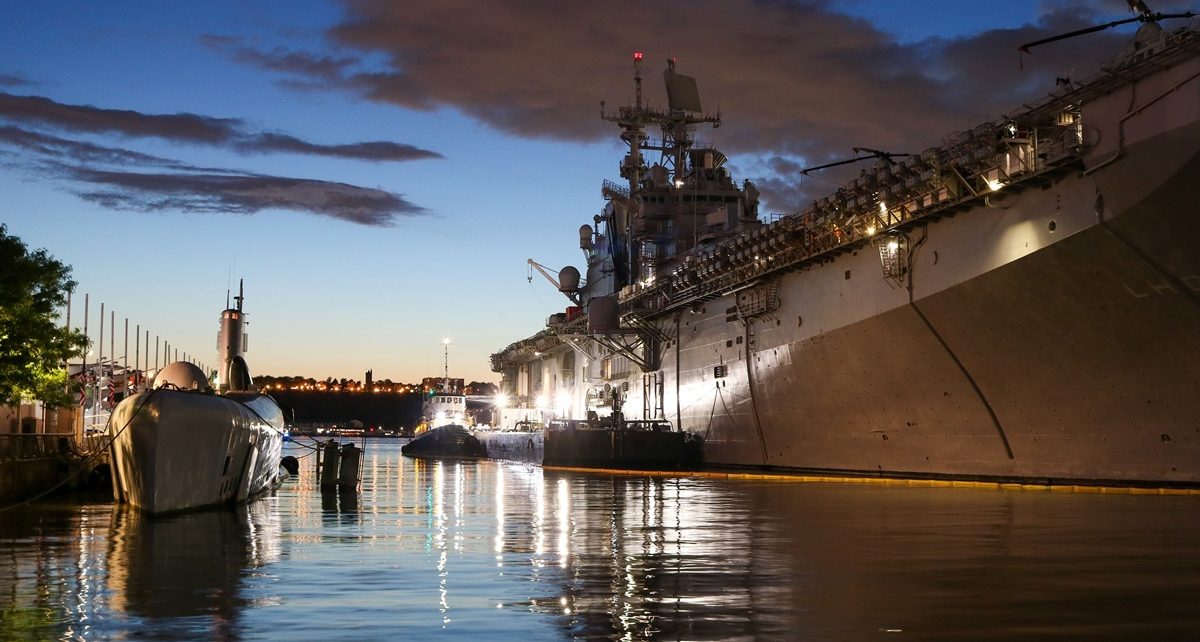
Photo: “Navy Ship Sailing on the Sea Under Night Sky” (2022), by Emma Guliani via Pexels. Licensed under the Pexels License.
Disclaimer: Any views or opinions expressed in articles are solely those of the authors and do not necessarily represent the views of the NATO Association of Canada.