Operations

The War in Ukraine: Key Moments in History

Below are photos, as well as an accompanying description from an exhibit that was organized by Canadians for Democracy in Russia and Euromaidan Canada Committee. In opposition to the war in Ukraine, the exhibit aims to reveal evidence of Russian support for anti-government militants, as well demonstrate the brutal and violent nature of the conflict (for more information, please visit http://thewarinukraine.info). 

In this week’s post, both the photos below and the accompanying descriptions highlight key historic moments from the current conflict in Ukraine. Within this photo array, two key dates stand out: April 7th and 12th, 2014. 

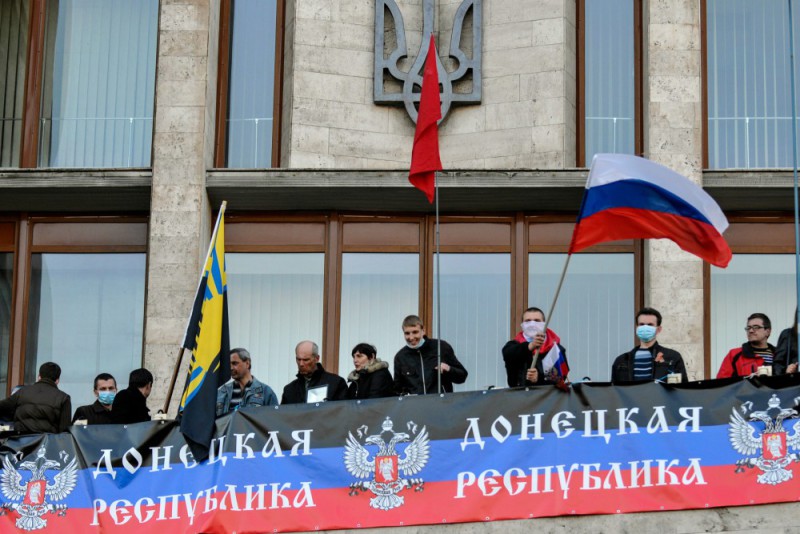
April 7, 2014: As tensions across Eastern Ukraine kept escalating, Russia-backed protesters declared the “Donetsk People’s Republic (DPR)” after having stormed and taken control over the government buildings.

April 7 a

April 7 b

April 12, 2014: A group of masked militants, which was formed in Crimea and led by former officer of Russian security services Igor Firkin (as he stated in his interview with A. Prokhanov on November 20, 2014), captured the Executive Committee building, the police department, and the Security Service of Ukraine offices in Slovyansk, a city in the northern part of the Donetsk Oblast.

April 12 b

Igor Vsevolodovich Girkin (pictured below) also known as  Igor Ivanovich Strelkov, who commanded the Russia-backed militant forces in the Donbass, is a Russian national and a former officer of the FSB (Russia’s Federal Security Service). Girkin’s political views are close to Russian nationalism, Monarchism and the White Guard movement, and are strongly influenced by the Russian Orthodox Church. As he has admitted in his memoirs, Girkin fought in the Bosnian and Chechen wars. Several sources and former Bosnian army officers accuse him of being involved in the Višegrad massacres, in which thousands of civilians were killed in 1992.

epa04309660 Self-proclaimed Defence Minister of the so called 'Donetsk People's Republic', Igor Strelkov (L) during his press conference in Donetsk, Ukraine, 10 July 2014. Ukraine insisted that there would be no ceasefire or negotiations before the pro-Russian separatists in the country's east give up their arms. Ukrainian government forces expanded their control in the Donetsk region over the weekend after rebels retreated from their strongholds Slaviansk and Kramatorsk to the city of Donetsk. EPA/PHOTOMIG


Author

  • The mission of NATO Association of Canada is to promote peace, prosperity, and security through knowledge and understanding of the importance of NATO.

    We strive to educate and engage Canadians about NATO and NATO’s goal of peace, prosperity and security. NATO Association of Canada ensures that we have an informed citizenry able to contribute to discussions about Canada’s role on the world stage.

    As a leading member of the Atlantic Treaty Association (ATA), NATO Association of Canada has strong and enduring ties with sister organizations in many of the alliance countries, as well as members of NATO’s “Partnership for Peace” and “Mediterranean Dialogue” programmes. The NAOC has had a leading role in the recent transformation and modernization of the ATA, and helped to create and develop the Youth Atlantic Treaty Association (YATA).

    The NAOC has strong ties with the Government of Canada including Global Affairs Canada and the Department of National Defence. We are constantly working to create and maintain relationships with international organizations such as the World Bank Group, the European Bank of Reconstruction and Development, NATO Headquarters, the International Criminal Court, and other prominent international NGOs and think tanks.


    View all posts
NATO Association of Canada

The mission of NATO Association of Canada is to promote peace, prosperity, and security through knowledge and understanding of the importance of NATO.

We strive to educate and engage Canadians about NATO and NATO’s goal of peace, prosperity and security. NATO Association of Canada ensures that we have an informed citizenry able to contribute to discussions about Canada’s role on the world stage. As a leading member of the Atlantic Treaty Association (ATA), NATO Association of Canada has strong and enduring ties with sister organizations in many of the alliance countries, as well as members of NATO’s “Partnership for Peace” and “Mediterranean Dialogue” programmes. The NAOC has had a leading role in the recent transformation and modernization of the ATA, and helped to create and develop the Youth Atlantic Treaty Association (YATA). The NAOC has strong ties with the Government of Canada including Global Affairs Canada and the Department of National Defence. We are constantly working to create and maintain relationships with international organizations such as the World Bank Group, the European Bank of Reconstruction and Development, NATO Headquarters, the International Criminal Court, and other prominent international NGOs and think tanks.