Twenty years after Operation Medusa, Afghanistan remains a significant part of the Canadian Armed Forces’ institutional memory. The 2006 battle, Canada’s largest combat operation since the Korean War, killed twelve Canadian soldiers. It was one episode in a broader mission in which more than 40,000 CAF members deployed, including officers who hold the CAF’s most senior leadership positions. Its anniversary provides an opportunity to assess Afghanistan’s continuing influence on the CAF and the assumptions that shaped its capability choice.
General Jennie Carignan, Chief of the Defence Staff, and Lt.-Gen. Steve Boivin, Commander of the Canadian Joint Operations Command, both served in Afghanistan and have since spoken publicly about leadership under crisis and dispersed command. Afghanistan’s influence extends beyond leadership to the CAF’s capability priorities. In Afghanistan, coalition air supremacy reduced the urgency of ground-based air defence (GBAD) and allowed the CAF to focus on capabilities needed for the immediate fight. Canada is now rebuilding that capacity as drones, missiles, and contested airspace place new demands on the force.
As the Afghanistan generation begins to leave senior service, the CAF has a narrowing window to preserve the judgment behind earlier capability choices. Preserving the assumptions, trade-offs, and accepted risks that shaped those decisions would strengthen future capability planning by helping leaders understand why those choices were considered reasonable at the time and determine when changing conditions require a different course.
Afghanistan’s Influence on Today’s CAF Leadership
Carignan has emphasized trust and team cohesion as core principles of leadership under crisis. Her operational experience includes her 2009-10 command of the Task Force Kandahar Engineer Regiment. She has argued that these qualities must be established before a crisis begins, while leaders still have time to prepare their people for the pressures of real-time operations. Once a unit faces an immediate threat, there is little room left to debate roles or build confidence from scratch.
Boivin has compared his command experience in Afghanistan with the more dispersed operations his current commanders oversee. During that deployment, he led task forces concentrated at a single location, where troops departed on missions and returned to the same base. Today, the commanders under him may oversee personnel spread across several countries and operating over a much larger area. Boivin argues that this complexity requires flexibility of thought and decisions anchored in facts, amid growing noise and disinformation.
Experience in Afghanistan extends further across the CAF’s senior ranks. Lt.-Gen. Michael Wright, Commander of the Canadian Army, commanded a rifle company in Kandahar in 2006-07 and received the Medal of Military Valour for his leadership in combat. His career reflects the broader presence of the Afghanistan generation among those now directing the force.
These officers served in different roles and drew lessons shaped by their respective responsibilities. Carignan and Boivin’s accounts nevertheless show that, for some of today’s senior commanders, Afghanistan remains an active reference point in their approach to leadership. It continues to inform how they prepare their teams, process information, and exercise judgment under pressure.
Afghanistan-Era Capability Priorities
In Afghanistan, the CAF organized its capability priorities around the threats its forces most frequently encountered. Canadian troops faced mines, improvised explosive devices (IEDs), and ambushes on the ground, while coalition air supremacy meant that GBAD was not an immediate priority. The mission placed greater emphasis on counter-IED capabilities, persistent surveillance, and improved protection for troops on the ground. These priorities reflected the mission’s operational demands.
By 2012, the Air Defence Anti-Tank System (ADATS) had been deemed obsolete and was no longer considered an operational priority. The system was retired in 2012 without an immediate replacement. This sequence suggests that Afghanistan’s permissive air environment contributed to the perception that maintaining GBAD was a lower priority than capabilities needed for the immediate fight. Its retirement followed the end of Canada’s Kandahar combat mission and coincided with spending reductions under the 2010 Strategic Review and the 2012 Deficit Reduction Action Plan (DRAP). Together, these conditions allowed a capability gap created in a specific operational context to persist long after the mission ended.
That capability gap is increasingly difficult to reconcile with the threats Canadian forces are now expected to face. Carignan has drawn the connection directly, stating that air defence is now “absolutely required at various layers, from space to ground”. Canada began restoring part of the capability in 2024 by procuring the RBS 70 NG system for troops in Latvia and has since committed $172 million to new GBAD infrastructure at CFB Gagetown. These investments reflect the changed threat environment and demonstrate how difficult it is to rebuild a capability after more than a decade without it.
Preserving Afghanistan-Era Institutional Knowledge
The ADATS case points to a broader institutional challenge. Official records confirm that ADATS was retired in 2012. They provide little insight into how commanders and planners weighed the threat environment, fiscal pressure, competing priorities, and the risk of proceeding without a replacement. Future leaders can therefore identify the decision’s outcome without necessarily understanding the judgment that produced it.
That context may become more difficult to reconstruct as officers with direct experience of Afghanistan leave senior positions. The CAF has extensively documented the mission. A 2017 Department of National Defence evaluation also found that joint concepts, doctrine, and lessons learned were “not fully exploited” in support of capability development. The findings suggest weaknesses in how lessons learned informed longer-term capability planning. Some of the constraints and risk calculations surrounding decisions such as the retirement of ADATS may therefore remain largely with those who participated in them.
Preserving this context allows earlier decisions to be understood within the conditions in which they were made. Choices that appeared reasonable within the operational realities of Afghanistan may entail very different risks in an environment where Canadian land forces must contend with persistent surveillance and the possibility of air-delivered attack. The Department of National Defence describes capability development as a process that anticipates changes in the threat environment and informs the “introduction, modification and divestment of defence capabilities” within acceptable levels of risk. Whether earlier choices remain valid requires an understanding of the assumptions on which they were based and whether those assumptions still hold or were specific to an operational context that has passed.
What Lessons Should the CAF Preserve?
Preserving Afghanistan-era institutional knowledge can strengthen future capability decisions. Official records generally document the decision and its timing; the assumptions, trade-offs, and accepted risks that informed the decision are often less clearly preserved. As the Afghanistan generation leaves senior service, the question is whether the CAF has adequately captured that reasoning. The Commander of the Canadian Army could consider using existing institutions such as the Canadian Army Doctrine and Training Centre, and the Army Lessons Learned Centre, to examine how Afghanistan shaped land-force priorities. The retirement of ADATS offers a clear starting point, linking the mission’s permissive air environment with the system’s condition, competing requirements, and fiscal restraint.
For future major acquisitions and divestments, the CAF should also consider whether existing decision processes adequately preserve the assumptions behind each choice, the risks accepted, and the conditions that would trigger reassessment. Recording that reasoning through mechanisms such as the Defence Lessons Learned System would make it easier for future leaders to determine whether the original assumptions still apply.
The current GBAD rebuild raises a related question about how much of this procurement can be communicated publicly. Recent procurement announcements and infrastructure investments demonstrate progress, but offer limited insight into how the CAF is managing the capability gap until it can reliably field, sustain, and employ the system. Greater public explanations, where operational security permits, could help clarify the assumptions and interim risks shaping that process.
Disclaimer: Any views or opinions expressed in articles are solely those of the authors and do not necessarily represent the views of the NATO Association of Canada.
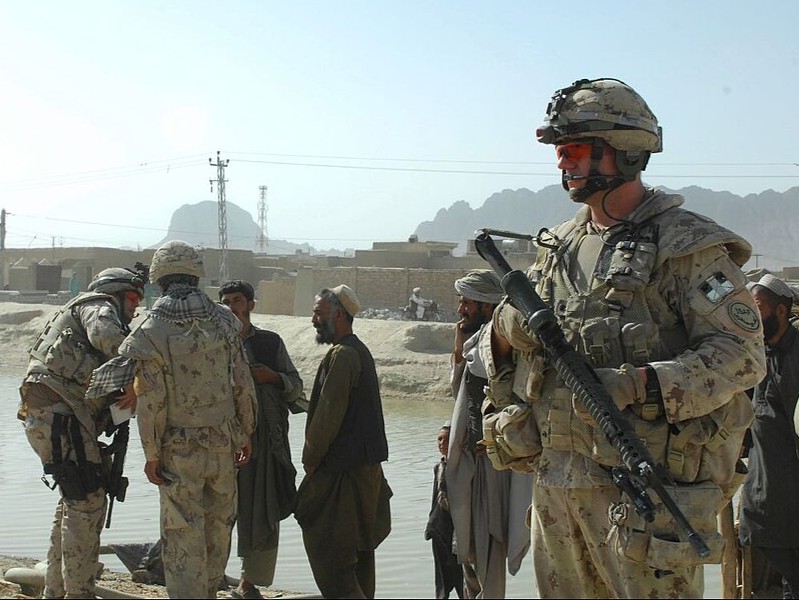
Photo: “Canadian soldiers talk to Afghans” (2008), by Staff Sgt. Jeffrey Duran via Wikimedia Commons. Public Domain.