Recent geopolitical shifts have exposed various gaps in global food supply governance as it pertains to climate and trade policy. From the Covid-19 pandemic, to the conflict between the United States and Iran in the Strait of Hormuz, to the worsening climate crisis, experts predict these significant and long-term disruptions to the global food system that will have social and economic impacts, especially for vulnerable groups. Given that women play an important role in agricultural production and food security, these disruptions have highlighted the necessity of including gender provisions in climate and trade agreements through mechanisms such as NATO’s Women, Peace, and Security (WPS) agenda, which contribute to the security and well-being of women around the world.
Disruptions in the global supply chain and the worsening climate crisis have highlighted the connection between food security, trade, and climate policy, as insecure food systems have micro and macro-level humanitarian, political, and economic effects. Food security is defined as “when all people, at all times, have physical and economic access to sufficient, safe and nutritious food that meets their dietary needs and food preferences for an active and healthy life.” However, food insecurity and malnutrition are extremely prevalent around the world, especially in lower-income or developing countries, as they are more vulnerable to trade disruptions and the impacts of climate change.
The Covid-19 pandemic exposed vulnerabilities in a global system that is interconnected and reliant on free trade, and today, the conflict in the Strait of Hormuz has spiked the price of oil and gas, as well as increased geopolitical instability in the region. Although new agreements are being negotiated seemingly every day to address the blockages, these have already initiated concerning long-term repercussions on global food security and supply chains. Here, experts are especially concerned about the impact on global fertilizer supply, which could disrupt the production of staple foods such as wheat, corn, and rice for years in the future. Even then, the blockage of energy and oil through the Strait is already raising the prices of food and essential goods at present, not to mention the cost of providing humanitarian assistance to populations that are already food insecure.
Despite its importance, food security is often a marginalized aspect in the WPS agenda and international humanitarian policy, demonstrating a need to include gender provisions not only in climate and trade agreements, but in security and post-conflict contexts. These conditions are all connected and reinforcing, and are specifically relevant for two out of four of the WPS agenda’s core pillars: protection and relief and recovery. A secure food system supports the well-being, security, and productivity of a population, where women are major contributors from the agricultural industry to the household level. Women often bear the responsibility of securing food, water, and fuel for their families, which becomes increasingly difficult during droughts, natural disasters, or environmental degradation resulting from climate change; these factors render them especially vulnerable to barriers that limit their earning potential and threaten their security.
Especially for lower-income and developing countries, which rely largely on food imports despite having larger populations, the climate crisis has worsened conditions, introducing more vulnerabilities and extra costs across the supply chain that affect the producers and the consumers. This is also true for war-torn states that suffer disproportionately from food shortages or price increases from supply chain disruptions, as food production and agricultural systems cannot be easily adjusted to respond to this. With this, it is important that NATO member states work in tandem with other international institutions to support the development of policies and practices that can mitigate the effects of this in countries that do not have the governance mechanisms. This includes ensuring that climate and gender policies are integrated into policy frameworks such as the WPS agenda, so the technical expertise is available to address ongoing developments.
For developed countries that are better able to mitigate the humanitarian effects, domestic policy plays one role in this. While free trade agreements (FTAs) allow certain countries to leverage their comparative advantages, increase economic activity, and support domestic food systems, states should seek to implement more inclusive clauses that encompass the reality of growing food insecurity and address the current policy gaps. However, leaders should be careful to ensure that progressive ideals do not overbear achievable measures. For example, Canada’s push for “sustainable and inclusive” trade under Prime Minister Justin Trudeau included pursuing gender provisions in the Canada-United States-Mexico Agreement (CUSMA) and the renaming of the Comprehensive and Progressive Free Trade Agreement for Trans-Pacific Partnership, formerly known as the Trans-Pacific Partnership.
However, this effort alienated negotiations with nations such as China, whose cultural values and political traditions are not aligned with this agenda. Thus, considering this norm-setting aspect is most efficient at the multilateral level, states should seek to establish more substantive policy objectives that still have these ideals embedded within, without risking potentially lucrative opportunities for partnership with regard to bilateral agreements. In terms of addressing the gendered dimension of the climate crisis, this is similarly applied. Though Prime Minister Mark Carney has been criticized for cutting back on his predecessor’s flagship gender equality and climate policy while prioritizing trade and investment, citing the costliness of such programs at a time when affordability is a concern, this is a scenario where more inclusive or appropriate provisions can be negotiated without completely rolling back key policy initiatives.
The need for integrated approaches to gender, climate change, and security is evident to address this multi-dimensional challenge; international agreements should take a holistic approach that reflects these intersecting factors. Gender, trade, climate, and security are interconnected and their respective policy frameworks can be targeted to address rising food insecurity. Moreover, as women are disproportionately affected by these compounding circumstances, the policy gap in this realm should be addressed while considering the varying conditions that women experience in developing and developed nations, in times of peace or conflict, and across different cultures or socio-economic backgrounds.
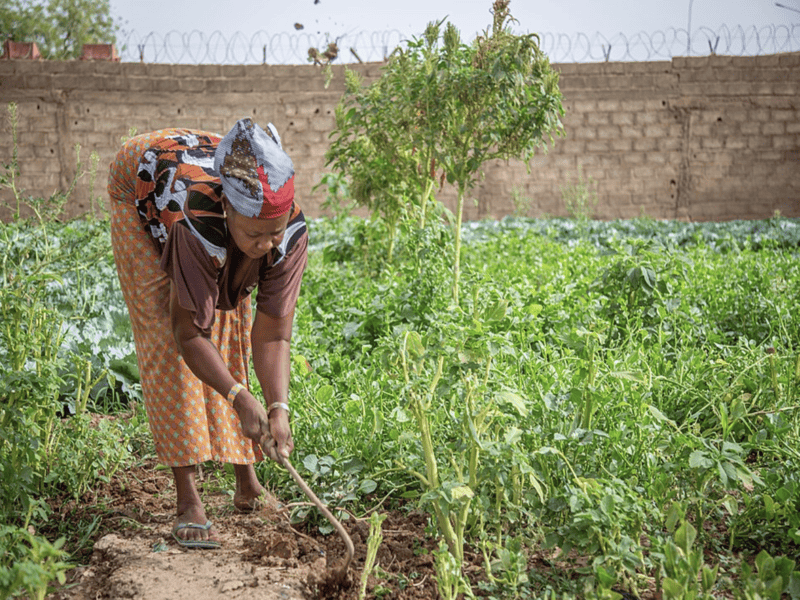
Photo: En vu d’une bonne récolte la jardinière prépare le terrain pour une nouvelle production. (Translation: With a view to a good harvest, the gardener prepares the soil for a new crop). Source: Masséni Héma, CC BY-SA 4.0, via Wikimedia Commons.
Disclaimer: Any views or opinions expressed in articles are solely those of the authors and do not necessarily represent the views of the NATO Association of Canada.