The COVID-19 global pandemic was both a public-health crisis and a catalyst for an infodemic: the flood of misinformation and disinformation that spread as rapidly, if not more rapidly, than the virus itself. A systematic review by the World Health Organization (WHO) found that this infodemic undermined compliance with health measures, fragmented social cohesion, and prolonged the pandemic’s impact. As governments raced to implement safety measures, online narratives discrediting masks and vaccines as ineffective and dangerous, and even the legitimacy of public health authorities, demonstrated how disinformation can weaken public trust in science and social cohesion.
For Canada, the pandemic underscored both the health risks of misinformation and its capacity to deepen social divides and test public confidence in institutions. For NATO and its allies, the infodemic highlighted how both foreign disinformation networks and domestic polarization amplified distrust in health authorities and government leadership, blurring the line between coordinated hybrid warfare and organic political discontent. COVID-19 demonstrated that in a globalized world, health security and information security are interdependent pillars of collective resilience: misinformation can weaken pandemic responses, while weak health systems create fertile ground for disinformation to thrive, producing a feedback loop that crosses borders and destabilizes societies. This, therefore, begs the question, what did COVID-19 teach Canada and NATO about the security implications of health disinformation?
Understanding how these dynamics unfolded domestically provides valuable insight into the broader consequences of the infodemic.
The Canadian Experience: When Health Meets Misinformation
In Canada, online misinformation contributed to what the Council of Canadian Academies’ Expert Panel on Health and Science Misinformation describes as “fault lines” — pre-existing fractures in civic trust, legitimacy, and social cohesion that misinformation can both exploit and deepen. Beyond merely gaps in knowledge, these “fault lines” were structural inequities, rooted in socioeconomic precarity, systemic discrimination, and unequal access to health and social resources, that shaped who was most vulnerable to misinformation. Long before vaccines were rolled out, marginalized and newcomer Canadians faced barriers such as housing insecurity, employment precarity, and low health literacy, which compounded their distrust in institutions.
Although heightened vulnerability to COVID-19 in marginalized populations underscores an increased need for vaccination, the aforementioned adverse social determinants that drive disparities in COVID-19 outcomes also contribute to lower levels of vaccination. Compounding this problem, misinformation intersected with the experiences of discrimination and low health literacy among marginalized and newcomer Canadians, amplifying mistrust. Related work has also emphasized that online disinformation natives, such as the belief that vaccines were tools of control, resonated in communities historically marginalized by health systems. Within this context, anti-mask campaigns and conspiracy movements spread rapidly through social media groups, capitalizing on public fatigue and frustration to amplify distrust in public-health measures.
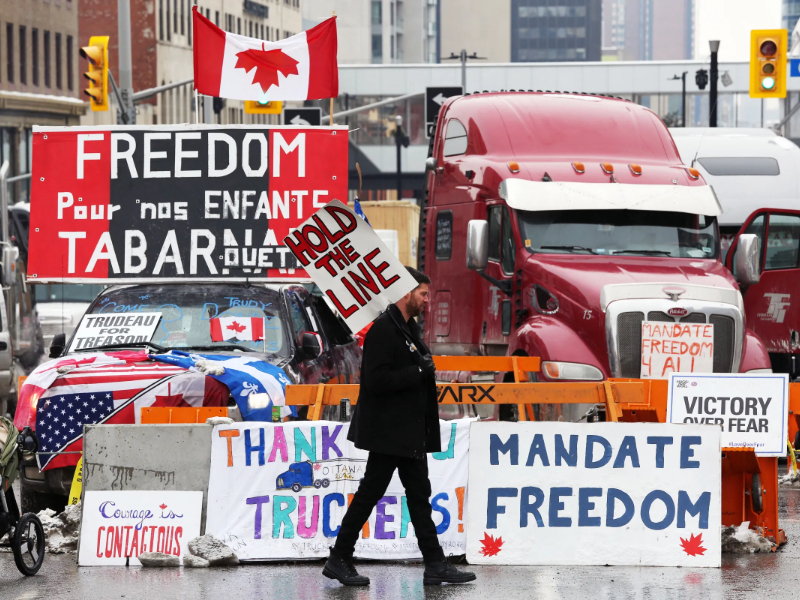
Research also shows that disinformation thrives on emotive content that provokes anger or fear because it spreads faster and more widely than verified information. In Canada, this dynamic took root amid pandemic fatigue, inconsistent public-health messaging, and growing political polarization, allowing conspiracy movements to frame health mandates as infringements on personal freedom. What manifested as a result was the Freedom Convoy that paralyzed downtown Ottawa for weeks, as citizens mobilized in protest against what they perceived as government overreach and the erosion of personal freedoms. The same distrust that fuelled these movements also underpinned widespread vaccine misinformation. A study in the Canada Communicable Disease Report found that online falsehoods about vaccine safety, ingredients, and side effects reached millions of Canadians.
Beyond simply a matter of correcting false facts, these trends reveal that Canada’s battle with health misinformation requires confronting deeper structural inequities and trust deficits. When people feel excluded from decision-making or underserved by institutions, misinformation exploits that alienation, eroding compliance with public-health measures and weakening confidence in democratic governance. The persistence of vaccine hesitancy underscores how information resilience depends not only on access to credible data, but also on addressing the systemic barriers that shape who is most likely to believe, or doubt, it.
The cumulative effect of these dynamics became increasingly evident as misinformation and miscommunication converged, shaping how Canadians perceived and responded to public-health guidance.
An “Infodemic” and Its Consequences
Research from the Trust in Canada Project shows that trust in science and government declined steadily between 2020 and 2023, particularly among younger Canadians who rely on social media as a primary news source. The challenge, however, was both misinformation and miscommunication. For example, in Ontario, inconsistent policy messaging often left citizens more confused than informed. Frequent reversals on mask mandates, reopening plans, and vaccine intervals created a credibility gap that misinformation eagerly filled. Similarly, experts argued that Canada lacked a coordinated, evidence-based communication framework during the pandemic. Public-health officials often worked in silos, leading to mixed messages across provinces. The result was a fragmented information environment where misinformation could thrive unchecked.
When considering these implications, the takeaway should be that facts alone cannot inoculate a population against uncertainty; they must be communicated through empathy, consistency, and trust. When official communication falters, misinformation becomes the default interpreter of events.
While these challenges strained Canada’s internal cohesion, they also revealed a broader geopolitical dimension: disinformation was not confined within national borders.
Disinformation as a Hybrid Threat
While the pandemic was first and foremost a health crisis, it also became a battleground for information warfare. Both state and non-state actors exploited uncertainty to undermine democratic cohesion. According to NATO’s factsheet on Russia’s COVID-19 myths, Russian-linked media outlets circulated stories portraying NATO as responsible for spreading the virus and as incapable of managing the crisis. Chinese state media outlets also used coordinated messaging to position China as the more competent global leader in pandemic response. NATO has also reiterated that disinformation is now a core component of hybrid threats, alongside cyberattacks and energy manipulation. By targeting trust in institutions, particularly health authorities, adversaries aim to weaken the societal resilience that NATO defines as essential to collective defence.
Taken together, these developments underscored the urgent need to understand disinformation both as a threat and as a test of institutional resilience and communication capacity.
The Way Forward: Building Information Health and Trust
As the world moves further from the acute phase of COVID-19, the ability of societies to process accurate, credible, and trusted information remains an urgent objective. The World Health Organization underscores that addressing misinformation must become a permanent function of public-health systems and not an emergency reflex.
For Canada, this means strengthening initiatives like the Digital Citizen Initiative, embedding health and media literacy in education, and ensuring that marginalized communities, who are often the primary targets of disinformation, are included as partners in communication design. At the international level, NATO can expand cooperation with the WHO, the European Union, and civil-society networks to develop an early-warning system for disinformation, similar to existing mechanisms for cyber and hybrid threats.
Ultimately, the pandemic exposed a new dimension of modern security: disinformation is not a side effect of a crisis but a strategic vulnerability that can erode public health, destabilize societies, and weaken democratic cohesion. Canada and NATO alike have learned that true resilience depends not only on vaccines or ventilators, but on trust in science, institutions, and one another. Building immunity against misinformation, much like against disease, is now essential to safeguarding both democracy and collective security.
Any views or opinions expressed in articles are solely those of the authors and do not necessarily represent the views of the NATO Association of Canada.
Photo retrieved from Vox.