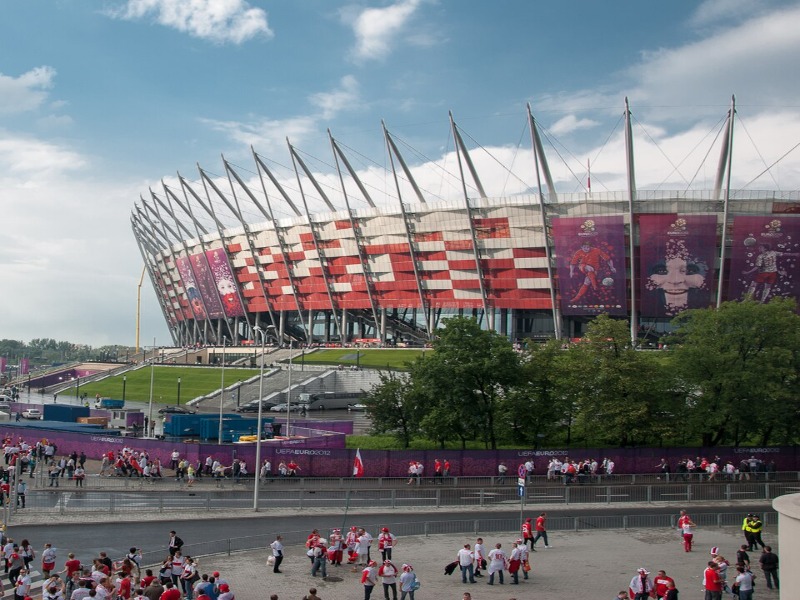
On 9 August in Warsaw, police detained 109 people during a concert by Belarusian singer Max Korzh for “drug possession, unlawful entry, assaults on security staff and use of pyrotechnics.” At the same event, one attendee displayed the red-and-black flag associated with the Ukrainian Insurgent Army (UPA).
The symbol is contentious in Poland because the UPA was a Ukrainian nationalist insurgent organization implicated in the World War II–era mass killings of Polish civilians. In Russian state and pro-Kremlin coverage, the episode was framed as a public-order ‘scandal’ around a so-called ‘Banderite’ flag, with emphasis on arrests and expulsions. By contrast, European outlets like Reuters led with Tusk’s warning not to let Russia “drive a wedge” between Warsaw and Kyiv, foregrounding restraint and coalition unity. The timing was crucial: the episode unfolded amid sustained Russian information operations targeting NATO members and partners, when unresolved memory politics can be weaponized to strain coalition cohesion.
The image prompted swift condemnation from Poland’s defence and interior ministers and circulated widely on social media. On 12 August, Prime Minister Donald Tusk stated that 63 foreign nationals, including 57 Ukrainians and 6 Belarusians, would be deported. At the same time, he called for restraint, warning that an overreaction could serve the goals of hostile propaganda. This tension between enforcing public order and avoiding a reaction that amplifies hostile propaganda frames the rest of this article. The case shows how disinformation can weaponize symbols to trigger punitive responses and deepen social division. The man who waved the flag later posted a video apology, saying he “had only meant to show support for his country,” according to Reuters.
Why It Matters: History, Identity, and the Politics of Timing
Poland is one of Ukraine’s most important military-support states, but their recent history is like a raw nerve. During the Second World War, the UPA committed atrocities against Polish civilians. Poland’s Institute of National Remembrance estimates that about 100,000 Poles were murdered in 1943–45 in Volhynia and Eastern Galicia. A single UPA banner, therefore, resonates far beyond a stadium.
Moreover, both governments use historical memory in their messaging against Russia, but their narratives clash when the Second World War is recalled. For example, although the Polish Home Army and the UPA both fought for national independence, they were enemies during the war and engaged in direct fighting in 1943 and 1944. This is because the Home Army was loyal to the Polish government-in-exile in the Allied camp, while the UPA emerged from a Ukrainian nationalist movement that initially cooperated with Nazi German occupation authorities. UPA’s mass killings of Polish civilians and the retaliatory violence that followed are remembered differently in Warsaw and Kyiv, making the UPA flag a sensitive symbol. These tensions also appear within Europe. Since most of those detained in Warsaw were foreign nationals, the episode feeds ongoing debates about identity, migration, and the conditions for supporting Ukraine.
Finally, the timing raises the stakes. The episode landed during a period of intensified contestation over continued support for Ukraine, when Moscow has strong incentives to exploit symbolic flashpoints and historical grievances to weaken NATO and partner unity. In this climate, this incident in Warsaw quickly became a contest of frames. Russian media leaned into division for domestic and international audiences, while Polish and Western voices stressed restraint and allied cohesion.
Russia’s Playbook: Amplifying Division, Silencing Context
In the Russian state and pro-Kremlin coverage of the incident, three themes recur. Headlines and leads adopt a moral-panic tone, speaking of a “scandal” and using “Banderite” language, a highly charged label that often appears alongside Nazi framing in Russian propaganda discourse. Reports give prominent space to opposition figures from Law and Justice and from the far right, turning their reactions into the main Polish voice in the story. Coverage then shifts quickly from the flag itself to the presence of draft-age Ukrainians in Poland and to demands that they be sent back to fight.
For example, on 10 August, Lenta, a Moscow-based Russian-language online news outlet, opened with a headline that “a scandal had erupted in Poland” and moved directly to claims that “hundreds of Ukrainians of conscription age” were at the concert and should return to Ukraine and join the army. Vesti, the news portal of VGTRK (Russia’s state-owned television and radio broadcaster), presented the story as Polish outrage over a so-called “Banderite” flag and highlighted demands from Law and Justice and Confederation politicians to prosecute the flag-waver and send draft-age Ukrainians to the front. RIA Novosti, another Russian state-owned news agency, followed the same line by quoting PiS MP Paweł Jabłoński as he urged Poland to consider how to “help mobilize Ukrainians living on its territory.” A later RIA Novosti follow-up on 12 August reinforced the public-order angle, focusing on expulsions, “aggression” and damage to property attributed to foreigners. In the articles reviewed for this piece, details such as the apology and the prime minister’s call for restraint, if mentioned at all, sit at the margins, while moral condemnation and evocative history stay in the foreground. Anchoring on a real event makes the framing harder to dismiss as fabrication and invites audiences to read a single episode as proof of wider splits in European support for Ukraine.
Solidarity and Restraint in the Western Press
In the Western wire and English-language European coverage reviewed for this piece, the Warsaw episode is framed less as a migration or public-order crisis and more as a test of allied cohesion. Detentions and expulsions are reported in detail, but they are consistently nested inside a narrative about denying Moscow a wedge.
Reuters leads with Tusk’s warning not to let Russia “drive a wedge” between Warsaw and Kyiv and presents the planned deportations in that light, as a public-order response that should not be allowed to rupture the alliance. AFP likewise highlights his argument that a quarrel over the flag would be “a gift for Putin,” reinforcing the message that the greater danger lies in fragmentation rather than in one concert. Polskie Radio’s English-language reporting stresses the concrete policing measures while echoing official signals that order will be enforced without turning the incident into an open rift with Kyiv. Taken together, these reports acknowledge the flag’s painful history but steer audiences toward a unity-first reading of the incident rather than an open-ended quarrel over memory.
The Resilience Test: Holding Europe’s Line on Unity
For NATO and its partners, the fight over how the Warsaw incident is framed matters as much as the incident itself. If Moscow’s version, a “Banderite scandal” proving that Poles and Ukrainians are turning on each other becomes the dominant story, it delivers a wedge narrative that can erode public support for allied policy and complicate coordination with Kyiv. The lesson is not to ignore memory politics, but to contain flashpoints through disciplined communication: NATO and partner governments should pair proportionate public-order enforcement with rapid, coordinated messaging that isolates individual misconduct from collective blame and denies adversaries the context they seek to strip away.
Any views or opinions expressed in articles are solely those of the authors and do not necessarily represent the views of the NATO Association of Canada.
Photo retrieved from Wikimedia.