When Prime Minister Mark Carney announced that his first major diplomatic tour would take him across the Indo-Pacific, the decision was widely interpreted as more than a symbolic gesture. The tour to India, Australia, and Japan occurred at a time when Canada’s economic and strategic position is being examined. For decades, Canada’s foreign involvement has been largely focused on its economic relationship with the United States, with over three-quarters of Canadian exports previously going south of the border. However, current trade tensions and evolving geopolitical realities have compelled Ottawa to deal with the risks of such dependence. Against this situation, Carney’s Indo-Pacific tour was a deliberate push to diversify Canada’s partnerships, improve ties with both developing and developed countries in Asia, and integrate Canada more securely inside the economic and geopolitical networks shaping the region’s future.
The Indo-Pacific region was chosen as the destination for Carney’s first large foreign trip with intention. Over the last decade, the region has emerged as the centre of global economic growth, technological innovation, and military rivalries. For Canada, whose economic livelihood is still intimately tied to global trade, engagement in the Indo-Pacific is becoming a strategic necessity rather than a policy preference. The region already accounts for a rapidly expanding share of global GDP and includes several of Canada’s most important trading partners. Carney’s trip reflects a growing agreement among policymakers that Canada must seek deeper partnerships with Indo-Pacific countries if it is to remain economically competitive and geopolitically relevant in a world marked by shifts in the global balance of power.
Carney’s first stop in India carried special diplomatic significance after years of tension. Canada-India ties had deteriorated dramatically in recent years, particularly with the diplomatic crisis in 2023 over the killing of Sikh activist Hardeep Singh Nijjar and the subsequent exchange of allegations between Ottawa and New Delhi. The outcome prompted the suspension of trade discussions, the expulsion of ambassadors, and a general cooling of political participation. In this environment, Carney’s visit acted to stabilize one of Canada’s most complicated bilateral ties. Meetings between Carney and Prime Minister Narendra Modi centered on reestablishing avenues of collaboration while gently addressing the remaining difficulties that had defined the relationship in recent years.
The visit generated some practical results aimed at changing the course of bilateral relations including Canada based Cameco’s $2.6 billion deal to supply India with uranium. Both governments also expressed new interest in progressing negotiations toward a Comprehensive Economic Partnership Agreement, a long-debated economic framework intended to strengthen commercial links between the two countries. Canada also unveiled a new Canada-India Talent and Innovation Strategy, which connects Canadian universities with Indian research institutions in fields such as artificial intelligence, biotechnology, and digital infrastructure. These initiatives indicate a growing understanding that India’s rapidly expanding economy offers both economic opportunities and geopolitical relevance to Canada.
Deeper engagement with India provides an opportunity for Canada to diversify commercial partnerships while aligning with a major rising power that is progressively extending its regional and global influence. Canada gives India access to investment capital, energy resources, and vital minerals which are all increasingly important in the global race for clean energy and innovative manufacturing.
Carney proceeded from New Delhi to Australia, a country with which Canada has long had a close but underdeveloped relationship. While the two countries have long collaborated through multilateral institutions such as the Commonwealth and the Five Eyes intelligence alliance, bilateral economic and defence cooperation has frequently lagged behind their shared strategic vision. Carney’s visits to Canberra and Sydney aimed to close this gap by transforming long-standing diplomatic alliances into more concrete forms of collaboration.
Discussions with Australian Prime Minister Anthony Albanese were largely focused on improving collaboration in developing strategic sectors. Critical minerals which are essential for battery technology, renewable energy infrastructure, and advanced manufacturing were prominently discussed during the talks, with both governments announcing a new Canada-Australia Critical Minerals Cooperation Framework to coordinate investment and supply chains for lithium, cobalt, and rare earth elements. Teck Resources, a Canadian company, and Lynas Rare Earths, an Australian company, have also investigated joint processing and refining operations to lessen reliance on China’s mineral processing markets. Canada and Australia, both resource-rich democracies with solid regulatory systems, are well-positioned to play a key role in these efforts.
Beyond geoeconomics, defence and security cooperation were central priorities during the visit. Both governments reaffirmed their commitment to a “free and open Indo-Pacific,” focusing on maritime security, international law, and the stability of regional institutions. During the meetings, Canada confirmed the continuation of Operation HORIZON naval deployments in the Indo-Pacific, as well as increased involvement in joint exercises with Australia’s Royal Australian Navy, which include coordinated patrols and intelligence sharing under the Five Eyes framework. Ottawa also expressed an interest in expanding collaboration on cyber defence and emerging military technologies, building on existing collaborations established through AUKUS-aligned research efforts in artificial intelligence and quantum computing.
Carney’s final trip to Japan emphasized the geopolitical logic underlying Canada’s Indo-Pacific coalition building. Japan has long been one of Canada’s most important Asian allies, particularly in trade and energy cooperation, and the visit resulted in the launching of an extended Canada-Japan Strategic Partnership Framework. Japan, the world’s fifth-largest economy and a key actor in regional security architecture, plays an important role in Canada’s overall Indo-Pacific policy. Carney’s meetings with Japanese leaders focused on boosting collaboration in geopolitically strategic industries such as energy, advanced manufacturing, semiconductor supply chains, and critical minerals.
Energy security in particular emerged as a significant topic. Japan’s energy security difficulties, deriving from limited local resources and reliance on imported fuels, make partnerships with stable energy exporters like Canada extremely important. During the visit, both governments reaffirmed long-term Japanese investment in Canadian liquefied natural gas infrastructure, particularly the LNG Canada project in British Columbia, and began discussions about future hydrogen export corridors connecting Western Canada to Japanese industrial markets.
Security dialogue was also a key topic in the discussions. Canada and Japan reaffirmed their mutual commitment to the principles of a rules-based international order and the preservation of open maritime lanes in the Indo-Pacific. The two countries agreed to strengthen defence cooperation by increasing naval port visits, sharing intelligence, and participating in joint maritime exercises aimed at improving interoperability between the Canadian Armed Forces and Japan’s Self-Defense Force. Canada also expressed its support for Japan’s expanding leadership position in regional security measures, including efforts to deepen cooperation among democratic countries such as Australia, South Korea, and India.
Ultimately, the significance of Carney’s Indo-Pacific tour lies not only in the agreements signed or the diplomatic symbolism of the visits themselves. Rather, the trip represents what could be the beginning of a sustained shift in how Canada’s foreign policy may evolve in the coming years. In an era defined by great-power competition, technological rivalry, and shifting trade networks, middle powers like Canada must increasingly rely on diversified partnerships and coalitions. Carney has taken an early step toward constructing such a network. One that could shape Canada’s role as a leader in the global order for years to come. Whether the potential of these efforts pays off will depend on sustaining these relationships over the long term and maintaining the credibility of commitments in a world increasingly marked by uncertainty and the unreliability of increasingly illiberal and unilateralist great powers.
Disclaimer: Any views or opinions expressed in articles are solely those of the authors and do not necessarily represent the views of the NATO Association of Canada.
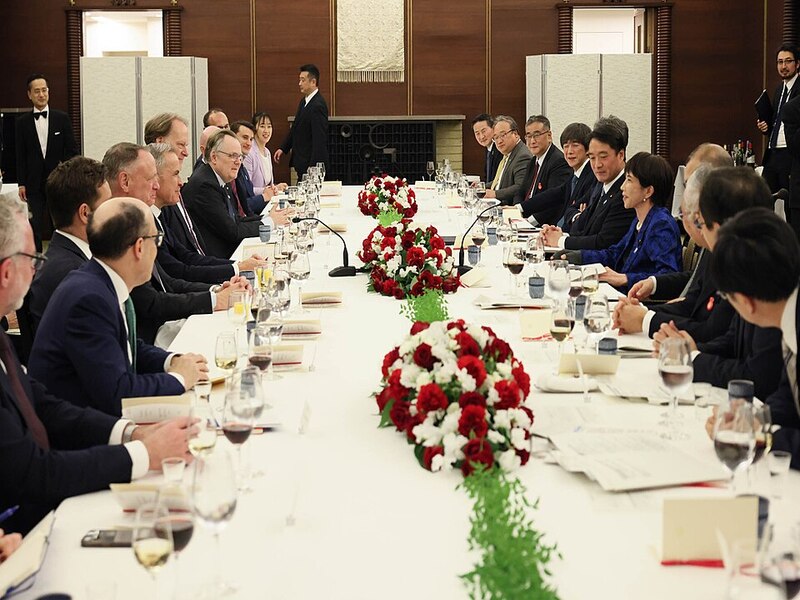
Image credit: Japan-Canada Summit Meeting on March 6, 2026. Accessed via Wikipedia Commons


.jpg#/media/File:Working_dinner_(3).jpg)
