The 2025 border crisis between Thailand and Cambodia serves as a case study in how unresolved territorial disputes can rapidly escalate when political incentives, historical grievances, and weak conflict-management mechanisms intersect. While the fighting itself remained geographically limited to contested areas near the temple complexes of Preah Vihear Temple and Prasat Ta Muen, the dynamics that drove the crisis are broadly applicable to many contemporary security environments.
For policymakers and analysts, the crisis illustrates a recurring feature of modern geopolitics: localized disputes can rapidly evolve into significant regional security challenges when political incentives favour confrontation. Even limited clashes can produce humanitarian crises, diplomatic tensions, and geopolitical ripple effects that extend well beyond the immediate battlefield. More importantly, it exposes a key limitation of conflict management: ceasefire agreements that focus solely on halting violence without addressing structural tensions often struggle to produce lasting stability.
The Thailand–Cambodia border dispute is rooted in colonial-era boundary ambiguities that have remained unresolved for decades. In 1962, the International Court of Justice ruled that the Preah Vihear temple was located on Cambodian territory and ordered Thailand to withdraw its forces from the site. A subsequent 2013 interpretation of the ruling clarified that Cambodia also held sovereignty over the site on which the temple sits. However, the surrounding frontier was never fully demarcated, leaving parts of the border contested and producing overlapping territorial claims between the two countries. For many years, the dispute remained relatively dormant despite periodic diplomatic tensions. However, the fragile equilibrium began to unravel in July 2025 when a landmine explosion injured Thai soldiers near the disputed border area. The incident triggered retaliatory troop movements and heightened military alert levels on both sides of the frontier.
What followed was a rapid escalation. Over several days of fighting in 2025, artillery exchanges, airstrikes, and ground clashes killed dozens of people and displaced hundreds of thousands of civilians. The crisis eventually drew international attention, prompting mediation efforts led by Malaysia and the United States. In July 2025, the two nations agreed to a ceasefire to halt hostilities, with the U.S. President Donald Trump publicly claiming credit for mediating between the two governments.
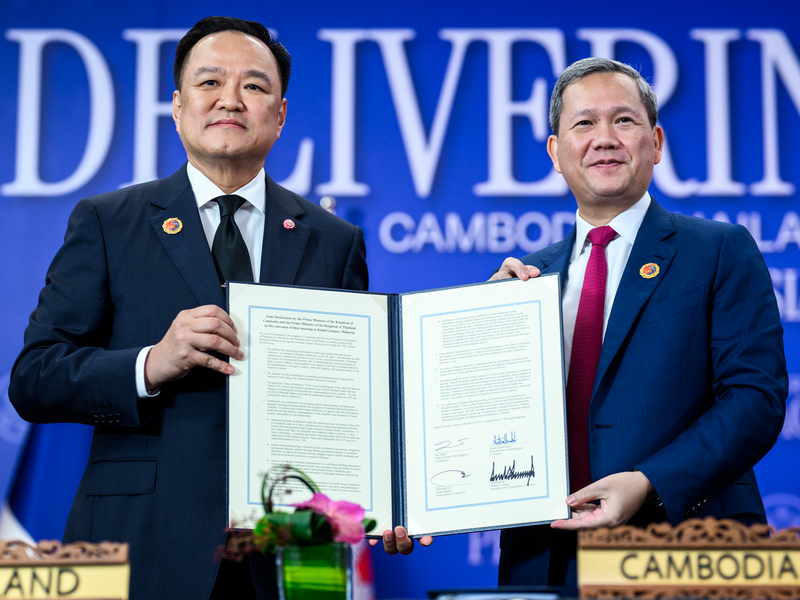
While the July ceasefire temporarily halted large-scale hostilities, it did little to address the deeper political and territorial issues underlying the dispute. A second agreement, known as the Kuala Lumpur Joint Declaration, signed in October 2025, attempted to stabilize the situation by requiring both sides to withdraw heavy weapons from the border and cooperate on landmine clearance. Yet sporadic incidents and accusations of violations continued to undermine the fragile peace.
By December 2025, renewed clashes once again displaced large numbers of civilians and demonstrated how unstable the ceasefire arrangements remained. Three interconnected structural factors help explain why the conflict escalated so rapidly.
First, domestic political incentives played a significant role in intensifying the dispute. In both Thailand and Cambodia, political leaders used the border crisis to mobilize nationalist sentiment and reinforce their domestic legitimacy. In Thailand, internal political divisions deepened after a leaked phone conversation involving Prime Minister Paetongtarn Shinawatra triggered a political backlash that eventually contributed to her removal from office. The border confrontation provided political actors with an opportunity to frame the government as weak on national sovereignty. In Cambodia, former prime minister Hun Sen also employed nationalist rhetoric to consolidate support. Public speeches and visits to military positions framed the dispute as a defence of Cambodian territorial integrity. In both countries, nationalist narratives increased public pressure on political leaders to adopt uncompromising positions, making diplomatic concessions politically risky.
Second, the crisis exposed the fragility of informal conflict-management arrangements. For years, tensions around the Ta Muen temple complex had been managed through informal understandings and bilateral coordination between Thai and Cambodian military officials, particularly through the General Border Committee (GBC). These arrangements generally aimed to de-escalate tensions by limiting troop deployments and avoiding actions that could alter the situation in disputed areas. However, this informal arrangement collapsed in February 2025 when Cambodian soldiers and civilians staged a nationalist demonstration at the site, singing the national anthem and asserting territorial claims.
The incident violated the spirit of the agreement and reignited tensions between the two sides. Subsequent ceasefires faced similar challenges. Although the Kuala Lumpur declaration called for the withdrawal of heavy weapons and cooperation on demining operations, both governments accused each other of violating the terms of the agreement. Without credible monitoring mechanisms, these accusations quickly eroded trust and allowed the conflict to reignite.
Third, the crisis revealed the limitations of regional diplomatic institutions in responding rapidly to escalating disputes. The Association of Southeast Asian Nations (ASEAN) traditionally relies on consensus-based diplomacy and a principle of non-interference in the internal affairs of member states. While this approach has contributed to long-term regional stability, it can also slow responses to urgent security crises.
ASEAN eventually convened emergency meetings and deployed observers to monitor the border situation. However, these efforts occurred only after significant violence had already taken place. The dispute also created tensions within ASEAN itself, as Cambodia attempted to raise the issue at the United Nations while Thailand insisted that the dispute should remain a bilateral matter handled within regional frameworks.
The Thailand–Cambodia crisis nevertheless offers several lessons relevant to policymakers. One key lesson concerns the importance of early monitoring and verification mechanisms. In contested border regions where military forces operate in close proximity, monitoring mechanisms can reduce mistrust and deter escalation. Credible observation mechanisms can reduce mistrust and deter escalation by increasing transparency.
Another lesson involves the role of crisis communication channels. Direct communication between military leaders can help prevent localized incidents from escalating into broader confrontations. Establishing reliable communication links between opposing forces remains an important tool for crisis management and conflict prevention.
The crisis also underscores the importance of supporting regional security institutions. ASEAN ultimately played a central role in facilitating dialogue and deploying observers to the border. For external actors such as NATO, supporting regional diplomatic frameworks can strengthen existing mechanisms for conflict management and help prevent further escalation.
Finally, the conflict highlights the importance of post-conflict stabilization measures. Landmines remain a major threat along the Thailand–Cambodia border, posing serious risks to both civilians and soldiers. International cooperation on demining operations, humanitarian assistance, and infrastructure reconstruction can help stabilize border communities and reduce the likelihood of renewed violence.
The Thailand–Cambodia crisis ultimately demonstrates that unresolved territorial disputes rarely disappear. Instead, they remain dormant until political conditions allow them to re-emerge. In this sense, the conflict should be understood not simply as a regional dispute but as a broader illustration of the dynamics that increasingly shape the contemporary security environment.
For Western policymakers, the dispute is a reminder that effective conflict prevention depends on strengthening the mechanisms that keep disputes from escalating in the first place. By supporting monitoring systems, reinforcing regional mediation frameworks, and contributing to stabilization efforts, international actors can help ensure that localized flashpoints do not evolve into larger security crises. In an international system increasingly defined by rapid escalation and interconnected instability, the ability to manage small conflicts before they grow may prove just as important as deterring major wars.
Image: Prime Minister of Cambodia Hun Manet and Thailand Prime Minister Anutin Charnvirakul sign the Kuala Lumpur Accord at the ASEAN Summit in Kuala Lumpur, Malaysia, October 25, 2025. Photo accessed via Wikimedia Commons. Public domain image from the White House. Image cropped from the original file. Daniel Torok/The White House, 2025.
Disclaimer: Any views or opinions expressed in articles are solely those of the authors and do not necessarily represent the views of the NATO Association of Canada.