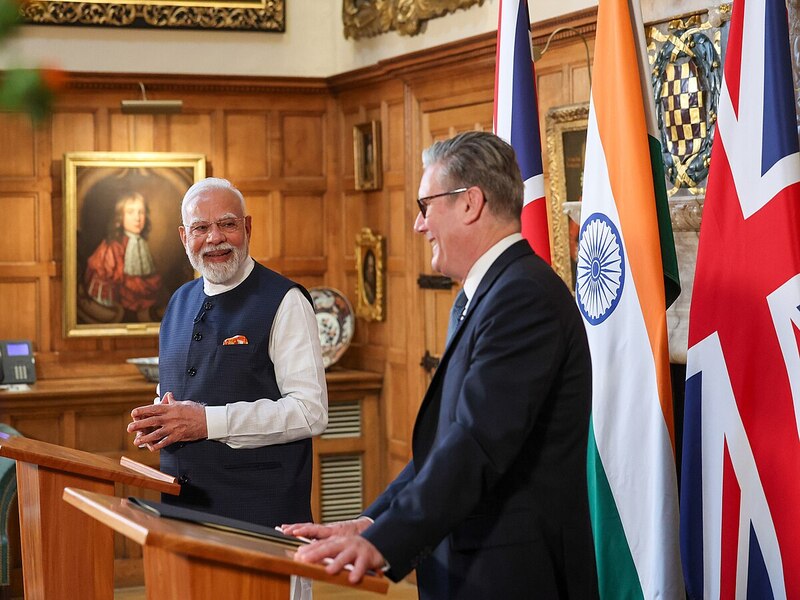
In October 2025, UK and Indian prime ministers Kier Starmer and Narendra Modi shook hands in Mumbai, sealing an agreement to supply £600 million ($1.1 billion) worth of Lightweight Multi-role Missiles and electric-powered naval engines to the Indian Armed Forces. This was not the first time the two leaders posed for the cameras together this year; in London, in July, the two governments signed a free trade agreement, boosting their economic ties. Evidently, in both trade and security, London and New Delhi have been strengthening their partnership at the highest level. Given India’s central position in an increasingly complicated South Asian security environment, how can NATO members advance their specific strategic goals without over-committing themselves or the alliance to New Delhi’s vision for the subcontinent? Furthermore, what lessons can other NATO members draw from Whitehall’s recent engagement in the subcontinent, in relation to India’s broader diplomatic strategy?
Britain’s recent arms deal with India serves as an illustrative example of why selective engagement with India can be so beneficial. Put simply, India is a big buyer of military equipment. Surpassed only by Ukraine, India is the world’s second largest importer of major arms, supplying over 1.4 million soldiers, sailors, aviators, and border guards. In recent years, moreover, New Delhi has shifted its arms purchases away from the Russian market, focusing instead on Western suppliers following Moscow’s illegal persecution of war in Ukraine. At the same time, Britain is prioritizing defence manufacturing as a key driver of national economic growth, building on its position as the world’s seventh largest exporter of major arms. As India looks for new suppliers, and Britain for new buyers, economic and strategic partnership appears mutually beneficial. These benefits are not exclusively available to Britain, moreover, especially because four other NATO members – the United States, France, Germany, and Italy – currently export even more military goods worldwide than the United Kingdom.
Furthermore, in the Indo-Pacific, India and Britain have connected through more than simple handshakes. For the first time, during October 2025’s rendition of their biennial naval exercise, the Royal Navy and the Indian Navy linked up their prized assets – HMS Prince of Wales and INS Vikrant. The two carriers, and their strike groups, completed Exercise Konkan in the Western Indian Ocean, supporting their interoperability and readiness. Symbolically, this is especially important as it presents the Prince of Wales and the Vikrant as peer aircraft carriers, of peer powers, despite Britain’s long-standing issues with its carrier strike capability (as London has struggled to supply a full complement of aircraft on the carrier since the Elizabeth class ships entered service in 2020). For NATO’s broader naval posture, moreover, the legitimization of another member’s carrier capabilities may boost collective deterrence.
When Royal Navy carriers sail away from the Indian Ocean, however, Britain’s relationship with New Delhi becomes even more important. The Indian Peninsula stretches into the Indian Ocean, granting it physical importance as a base for emergency aircraft landing, refuelling, and repair. Such logistical considerations are growing in importance, given Britain’s ongoing surrender of the British Indian Ocean Territory (BIOT), which lies about 1,800 kilometres off India’s southern coast, to Mauritius. Whilst Britain and the United States will retain leased access to a key base in the former BIOT, having a backup option on NATO-friendly territory would be more than welcomed by the Royal Air Force (RAF), Royal Navy, and all NATO armed forces. Indeed, when an RAF F-35B needed emergency repairs and could not make it back to the HMS Prince of Wales in July 2025, it landed safely in Kerala and was serviced by British engineers with support from Indian authorities.
Whilst India will have its own expectations surrounding Britain’s contribution to this relationship, moreover, New Delhi knows the value of more limited geopolitical quid pro quos. When former Japanese Prime Minister Shigeru Ishiba suggested a NATO-style alliance in the Indo-Pacific, for example, Indian External Minister Subrahmanyam Jaishankar was quick to remind the press that India does not really ‘do’ broad alliances; New Delhi believes that it stands to gain more from geopolitical flexibility than rigid or far-reaching diplomatic commitments. This explains India’s latent purchases of Russian oil, which it is only now winding down following U.S. President Donald Trump’s imposition of an additional 25% tariff on Indian goods entering the United States. For India, flexibility is the best part of self-interest.
Self-interest goes both ways, however. Just as India seeks to distance its economically and strategically motivated decision-making from the war in Ukraine, Britain and other NATO members should aim to make deals with India without implicating either themselves or the alliance in South Asia’s increasingly challenging security environment. Britain’s relationship with India, therefore, does not have to be comprehensive, most simply because that’s not how India operates. Whilst India might welcome active British support for its position in Kashmir, for example, this is not a precondition of engagement. Mirroring this stance to avoid contentious issues and deeper commitments that would not necessarily be in Whitehall’s interests, Britain should engage with India on limited and mutually beneficial terms. Following this example, other NATO members should likewise profit from arms sales, reinforce the alliance’s naval posture in the Indo-Pacific, and strengthen relations with a useful regional partner. If Britain or NATO want an ally, they will have to look elsewhere.
Photo: PM addressing the Joint Press Statement with the Prime Minister of United Kingdom, Mr. Keir Starmer at London, in England on July 24, 2025,a copyrighted work of the Government of India, licensed under the Government Open Data License – India (GODL). accessed via Wikimedia Commons.
Disclaimer: Any views or opinions expressed in articles are solely those of the authors and do not necessarily represent the views of the NATO Association of Canada.