The Women, Peace, and Security (WPS) agenda was formally introduced in 2000 with UN Security Council Resolution 1325, bringing WPS into international diplomatic discourse. NATO followed suit in 2007, publishing the Alliance’s first policy to implement the UN’s WPS agenda in its own operations. Since the inception of the WPS agenda in 2000, it has faced unsteady adoption and inconsistent implementation. In 2026, with increasing global conflict and faltering political popularity for gender policy, achieving the goals of widespread women’s inclusion in peacebuilding appears far from reach. Instability and conflict continue to prevail, creating compounded insecurities for women and girls. In order to achieve its stated WPS goals, NATO must anchor the WPS agenda into its operations and policymaking with long-term resilience in mind. Multilateral initiatives that seek durability in the face of fluctuations in country commitments offer valuable opportunities on this front.
The Trump administration’s recent elimination of the U.S.’s Women, Peace, and Security Program illustrates primary challenges faced by the agenda today. The agenda has been deemed irrelevant to a national security policy focused on war readiness, motivated in part by politicization fueled by online disinformation promoting radicalism, social division, and anti-gender rhetoric. This is not an isolated example. In recent years, Türkiye, Slovakia, and Hungary have opposed WPS and gender equality-focused policy at NATO, as well as at the European Union, United Nations, and other multilateral forums. The politicization of the WPS agenda in the face of right-wing populist movements poses an active threat to the agenda’s survival as a meaningful policy tool, and contends to accelerate a worrisome trend of WPS being reduced to superficial bureaucratic terminology.
The American withdrawal from WPS initiatives sets an important precedent: political fluctuations may cause inconsistency in commitment to WPS, making it imperative for multilateral institutions such as NATO to develop durable mechanisms for WPS incorporation. For instance, to prevent unreliable funding streams, allies should distribute financial and programmatic responsibility across nations to sustain efforts. One solution is leveraging “common funding” models that operate independently of individual state political leadership. In the NATO Comprehensive Assistance Package for Ukraine, allies funded properly-fitted armour for female Ukrainian soldiers in 2024. This was a collaborative effort without financial contribution from the United States and incorporated a WPS priority into a broader policy addressing collective security interests. By strategizing burden-sharing and minimizing politicization, this creates an example for the strategic incorporation of WPS into broader operations.
NATO allies who are committed to WPS must work towards its durability by focusing on achievable outcomes, minimizing politicized language, and focusing on operational elements. NATO has already taken steps in this direction, with staff adjusting language around gender to avoid politicization since the beginning of President Trump’s second term in office. WPS advocacy must focus itself on embedding the Agenda into high-priority and sustainably-funded programs to maintain implementation, and to minimize its use as a politicized buzzword. In effect, such uses have historically misrepresented WPS as a diversity initiative rather than an operational one with a proven track-record for supporting holistic military success.
While NATO adopted WPS in 2007, it hasn’t yet renewed its 2021-2025 action plan, reflecting a less motivated political environment towards WPS. Sweden even distanced itself from its Feminist Foreign Policy (FFP) as it sought to join NATO, courting the approval of Hungary and Türkiye in particular. While more than half of the UN’s member states have adopted WPS National Action Plans (NAP) since the beginning of the century, turning WPS from a dialogue norm into an implementation norm remains a largely unrealized feat.
The aptly titled “Holding the Line on Women, Peace, and Security” policy paper by WO=MEN: Dutch Gender Platform, published in 2025, examines “navigating pushback and backsliding” in relation to current global conflict. It recommends the preservation of the WPS agenda by strategizing messaging, building broad alliances as opposed to relying on a narrower scope of patrons, and building resilience by maintaining a long-term focus on keeping WPS embedded in security frameworks. In sensitive environments, terminology must be adapted, and WPS must be named with a clear objective in mind to prevent distorted narratives from infiltrating public discourse. Effective communication links WPS to current security challenges, ensuring it remains relevant and resonant.
Characterized by the U.S. Joint Chiefs of Staff as a “low-cost, high-yield” program that offers strategic advantage relative to competing states, WPS is an indispensable element to building lasting peace. As many NATO states face different degrees of democratic backsliding and social erosion, bridging civil society, communities, and militaries to build societal resilience finds itself at the core of NATO’s goals. In order to combat fluctuations in national political climates, NATO must build WPS resilience at the multilateral level.
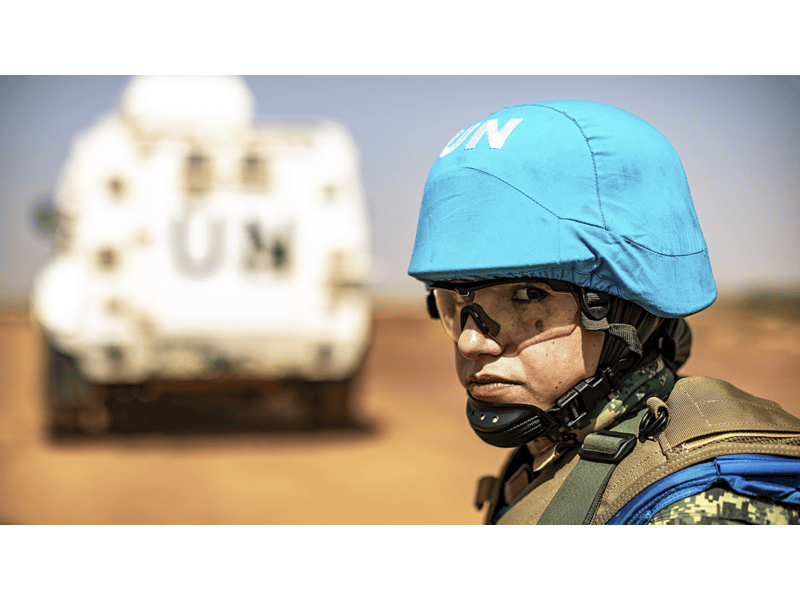
Photo: A member of the UN’s first all-women peacekeeping unit, formed by Egyptian peacekeepers stationed in Mali. Photo by Harandane Dicko (2022), via United Nations Multidimensional Integrated Stabilization Mission in Mali (MINUSMA).
Disclaimer: Any views or opinions expressed in articles are solely those of the authors and do not necessarily represent the views of the NATO Association of Canada.