For decades, Canada has treated defence as background noise. Elections were won on healthcare, affordability, and social programs, while military spending was continuously deferred. Protected by geography and the American security umbrella, Canada developed the luxury belief that its hard power capabilities were irrelevant to its own security. Operating comfortably within the familiar “guns versus butter” paradigm, Ottawa consistently chose domestic priorities over military investment, with the assumption that there would be little cost to national security. For much of the post-Cold War era, that gamble appeared to pay off, sustained in no small part by the broader architecture of North American defence: NORAD’s continental air and missile defence system and the American nuclear deterrent that effectively outsourced Canada’s most existential security guarantees to Washington. Today, however, that assumption is being challenged by an increasingly volatile international order: Russia’s invasion of Ukraine, intensifying competition in the Arctic, NATO’s rapid remilitarization, and growing international instability have shattered the sense that collective security can remain politically abstract. Canada’s defence posture is no longer a niche policy issue buried in Ottawa briefing rooms; it has become a national dilemma about whether the country is politically, economically, and socially prepared to sustain the alliance commitments its government is making. Most importantly, it also raises a deeper, more uncomfortable question: does the Canadian public actually understand what those commitments require? If the answer is no, then Ottawa may need to confront what is quickly becoming its greatest defence vulnerability: a population being asked to finance and sustain collective security commitments it has never expected over the long term.
Plans to operationalize Canada’s defence spending awakening carries this longstanding awareness gap at its core. In March 2026, the country officially reached NATO’s 2% GDP target for the first time since the late 1980s, with Prime Minister Mark Carney declaring that this was a necessary step to prove that “we control our destiny.” Ottawa has since pledged to reach the new alliance target of 5% by 2035, a commitment that could amount to roughly $150 billion annually and represent the most dramatic military expansion in modern Canadian history. While media discourse has framed this moment as a long-overdue strategic awakening, the reality is far more complicated.
Canadians are increasingly supporting higher defence spending, but the nature of that support reveals its own limits. Abacus Data from 2025 found rising public support for the military alongside a clear preference for domestic functions — territorial defence, disaster response, and economic spin-offs — while support for NATO operations and international commitments remains noticeably weaker. The Angus Reid Institute found in June 2025 that roughly two-thirds of Canadians support the 2% target, yet almost as many consider 5% excessive. That gap is telling, and it cannot be explained by a population carefully weighing strategic trade-offs. It reflects one being moved by the intensity of the news cycle rather than by any grounded understanding of what alliance membership actually demands.
This distinction matters enormously. Collective security alliances such as NATO require forward deployments, burden sharing, and binding commitments to allies whose security crises may feel geographically distant from Canadian life. While NATO is a transatlantic alliance, its strategic centre of gravity remains in Europe. For countries on NATO’s eastern flank, collective defence is an immediate priority shaped by geography and proximity to instability. For Canada, separated from that reality by an ocean, those same commitments can feel more abstract, rooted in ideological and political solidarity rather than survival. That distance makes sustained public support far harder to cultivate, and it is reflected clearly in how Canada has historically chosen to spend. Since the end of the Cold War, Canadian defence spending declined 25% in real terms and never recovered to pre-Cold War baselines. In fairness, this trajectory was not purely the result of negligence. The collapse of the Soviet Union reshaped the strategic priorities of many Western states, and with the United States acting as the dominant global hegemon, the threat environment appeared to justify reduced military investment. What began as a rational post-Cold War adjustment, however, gradually hardened into a political culture that treated defence as strategically necessary but politically secondary.
Such apattern of evasion has left a paper trail over time. Leaked Pentagon documents in 2024 revealed that former Prime Minister Trudeau privately admitted Canada would “never” meet the 2% target without a massive shift in public opinion, even as his government publicly pledged to reach it by 2032. Former Deputy Prime Minister Chrystia Freeland captured the underlying psychology with unusual candour in 2017 when she questioned spending billions on defence when Canadians could argue they were safe and had more pressing priorities at home. For years, Ottawa understood the disconnect between Canadians and national defence and repeatedly chose to govern around it rather than confront it directly.
The current government deserves credit for communicating the strategic rationale for defence spending more directly. Prime Minister Carney has been relatively candid about Canada’s place in the shifting global order, and the economic case for defence investment — job creation, industrial capacity, domestic growth — is legitimate. Government spending in the defence sector does generate real economic returns; according to the Canadian Global Affairs Institute, every dollar invested in defence generates approximately two dollars in broader economic activity. The more honest concern is one of emphasis and depth. Framing defence investment primarily through the language of sovereignty and economic resilience may generate short-term approval, but it does not build the strategic literacy needed to sustain long-term commitment. Canadians can be told that defence spending creates jobs and protects their borders without ever being asked to genuinely grapple with what NATO membership requires, what burden-sharing actually means, or why Canada’s commitments may demand more than any domestic framing can justify. The result is a public that supports the spending in principle but remains unprepared to sustain the obligations attached to it.
NATO’s new framework, agreed at The Hague in June 2025, revised the core military spending target to 3.5% of GDP, alongside an additional 1.5% dedicated to infrastructure, cyber defence, and resilience. The fiscal challenge is substantial , but democratic pressure may be even greater. Public support built on geopolitical anxiety and crisis-driven narratives is inherently fragile, given it is only as durable as the next economic downturn, election cycle, or shift in international attention. Fullysustainable defence policies require something harder to cultivate : a population capable of understanding the logic behind collective security, the trade-offs it demands, and the consequences of failing to uphold it.
The lessons from allies that have navigated similar transitions more successfully point to one common thread: treating public strategic literacy as a national responsibility rather than a political afterthought. Finland spent decades publishing regular reports on foreign and defence policy, gradually cultivating a population capable of understanding and debating major security questions before a crisis forced immediate action. That preparation creates durable political legitimacy precisely because it asks citizens to confront trade-offs honestly rather than rallying them around fear.
Canada has made the spending commitment. It has yet to make the democratic case for why those commitments are necessary, what they will require, or how they will reshape national priorities in the years ahead. Budgets can be revised in a matter of months; strategic culture takes years to build. That is a reality Ottawa can no longer afford to ignore.
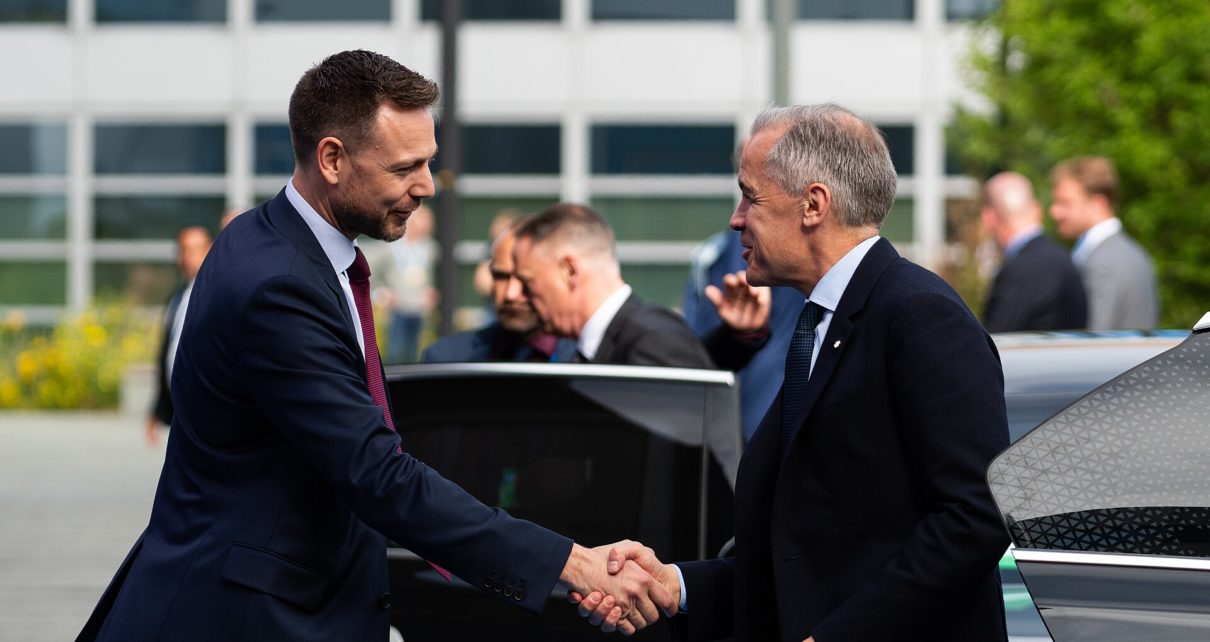
Photo: Mark Carney Arrives at NATO Summit in The Hague.jpg Floris de Bijl
Disclaimer: Any views or opinions expressed in articles are solely those of the authors and do not necessarily represent the views of the NATO Association of Canada.