One of the most anticipated and consequential elections of 2026 has been Hungary’s April 12th parliamentary election. Under the premiership of Viktor Orbán, who had served as Hungary’s prime minister for almost 20 cumulative years, Hungary had become synonymous with democratic backsliding and obstructionism within the European Union (EU) and NATO.
Orbán, a former anti-communist activist, became the foremost pro-Russian leader within the EU and NATO. As the leader of the nationalist political party, Fidesz, he continuously blocked both the EU’s sanction packages against Russia and Ukraine’s accession negotiations. In NATO, Hungary under Orbán delayed the accession of Finland and Sweden when the two Nordic states sought membership after Russia’s full-scale invasion of Ukraine. Domestically, Orbán consolidated Fidesz’s power by capturing public institutions, rewarding allies with lucrative sinecure appointments, and diverting state assets to Fidesz-backed NGOs and corporations.
On April 12th, however, Orbán and Fidesz were resoundingly defeated by Fidesz defector Péter Magyar and his Tisza Party. Magyar and Tisza won a whopping majority of 137 seats in the 199-seat Hungarian parliament, despite a hostile, Fidesz-dominated media landscape.
Magyar’s victory proved inspiring for pro-Western, pro-NATO democrats in Europe, but it should also be instructive. This victory came with years of non-stop campaigning and grassroots community mobilization that has become the norm in Hungarian politics. As allies look to revitalize civil defence efforts in the pursuit of greater national resilience across NATO, Hungary’s example may have something of substance to offer.
Péter Magyar, Tisza, and civil society
Magyar, a former low-profile Fidesz member, rose to prominence in 2024 in the wake of a major political scandal. Hungary’s president, an Orbán appointee, had pardoned a man guilty of covering up a child sexual abuse scandal in a government-run children’s home. Magyar’s ex-wife, Judit Varga, who had been serving as Orbán’s Minister of Justice, was forced to resign alongside the President of Hungary. In response, Magyar publicly broke ranks with Fidesz and joined the Tisza Party, a minor centre-right opposition party formed in 2020. To the Hungarian public and media, Magyar offered a ‘megaspectacle’ as a former insider who promised to expose Fidesz’s pervasive network of control and corruption across private corporations, official media, and state institutions.
Magyar’s megaspectacle overcame Fidesz’s dominance over the traditional media, which still commands much attention across Hungary. Simultaneously, Tisza looked to the grassroots for support. The party established ‘Tisza Islands’ across the country — local clubs not formally affiliated with the party. These Tisza Islands served as debate clubs, community service organizations, and mutual aid societies. They offered a space for citizens to express discontent with the government in communities where Fidesz’s lead seemed monolithic and insurmountable. They brought together urban pro-European liberals, who were traditional opponents of Orbán and Fidesz, and disenchanted but conservative-minded rural voters. In other words, they fostered a resilient civil society where there were no other institutions doing so.
When election time came, Tisza’s broad coalition turned out in numbers across the country to deliver Magyar his landslide victory, overcoming Hungary’s Orbán-instituted election system which punishes parties with concentrated, urban support.
These tactics were not Tisza or Magyar’s innovation. Fidesz itself had created ‘civic circles’ out of church communities during its time in opposition between 2002 and 2012, but the party quickly abandoned them after having consolidated its power while in government. Indeed, even satirical parties in Hungary participate in grassroots organization and community mobilization. Fidesz’s approach of forsaking grassroots support after having captured state institutions ultimately created a power vacuum in civil society, which Tisza would then exploit to great effect.
Though the Tisza Islands were set up by a political party for vested partisan purposes, the same methods of promoting grassroots engagement through community services and programming may prove effective for other governments across NATO. As NATO allies, including Canada, begin reprioritizing civil resilience as a part of defence transformations, Tisza’s successful revitalization and incubation of civil society should be closely examined.
Georgia: the next domino to fall?
Entrenched pro-Russian authoritarian governments are not unique to Hungary. In the Caucasus, Georgia has been governed since 2012 by the Georgian Dream party, which has become a pro-Russian movement backed by the Georgia’s richest man, Bidzina Ivanishvili. Orbán’s ousting in Hungary deprived Georgian Dream of a key ally and fellow authoritarian in Europe. Indeed, pro-Western opposition leaders in Georgia have hailed Magyar’s victory as a sign that Georgian Dream’s position is vulnerable.
Georgian Dream promotes a theory which claims that Western states, the EU, and NATO are part of a “Global War Party” that thrives off instigating armed conflict. Accordingly, the party claims that rapprochement with Russia is the only way of maintaining Georgia’s peace, a claim fundamentally at odds with Russia’s ongoing occupation of Georgian territory in Abkhazia and South Ossetia. Like Fidesz, Georgian Dream receives support from Russian official media and maintains a strong grasp over the traditional media, which holds great sway in a largely rural country like Georgia.
In the manipulated 2024 Georgian election, Georgian Dream deployed striking posters urging the voter to “choose peace”, insinuating that the election of a pro-Western government would draw the country into war with Russia. Though Fidesz and Orbán had made similar claims in Hungary, Magyar was able to counter Orbán’s fearmongering by highlighting the financial consequences of his dismantling of democratic safeguards, in the form of billions of euros of frozen EU funding. Simultaneously, Magyar maintains a degree of ambiguity on the extent to which his government would support Ukraine. Georgia’s EU accession process has likewise been halted by the European Council since 2024, in response to widespread electoral fraud and intimidation. Emphasizing Georgian Dream’s sabotaging of Georgia’s EU relations would undoubtedly be a priority for the Georgian opposition, as the Georgian public remains overwhelmingly pro-EU and pro-NATO.
Georgian Dream has gone further than Fidesz in its assaults on Georgia’s democracy, given the lack of constraint from EU institutions. Georgian Dream has cracked down on pro-Western protests and jailed opposition politicians, prompting opposition parties to boycott parliament. Though the resultant political landscape in Georgia is much more hostile to democratic opposition parties than in Hungary, Georgia’s opposition parties should nevertheless recognize the need for fresh leadership and inclusive alternative visions for governance.
Georgia and Hungary both have histories of popular pro-democratic uprisings. Magyar and the Hungarian opposition have frequently drawn parallels between themselves and the 1956 Hungarian uprising. Georgia’s bloodless 2003 Rose Revolution successfully deposed the country’s post-Soviet authoritarian leader, the former Soviet foreign minister Eduard Shevardnadze. While Georgia’s democratic parties dig in for a stint in persecuted opposition, invocations of the memory of the Rose Revolution may prove resonant in the public imagination.
Georgia’s opposition should again emulate the Hungarian example and look to rural Georgia, where Georgian Dream’s main constituency lies. Georgia’s democratic parties will need to pursue a broad national coalition which mobilizes all grievances towards Georgian Dream’s authoritarianism and corruption. By doing so, the Georgian opposition may effect a similar civil society transformation that delivers it an eventual political triumph against an entrenched authoritarian government.
The way ahead for Hungary
When Fidesz was unable to deliver on its economic promises, Magyar and Tisza were able to offer a viable, unblemished alternative. As Hungary’s new government, Tisza now faces the unenviable task of rebuilding the state and civil society and repairing Hungary’s fraught relations with its neighbours and the EU. On this front, at least, Tisza will be able to lean on the Polish experience with reversing democratic backsliding under right-wing populist rule.
Magyar has proved himself to not be the parrot of Brussels which Fidesz has accused him of being. Magyar personally identifies as a conservative and draws support from a broad coalition of anti-Fidesz conservatives, liberals, and progressives. He diverges from much of the EU and NATO on some foreign policy issues, including on Ukraine’s membership in the two organizations and lethal aid for Ukraine. Increased defence spending and meeting NATO’s new 5 percent of GDP target is also not a priority for Magyar, as rooting out pervasive Russian influence within Hungary’s national security establishment will prove a more immediate challenge. However, Magyar has signalled strongly that even when there are disagreements, he will remain a constructive, not obstructionist partner within the EU and NATO.
The story of Magyar and Tisza’s victory over Fidesz will continue to inspire pro-Western democrats across Europe and the world as they struggle against authoritarian, populist governments. As NATO begins the process of enhancing its internal resilience, all allies should be inspired equally by the strength of grassroots, local engagement.
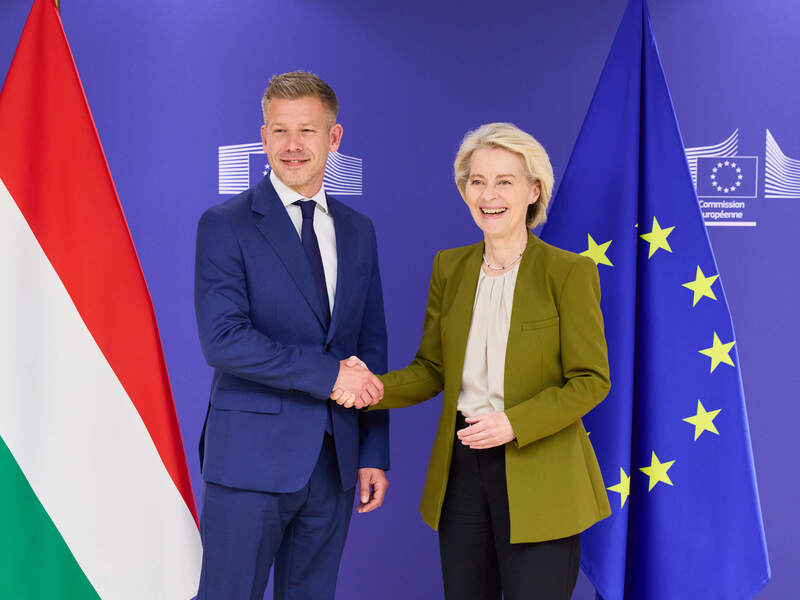
Image credit: Ursula von der Leyen, President of the European Commission, receives Péter Magyar, Prime Minister-designate of Hungary (2026) by Dati Bendo / European Commission via Wikimedia Commons. Licensed under CC BY 4.0.
Disclaimer: Any views or opinions expressed in articles are solely those of the author and do not necessarily represent the views of the NATO Association of Canada.