Like much else in the Canadian Armed Forces, the Royal Canadian Navy’s submarine fleet is rapidly aging out. The RCN’s second-hand Victoria-class diesel-electric submarines, built for the Royal Navy in the 1980s, will reach the end of their service life in the 2030s. The four Victoria-class submarines are already showing signs of their age, having become so prone to breakdowns to the point where the RCN is now down to one operational submarine – HMCS Corner Brook. In 2024, the Department of National Defence officially launched the Canadian Patrol Submarine Project (CPSP), to procure up to twelve conventionally-powered submarines to replace the current fleet.
By August 2025, the Government of Canada identified two qualified submarine bids: Korean firm Hanwha Ocean’s KSS-III Form II, and the Type 212CD (Common Design) – a joint German-Norwegian project between ThyssenKrupp Marine Systems (TKMS) and Kongsberg Defence & Aerospace. Military procurement, however, is as much an exercise in strategic analysis as it is in alliance politics. In selecting a bid, Canada must consider which of the options is most consistent with its stated strategic needs and geopolitical orientation.
The TKMS-led bid offers the quickest delivery, with the first submarine to be delivered by 2032 alongside numerous technical, strategic, and economic benefits for a Canada that finds itself increasingly looking across the Atlantic. Built on the Type 212A design, which pioneered diesel-electric air-independent propulsion, the German-Norwegian Type 212CD promises to run completely silent as its propulsion system features no moving parts. Other unique innovations of the Type 212CD include a diamond-shaped hull designed to reduce its sonar profile, and a fully non-magnetic architecture which makes it invisible to magnetic sensors.
The KSS-III’s much-vaunted vertical launch system, capable of launching ballistic or cruise missiles, reflects South Korea’s need to deter aggression from North Korea and the People’s Republic of China. Canada, however, has never fielded submarines with a vertical launch capability and would either have to procure Korean-produced submarine-launched missiles to supply the KSS-III or leave these vertical launch tubes empty. Crucially, this vertical launch capability was never a part of the Canadian design criteria, and is therefore entirely a superfluous feature as far as Canada’s needs are concerned. Though the KSS-III’s additional firepower might prove tactically useful in certain scenarios, its non-nuclear ballistic missiles are of an uncertain strategic value to Canada.
The Type 212CD brings no superfluous impositions and is already well moulded to Canadian doctrinal needs. A major limitation of the current Victoria-class fleet is its inability to conduct regular Arctic operations, as its design necessitates regular surfacing to vent diesel exhaust. In contrast, the Type 212CD is particularly suited for Arctic operations, with better littoral manoeuvrability within the Canadian Arctic Archipelago. This is due to its nimble size and ability to not just operate under ice but also surface through Arctic ice. The Type 212CD features an air-independent propulsion system (AIP), enabling extended periods of underwater operation, inevitably necessary for operations in the Arctic. As Canada’s Arctic becomes a more contested space, where states like China have attempted to conduct surveillance, the need for reliability and stealth becomes paramount.
Prime Minister Mark Carney’s government has emphasized that the successful bid will be the one which offers Canada the most economic benefits. TKMS delivers fully on this front too, having secured a flurry of partnerships with Canadian universities, firms, and Indigenous organizations. Though the boats may end up being constructed in Kiel, they would be built with Canadian critical minerals while being equipped and maintained with Canadian-designed technologies through TKMS’s proposed Canadian Defence and Dual-Use Innovation Ecosystem.
Canada does not currently have the industrial capacity to build submarines domestically and has ruled out building these newly procured submarines in Canada due to the inevitable time lag. Despite this, TKMS has expressed a desire to build some part of the Type 212CD fleet in Canada. TKMS has also committed to training Canadian submarine technicians, as well as transferring technology and intellectual property related to the submarine to allow for independent upgrades and maintenance. Indeed, the German-Norwegian bid includes an invitation for Canada to join “Team 212CD” as the third partner in the Type 212CD project. This aligns well with Canada’s Defence Industrial Strategy, which outlines a “build-partner-buy” framework for defence procurement. By buying the Type 212CD, Canada is partnering with its reliable NATO allies to develop the domestic capabilities that it needs to build more critical defence technologies at home.
A major advantage of the Type 212CD is the element of common design. A common submarine design across several NATO partners allows for quicker sourcing of parts and production ramp-up. Given TKMS’s long-established status as the foremost supplier of NATO’s conventional submarines, producing 70 percent of the alliance’s fleet, one can reasonably expect that other NATO allies may express future interest in the Type 212CD. If Canada were to become a fully-fledged partner of the Type 212CD project and Canadian firms fully integrated into the production process, Canada also stands to reap the economic benefits of future allied orders.
Aside from these technical and economic considerations, the Canadian government has taken major steps to revitalize and deepen its strategic partnership with the European Union. Having concluded the Canada-EU Security and Defence Partnership (SDP) in June 2025 and secured Canadian accession to Security Action for Europe (SAFE) in December, the EU’s €150 billion defence procurement financing instrument, Canada is sending a clear signal that it wishes to seriously engage the EU as its primary strategic partner. If Canada were not to procure the Type 212CD, a product of European defence cooperation, it would send a mixed message for a country which has so strongly and consistently signalled its European orientation and ambitions.
While one may argue that procuring the KSS-III would allow Canada to pursue closer defence integration with South Korea and the Indo-Pacific, there exists no equivalent institutional infrastructure in the region which would transform such a purchase into a broader project with several allies. On the other hand, procuring the Type 212CD would integrate Canada into a trilateral project under the aegis of the existing Canada-EU SDP. Though NATO allies may have integrated South Korean tanks and artillery systems into their militaries, submarines are considerably more technically sophisticated and require a much stronger industrial capacity for their maintenance. Both Hanwha Ocean’s and TKMS’s numerous Canadian industrial partnerships are a testament to this fact.
Ultimately, it is up to Canadian policymakers to select the bid that offers the most practical and tangible benefits and is best suited to Canada’s specific strategic needs. As Canada steps up its Euro-Atlantic commitments and reinforces its engagement with Europe, participation in projects like the Type 212CD represents a valuable opportunity to deepen ties with NATO allies and become part of a truly transatlantic endeavour.
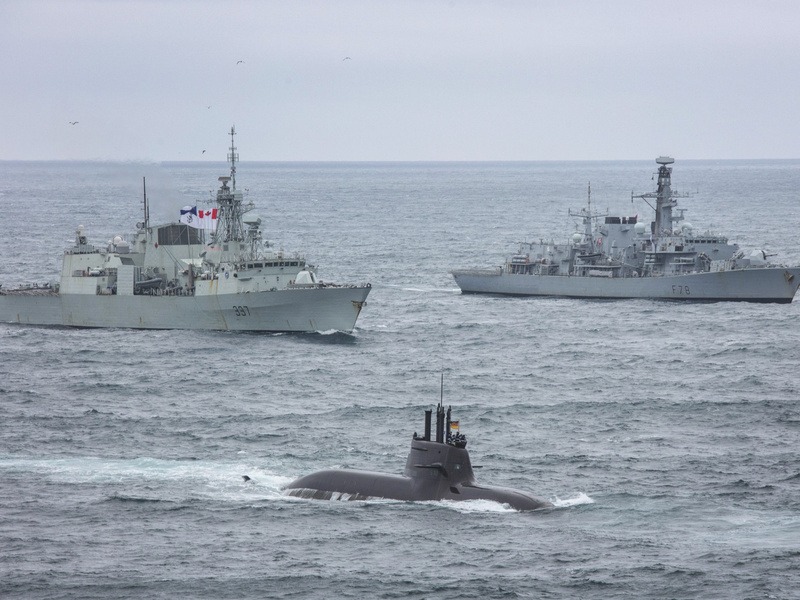
Image credit: U-36 (A Type 212A submarine of the German Navy), HMCS Fredericton, and HMS Kent in Exercise Dynamic Mongoose 2020 by LPhot Dan Rosenbaum via Wikimedia Commons. Licensed under UK Open Government Licence v3.0.
Disclaimer: Any views or opinions expressed in articles are solely those of the author and do not necessarily represent the views of the NATO Association of Canada.