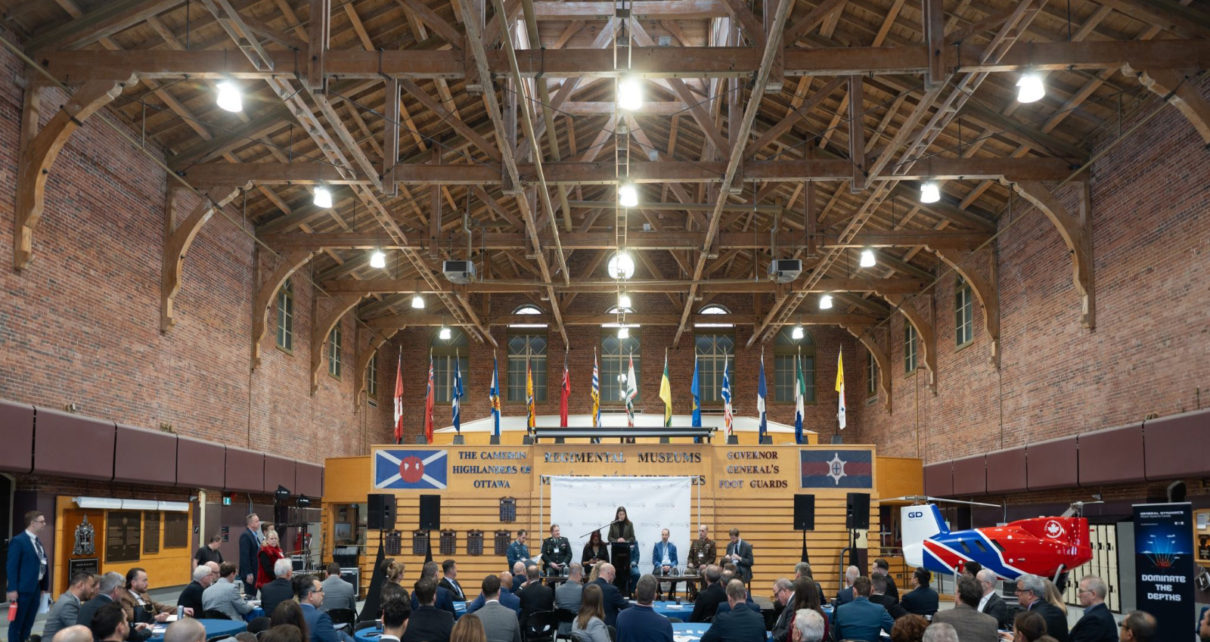
On November 28, 2025, the NATO Association of Canada (NAOC) organized a panel discussion entitled “Unmanned Horizons: The Future of Aerial, Land, and Naval Drones”. The event took place in the Cartier Square Drill Hall in Ottawa and brought together more than 150 defence leaders, industry innovators, and policymakers to discuss the rapid evolution of drone technologies and their implications for Canada’s capabilities.
The event commenced with opening comments from Bogdana Torbina, NAOC Chief of Staff and Master of Ceremonies for the afternoon. Her brief remarks highlighted the NAOC’s critical role in educating Canadians about the importance of the country’s contribution to the NATO alliance and the broader significance of investment in defence and security.
The event proceeded with an introduction of the keynote speaker, former Minister of National Defence and current Chair of the NATO Association of Canada, Hon. David Collenette. In his address, Mr. Collenette identified drones as an increasingly relevant component of modern warfare. He underlined that as global security faces internal and external pressures, new tools and technologies are required to ensure the security of all.
Using the COVID-19 pandemic as an example, Mr. Collenette went on to highlight how like-minded nations can and must continue to work together to develop new technologies and overcome various existential threats. These include climate change and the dangers associated with growing authoritarianism. Additionally, Mr. Collenette mentioned that emerging non-state actors, armed with new weapons such as drones, make it incumbent for nations like Canada to adopt new technologies and be ready to sustain increased defence spending.
Mr. Collenette also noted that strengthening government procurement of equipment and weapons is essential in the context of a weakening liberal international order and growing security threats. He warned that overspecification in military equipment can cause procurement delays and stressed that Canada must accelerate its procurement process. A focus on complex and numerous requirements must not delay the acquisition of much-needed weapons. Finally, Mr. Collenette asserted that with the increased use of drones in the Russian invasion of Ukraine, questions must be raised about their utility in future wars elsewhere. He mentioned the possibility of this being the “First Drone War”, and underlined the need for nations to ensure they learn new techniques to counter the increasing ubiquity of drones.
Following the keynote address, the event segued into a panel discussion with the MGen Smyth from the Royal Canadian Air Force, Col Labbe from the Vice Chief of Defence Staff, LCol Lemay from the Canadian Army Land Warfare Centre, Paula Folkes from Public Services and Procurement Canada, Col Pavese from the Canadian Special Operations Forces Command, and Andrew Carryer from General Dynamics Missions Systems – Canada. The panel was moderated by Dr. Alexander Salt, a post-doctoral fellow at the Canadian Global Affairs Institute.
The discussion focused on how Canada could better utilize and integrate unmanned weapon systems into its military forces. As an example, Dr. Salt encouraged the panelists to reflect on what Canada should learn from the Russian invasion of Ukraine. In response, the speakers indicated that while the ongoing war offers lessons for the future of warfare, some of them do not apply to the Canadian context. They emphasized that armed conflict is not always heavily centered around emerging technology and that the successful use of drones in Ukraine would not necessarily translate into success in Canada. This stems from differences in drone systems and risk tolerance. Ukraine has taken risks in developing its drone strategy that Canada has traditionally been unwilling to accept. These dangers include using various types of drone systems that may not be fully interoperable.
Another question addressed the challenges the Canadian Armed Forces face in approaching technological interoperability between allies when purchasing unmanned systems. Panel members responded that while interoperability between allies is important, it is not necessarily the highest priority; unique unmanned weapon systems can still be used effectively.
During the Q&A section, the audience asked how to ensure closer collaboration between the industry and the public sector, especially in weapons procurement. The panelists responded that when possible, they encourage unsolicited bids from the industry and advocate for a more streamlined procurement process. They also emphasized the need for ongoing dialogue between the private and public sectors to address Canada’s technological challenges and better predict future warfare needs.
In her closing remarks, Honourable Chair Emerita of NAOC, Kathryn E. Langley Hope, thanked the attendees and speakers for their presence and enjoined everyone in attendance to continue conversations of this nature in the immediate and distant future to build a stronger Canada and NATO together.
Disclaimer: Any views or opinions expressed in articles are solely those of the authors and do not necessarily represent the views of the NATO Association of Canada.