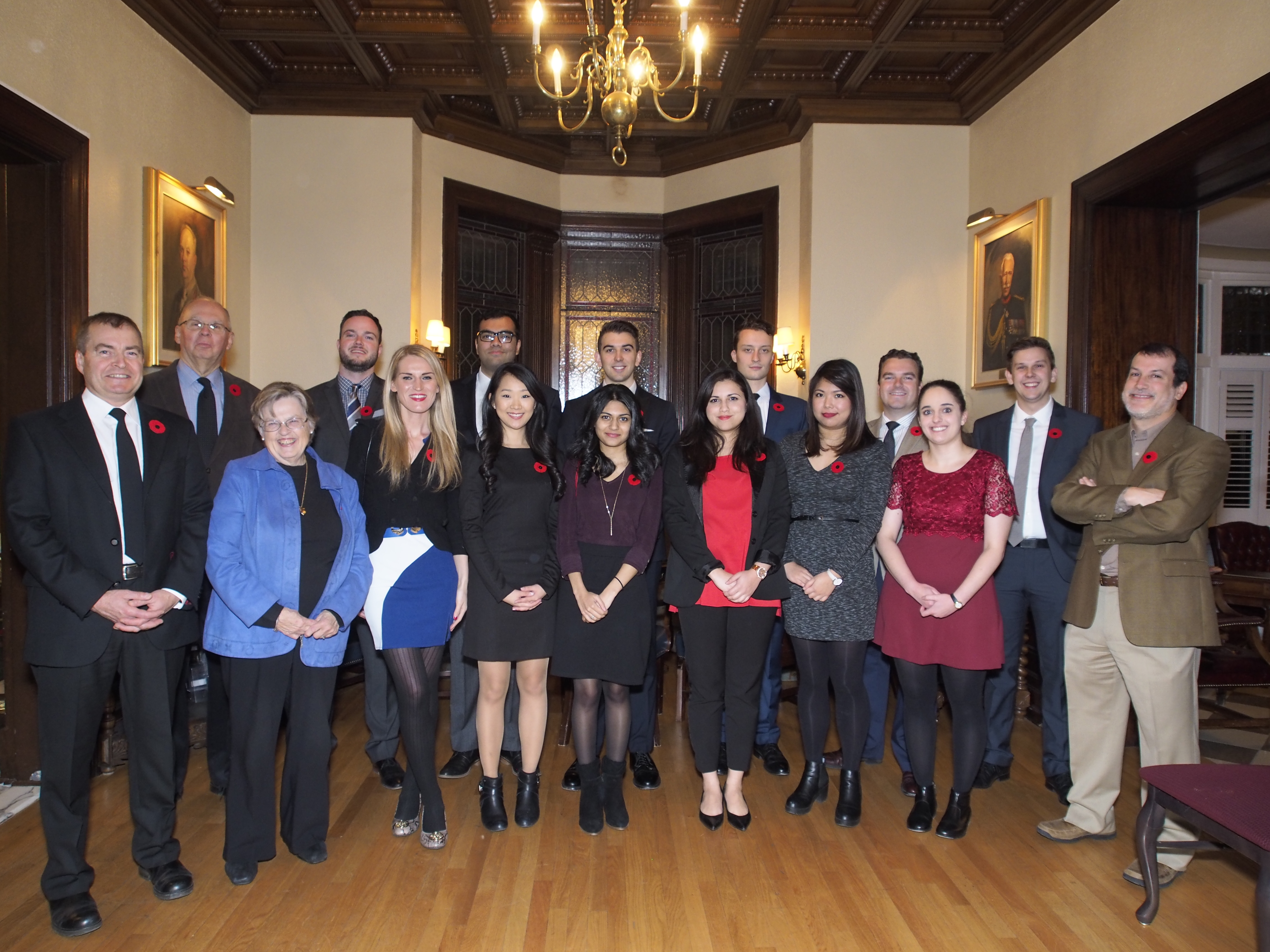
On November 10, 2015, the NATO Association of Canada (NAOC) hosted its annual fall conference at the newly renamed Department of Global Affairs in the Cadieux Auditorium of the Lester B. Pearson Building in Ottawa. Well over 100 government officials, foreign dignitaries, defence company representatives, and university and high school students were in attendance, all of whom were treated to a day’s worth of insightful observations from experts on NATO’s future role in global security.
The Honourable Hugh Segal, NAOC Chair, and Senator Raynell Andreychuk, who currently chairs the Standing Senate Committee on Foreign Affairs and International Trade, set the stage for the discussion to follow by proving an overview of the thicket of security threats that NATO must navigate over the coming years. Considerable attention was focused on Russia’s recent behaviour, with Mr. Segal arguing that Moscow only understands and respects strength, which requires NATO to assume a firm posture if its relatively new eastern members are to be safeguarded from Russia’s armed expansion. Senator Andreychuk echoed much of this thinking, alerting the audience to the methods of “hybrid warfare” –low-intensity offensives carried out by proxy forces and a concerted propaganda campaign that disseminates false narratives –that Russia has employed in eastern Ukraine. The first panel of the day featured Paul Chapin, Ferry De Kerckhove, and Colin Robertson, three distinguished commentators with more than 100 years’ service in Canada’s foreign service between them. With that wealth of experience, each was able to draw comparisons and contrasts between today’s security environment and the Cold War, as well as elaborating on the challenges confronting Canada and its NATO partners in meeting the asymmetric threats outlined by Senator Andreychuk.
A speech then delivered by Dawood Qayomi, Chargé d’Affaires of Afghanistan’s embassy in Ottawa, served as a reminder that NATO has been called on to address instability outside of Europe. Mr. Qayomi’s remarks offered a hopeful prognosis for that troubled country’s future, which he attributed in no small part to the Alliance’s role in countering the insurgency against the government in Kabul and in rebuilding state institutions. He asked that such vital assistance continue to be provided.
Before breaking for lunch, NAOC Julie Lindhout presented the preliminary recommendations of a defence policy review paper that is being prepared by a number of the organization’s program editors and will soon be presented to Canada’s new Minister of National Defence. This report will also be available for viewing on our website in the coming weeks. A second panel, moderated by The SecDev Group’s Alex Corbeil, offered an ideal forum for LGen (ret’d) Mike Day and Professor Stephen Saideman to discuss future NATO operations. Both speakers emphasized that the Alliance will have to clarify what potential transgression could trigger NATO’s collective security guarantee, as well as the importance of maximizing its contributions to global security even as its member states contend with constrained resources.
The closing address by Brigadier-General Bruce Ploughman, Chief of Staff Readiness at Canadian Joint Operations Command, reviewed Canada’s recent role in Trident Juncture, NATO’s biggest military exercise in over a decade that mobilized soldiers, sailors, and airmen from more than 30 countries to test the Alliance’s ability to respond to new security threats.
This successful event would not have been possible without the generous support of Ports Toronto, Porter, VIA Rail, and General Dynamics. Special thanks go as well to the Department of National Defence, which provided a grant, and the former Department of Foreign Affairs, Trade and Development for providing an appropriate location for an informative discussion of global issues.