Japan’s decision to review its Free and Open Indo-Pacific Strategy (FOIP) comes at a time when the regional order it was designed to protect is under greater strain and the alliance structure it relied upon looks much less dependable than it did before. Over the past several months, Chinese pressure on Japan has intensified across multiple domains, ranging from military activity near Japanese territory and economic coercion through trade and export restrictions to reported influence operations targeting Japanese political leadership. At the same time, the United States has become a far less dependable strategic partner. Policy shifts under the Trump administration have introduced instability into the alliance system, while U.S. involvement in the Middle East has raised questions about whether American attention can remain focused on the Indo-Pacific. Japan now faces a more exposed strategic position where it must now navigate intensifying great-power rivalry while also developing forms of resilience that does not depend entirely on the U.S. It is within this context that Tokyo’s decision to review FOIP should be understood.
To understand FOIP’s current crisis, some context is necessary. Originally advanced by former Prime Minister Shinzo Abe, the strategy rested on the basic idea that an Indo-Pacific order grounded in the rule of law, economic prosperity, and free connectivity could be sustained through inclusive partnership. For Japan, this gave Tokyo a way to play a larger strategic role by defending maritime order, protecting critical sea lanes, and shaping the regional balance without presenting itself as purely confrontational. For Indo-Pacific partners, FOIP promised infrastructure, connectivity, and security cooperation that could widen their options and reduce vulnerability to coercion. For partners beyond the region, it framed the Indo-Pacific as part of a broader rules-based order in which European, African and other like-minded states also had a stake. In that sense, a limited rapprochement with China did not contradict FOIP’s earlier logic as it was never intended to act as a simple containment strategy. Under Prime Minister Fumio Kishida, Tokyo also adopted the broader language of a “Free and Open International Order,” with the two concepts working in tandem: FOIP as the regional expression of a wider effort to defend international cooperation and a rules-based order. When Chief Cabinet Secretary Minoru Kihara announced on February 16, 2026 that the government would begin a formal review, citing the growing importance of economic security and emerging technology competition, he was signalling that those earlier assumptions no longer fit the strategic environment Japan now faces.
The most immediate reason why FOIP now appears inadequate is the collapse of Japan’s brief thaw with China. The relationship had been badly damaged by Japan’s 2012 purchase of the disputed Senkaku Islands, but for years afterwards,Tokyo repeatedly tried to keep ties with Beijing from sliding into a permanent fracture. Prime Minister Abe pushed for a more stable relationship in the mid-2010s, the two sides entered a visible thaw by 2018, and Kishida continued that stabilizing line, with his 2023 reaffirmation with Xi Jinping of a “mutually beneficial relationship” based on common strategic interests. Even under Prime Minister Sanae Takaichi, that pattern initially appeared to continue. At the APEC summit on October 31, 2025, she and Xi met and agreed to pursue constructive and stable ties. However, just a week later, Takaichi would go on to state in parliament that a Chinese attack on Taiwan could constitute “a situation threatening Japan’s survival” that may necessitate military action. Beijing treated the comment as a serious provocation, and it quickly became Japan’s biggest fallout with China in years.
What followed was a coordinated escalation that exposed the full range of coercive tools Beijing is willing to use. By early 2026, China had banned exports of dual-use items, reduced rare earth magnet shipments, and placed twenty Japanese entities on an export-control list targeting defence-linked actors. Just a few months prior, Chinese fighter jets locked their radars at Japanese military aircraft near Okinawa, while state-linked influence operations attacked Takaichi’s legitimacy during her election victory. The integration of economic pressure, military signaling, and cognitive warfare into a single coordinated campaign was unprecedented and exposed the limits of FOIP’s operational framework. FOIP was conceived as a tool for shaping competition through dialogue, connectivity, and institutional partnership, but was not designed for managing coordinated pressure moving across multiple domains simultaneously.
If FOIP is to remain credible, it must move beyond broad regional principles and focus on practical forms of strategic adaptation. That means diversifying supply chains, expanding cooperation with other states on advanced technologies and dual-use sectors, and strengthening partners before coercion hardens into crisis. Much of the review already appears to be moving in this direction, especially through its greater emphasis on economic security, critical technologies, and targeted regional support.
However, even a more resilient FOIP will be limited so long as Japan’s regional strategy remains tied to an American alliance that looks less predictable than it did when FOIP was first conceived as it was always designed to complement the U.S.-Japan alliance rather than function in its absence. The Trump administration’s planned May summit with Xi Jinping has already raised questions about the durability of U.S. commitments in the Indo-Pacific. Those concerns became more visible when the U.S. became militarily involved in Iran in late February 2026, setting off consequences that reached Japan almost immediately. The closure of the Strait of Hormuz triggered an energy shock for a country that relies on the Middle East for roughly 90 percent of its crude oil; Japanese markets fell, inflation pressures intensified, and the yen weakened right as Tokyo needed economic stability to manage its worsening China challenge. There were more direct effects too; for instance U.S. deliveries of Tomahawk missiles were postponed as Washington redirected those systems to the Middle East leaving Japan’s future preparedness more exposed. If FOIP is to survive in these harder conditions, Japan will have to build a strategy that can hold even when Washington’s attention, resources, or priorities shift elsewhere.
Tokyo’s changing diplomatic language shows this downturn is no longer being treated as a temporary rupture but as a more lasting shift in Japan’s strategic environment. Japan is now downgrading the relationship with China in its own official hierarchy, moving away from describing it as one of its “most important” bilateral relationships and toward framing China more narrowly as an “important neighbour”.
Japan’s FOIP review has implications beyond Tokyo because it captures a broader dilemma now confronting Western allies across the Indo-Pacific. American power remains essential to regional deterrence, but strategies built on the expectation of steady U.S. attention and predictable support are becoming harder to sustain. Japan is now being forced to adapt to that reality by placing greater weight on economic resilience, technological cooperation, and practical support for regional partners. Its allies should also draw lessons from that shift. Japan’s experience shows that coercion now cuts across military, economic, and political domains all at once, and that broad declaratory strategies are no longer enough without material backing. If Washington is becoming less consistent or more easily diverted, then countries such as Canada and other like-minded partners should be doing more to reinforce Japan’s position through deeper security cooperation, supply-chain coordination, stronger diplomatic support, and more sustained regional engagement. FOIP’s future credibility will depend not only on how Japan responds, but on whether its partners are prepared to help uphold the regional order it was designed to defend.
Disclaimer: Any views or opinions expressed in articles are solely those of the authors and do not necessarily represent the views of the NATO Association of Canada.
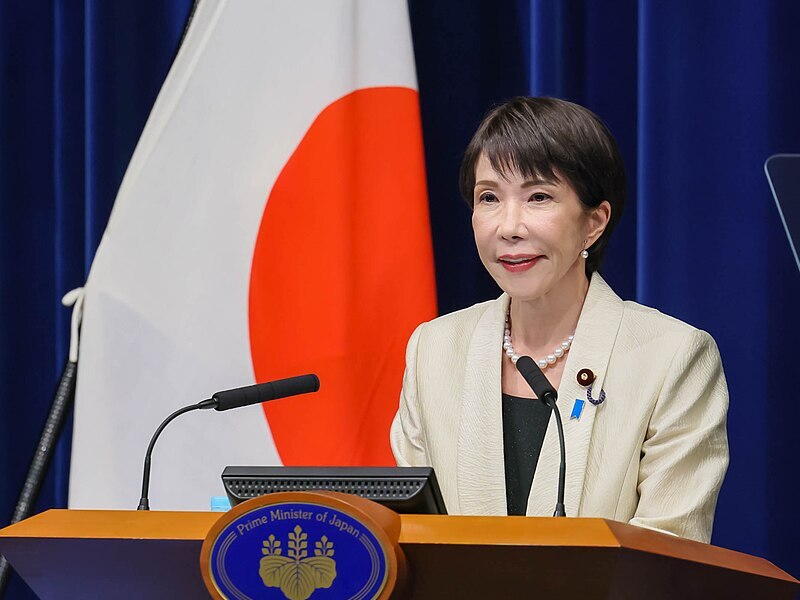
Photo Credit : Cabinet Public Affairs Office, Photo from the formation of Sanae Takaichi’s second cabinet, 18 February 2026, Wikimedia Commons, CC BY 4.0