British Army Chief General Sir Roly Walker warned parliament this April that the rise of the manosphere, an online network of communities united by an opposition to feminism, is making it harder for the military to combat misogyny and sexual harassment. He noted that this phenomenon is accelerated by social media and accompanied by deepening divisions between young people. These trends, he cautioned, risks undermining the Armed Forces’ ability to guarantee the safety of women as younger cohorts enter the armed forces. The manosphere has rapidly expanded from fringe corners of the internet into mainstream public discourse. Social media algorithms disproportionately expose Gen Z to its content and contribute to an increase of misogynistic beliefs among young men, normalizing violence against women and girls and creating links to extremist ideologies. As this cohort reaches military recruitment age, the cultural attitudes it carries pose a growing threat to the safety and participation of women in NATO’s armed forces and to the Alliance’s commitments under the Women, Peace and Security (WPS) agenda. Addressing this threat requires NATO and allied militaries to update its WPS frameworks and invest in digital and gender literacy programming for military recruits and personnel.
The manosphere refers to a network of ideologically coherent online spaces that promote the narrative that feminism has victimized men, and gender equality comes at men’s expense. These narratives have roots in the Men’s Liberation Movement of the 1960s and 70s, where Men’s Rights Activists emerged in opposition to women’s liberation. Today, the manosphere encompasses a range of communities, from involuntary celibates (incels) and pick-up artists to the Men Going Their Own Way (MGTOW) movement, united under the guise of offering advice to tackle men’s issues such as dating or fitness. Beneath this framing, these online groups share the common foundation of misogyny, the designation of men as systemic victims, and the normalization of violence against women.
Rapid technological change has transformed the ways misogynistic ideologies spread and create new and expanding risks, particularly for Gen Z. The speed, scale, anonymity, automation, and affordability of digital communication have broadened the reach of violent rhetoric in ways previously impossible. Manosphere content is especially difficult to moderate. Its packaging within the benign genre of men’s self-improvement allows it to remain in accordance with platform content policies, while being amplified by algorithms designed to maximize engagement. The result is that Gen Z has become the most exposed generation to sexist rhetoric online. Experts estimate 70% of young men today have been exposed to manosphere content, and two-thirds engage with pro-masculinity influencers online. These patterns of exposure coincide with a significant generational shift: younger men are now more likely than older men to hold stereotypical and regressive views of gender roles and to perceive advocacy for gender equality as discrimination against men. 80% of educators report witnessing misogynistic behaviours in the classroom, which suggests these attitudes are translating into real-world consequences among youth.
The normalization of misogynistic beliefs in younger generations poses risks to security institutions and the women who serve within them. The ideologies of the manosphere intersect with other forms of extremism such as racism, homophobia, and authoritarianism, beliefs that have manifested in real-world violence, including attacks against civilians. The manosphere additionally serves as a recruitment pathway into broader far-right networks, drawing on sexism as an entry point. Within military institutions, this rise risks compounding an already pervasive problem: misogyny is considered a norm in military culture, with women disproportionately subjected to gender-based discrimination or harassment and less likely to hold leadership roles or receive unit support. Further, existing trends linking military personnel to participation in far-right organizations suggests the manosphere could exacerbate these connections. The entry of a generation carrying disproportionately misogynistic attitudes into these military conditions risks deepening existing gender inequalities and undermining efforts to create safe military environments.
The rise of the manosphere also poses a threat to progress in gender policy. The manosphere sits within the broader category of technology-facilitated gender-based violence (TFGBV), the use of technology to cause virtual or in-person harm. TFGBV also includes cyber-harassment, non-consensual deepfakes, and digital stalking. NATO’s 2024 WPS policy mandates the integration of a gender perspective across all Alliance activities and commits member states to the protection and meaningful participation of women in peace and security processes. Algorithmically-amplified online misogyny and its downstream effects on military culture and extremist recruitment explicitly violate these pillars of the WPS agenda. Thus, while the policy acknowledges the threat of TFGBV and commits to its prevention, operationalizing this commitment requires the implementation of specific policy measures. First, NATO should update its WPS and conflict-related sexual violence (CRSV) policy language to explicitly include manosphere-produced threats and terminology, which would enable consistent Alliance-wide identification of and response to TFGBV in NATO missions. Second, NATO’s counter-radicalization programmes should recognize online misogyny as a potential pathway to extremism and expand their preventative efforts to address misogynistic radicalization in digital environments. Third, NATO should invest in media literacy and healthy masculinity programming for military recruits and existing personnel, as education is widely-recognized as the most effective tool for dismantling the foundations of misogynistic ideology. The UK Armed Forces prevention programme targets young recruits to build understanding of consent, misogyny, incel culture and harmful online influences. Its structure could serve as a replicative model for implementation across the Alliance. For NATO to uphold its WPS commitments and ensure the safety of women within its institution, it must recognize the manosphere as a growing security concern and respond through policy reform to introduce cultural change.
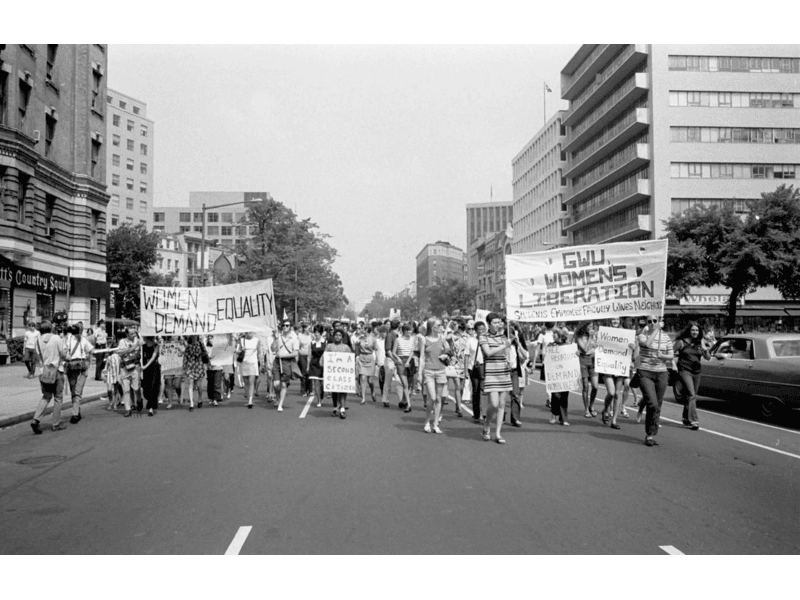
Photo: Women’s Liberation march in Washington, D.C. (1970), by Warren K. Leffler via the Library of Congress. Source: Public Domain.
Disclaimer: Any views or opinions expressed in articles are solely those of the authors and do not necessarily represent the views of the NATO Association of Canada.