For the first time since the end of the Cold War, Canada has achieved NATO’s 2% defence expenditure target. While the increase in spending strengthens Canada’s credibility within the North Atlantic Treaty Organization (NATO) and supports domestic defence-related industries and employment, the 2% target does not reliably measure actual military capability. Can Canada convert higher defence expenditures into deployable capabilities, a more efficient procurement process, personnel increases, and reduced dependence on the United States?
On March 26, 2026, Prime Minister Mark Carney announced that Canada had achieved the 2% defence expenditure target. This has been achieved through increased spending and substantial funding across several federal departments. To align itself with NATO’s updated target of 3.5% of GDP on core defence spending and 1.5% on military infrastructure and other supporting elements, Canada has announced more than $3 billion in infrastructure and defence-related funding across Atlantic Canada. At the centre of this progress is the Defence Investment Agency, established in October 2025 to accelerate defence procurement. Defence spending produces outputs such as equipment, infrastructure, readiness, serviceability, deployability, and trained personnel.Military capability derives from these outputs and includes the ability to operate effectively, project force, apply military effects, and sustain operations over time. More money spent on the armed forces does not necessarily lead to more military capability; it may merely increase the perception of Canada’s military capability.
The difference between “input” (funding) and “output” (readiness) can be demonstrated most effectively through an examination of Canada’s readiness statistics. Readiness for the core concurrent mission set was only 30 percent of planned readiness for DND/CAF in fiscal year 2024 to 2025, below the required 90 percent. Similarly, operational readiness for all force elements was only 61.3 percent, again below the expected 90 percent. Readiness for other types of support was also lower than expected; specifically, maritime key fleet serviceability was 59.6 percent, land key fleet serviceability was 51 percent and aerospace key fleet serviceability was 42.3 percent. These results suggest that spending cannot directly equate to capability when outdated equipment requires burdensome maintenance, parts shortages affect obsolete systems, and personnel shortages slow the translation of funds into capabilities.
These spending increases and planning changes come after a period of declining recruitment for the Canadian Armed Forces. Recruitment levels have now increased significantly. In 2025 to 2026, the CAF enrolled 7,310 Regular Force members, surpassing its target of 6,957 and marking the highest number of enrolments in more than 30 years. This progress is beginning to address an ongoing personnel shortage, but recruiting candidates is still different from making those recruits ready for duty. New members must be trained, retained, equipped, and integrated into functioning units before recruitment gains become capability. Thus, while some progress has been made, much remains a work in progress.
This dichotomy between increased spending and actual capability is perhaps most pronounced in terms of Canada’s procurement activities. Only 44 percent of capital equipment projects remained on schedule in 2024 to 2025, far below the target of at least 90 percent. Staff shortages, procurement timelines, contracting and legal issues, technical problems, and costing challenges were cited as primary causes. The key question is whether the Defence Investment Agency can shorten acquisition times and deliver needed equipment to the CAF. The mere creation of an additional organization is insufficient to ensure success.
Canada’s reliance upon the United States for defence can endanger Canadian capability if Canada cannot access the parts, software updates, or sustainment for U.S.-origin equipment. President Donald Trump has referred to Canada as “the 51st state,” raising public concern about strains in the Canada-U.S. military relationship. More importantly, if Canada relies too heavily on one foreign partner for equipping and sustaining its military, then simply increasing spending will not necessarily build a sovereign defence industrial base. As well, Canada’s Defence Industrial Strategy utilizes a Build, Partner, Buy framework, which prioritizes Canadian production where possible, allied partnerships where needed, and external purchases when they support domestic reinvestment and sovereign control. This marks a more deliberate approach than past practice by placing domestic production first where Canada has sovereign industrialcapability or existing strengths. It appears that Canada’s spending increases are being driven not just to meet NATO expectations, but also to develop a domestic defence industrial base while remaining aligned with NATO.
The reduction of dependence upon the United States also ties into Canada’s economic view of defence. If Canada wants greater control over its military capabilities, it must develop those domestic industries that can produce and sustain those capabilities. Defence spending can have many positive effects, such as job creation and intellectual property development in defence and defence-adjacent industries. In 2024, Canada’s defence industry generated $17.3 billion in revenue, added approximately $11.1 billion to Canada’s Gross Domestic Product, and supported 81,800 jobs.
Canada intends to meet NATO capability expectations while supporting job creation, regional development, and industrial growth. When military requirements compete with industrial policy, timelines often become longer and costs increase, especially where domestic production lacks a comparative advantage. Thus, Canada faces a trade-off: domestic sourcing can strengthen jobs, intellectual property, and industrial capacity, but faster delivery may sometimes require foreign sourcing.
Canada achieving the 2 percent defence spending target set by NATO is an important milestone; however, it should not be viewed as the final measure of Canada’s military restoration . Increased spending improves Canada’s credibility within NATO, supports the Canadian defence industry, and reflects Canada’s efforts to decrease its dependence on the United States. Canada’s ability to transform this spending into deployable capability is uncertain. The issues facing Canada include procurement timelines, personnel shortfalls, equipment gaps and readiness concerns. Therefore, the ultimate test of Canada’s defence transformation will not be based on how much money is spent, but whether that spending produces greater deployable capability, strengthens Canada’s sovereignty, and manages the trade-off between NATO commitments, domestic industrial goals, and Canada’s broader economic and security priorities.
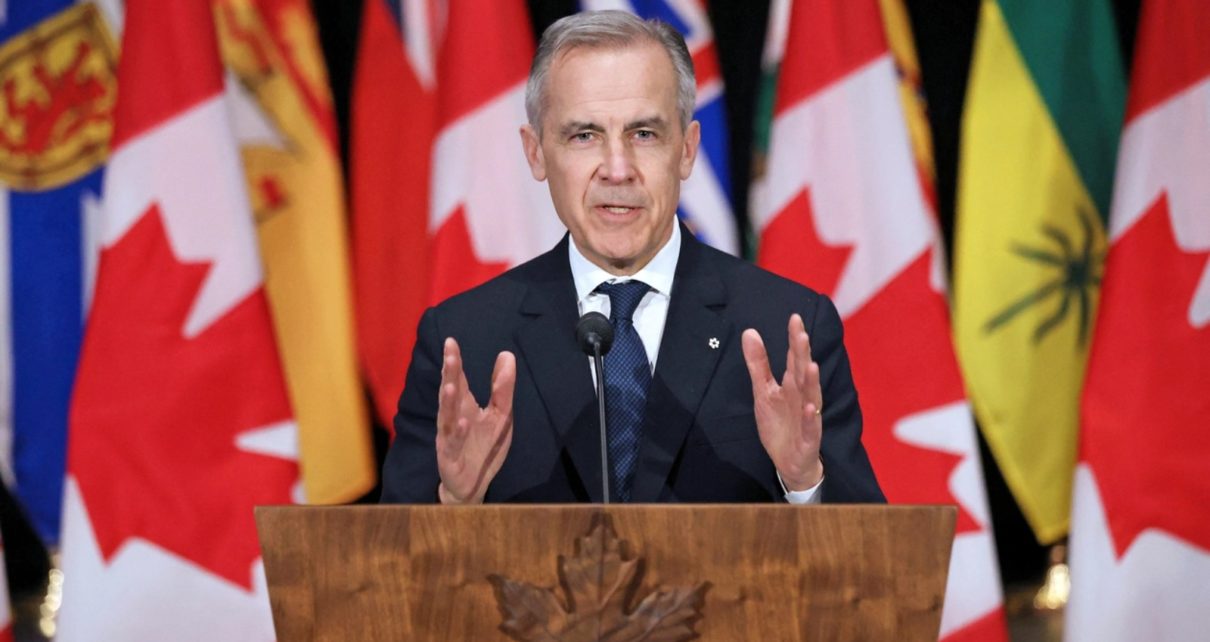
Photo: Canada’s Prime Minister Mark Carney speaks during a press conference after the First Ministers Meeting in Ottawa on March 21, 2025. Dave Chan/AFP via Getty Images.
Disclaimer: Any views or opinions expressed in articles are solely those of the authors and do not necessarily represent the views of the NATO Association of Canada.