Canada’s Climate Vulnerability
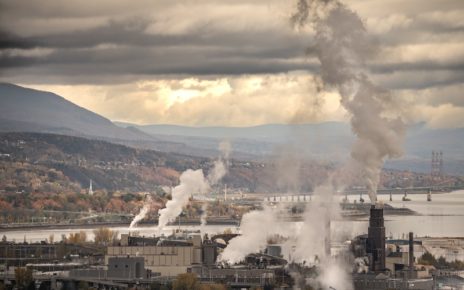
Canada’s climate is warming at twice the global average rate, and Arctic regions are at nearly four times the global average rate. As snow and sea ice melt, reduced surface reflectivity exposes darker land and water that absorb more solar radiation, further accelerating warming. The consequences are already visible in the frequency and scale of climate-driven disasters across the country.
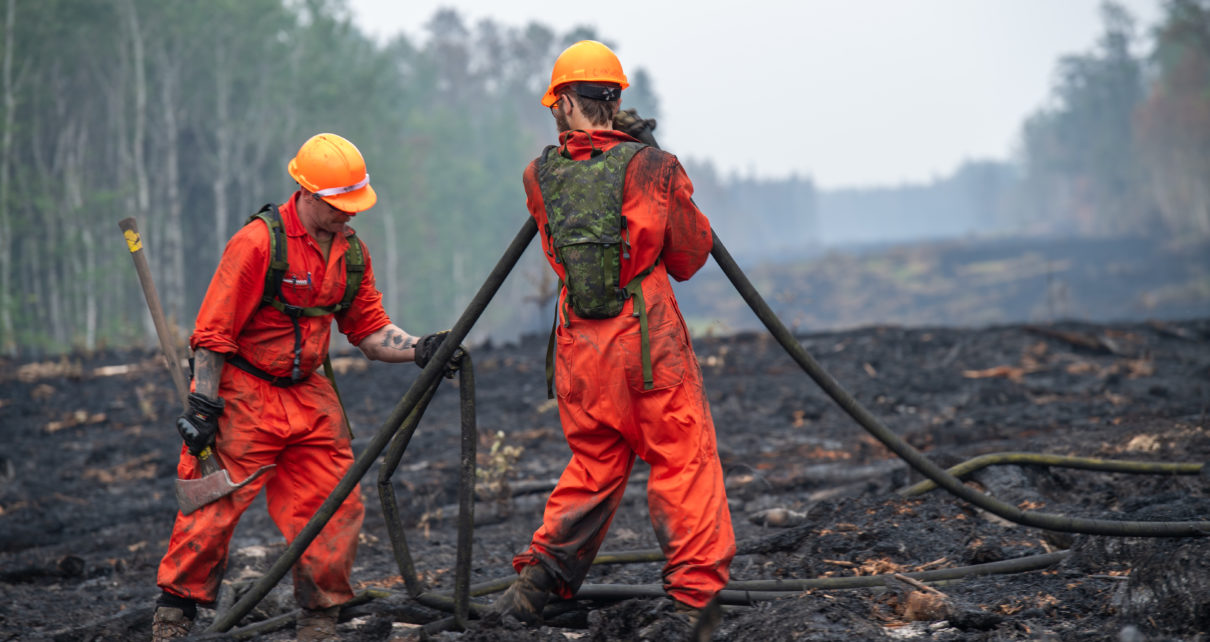
Six months into 2026, federal officials have already reported 65 active wildfires, six of which are burning out of control. In 2025, 6,125 fires burned over 8.78 million hectares and forced more than 85,000 people from their homes, which was Canada’s second-worst fire season on record. In 2023, over 6,000 fires torched a staggering 15 million hectares, more than double the previous record, and displaced over 232,000 people.
Canada’s Emergency Management Act places primary responsibility for disaster response with the provinces and territories, with the federal government and the Canadian Armed Forces (CAF) serving as backstops. In theory, this is sensible: provinces hold direct jurisdiction over their lands and populations and are better positioned to assess local conditions. In practice, local resources have been overwhelmed in each of these emergencies, and as climate change accelerates the frequency and severity of such disasters, the military cannot indefinitely fill the gaps left by civilian governance.
Operation LENTUS
Operation LENTUS was activated once in 2010, but by 2023, it was activated eight times in a single year, deploying over 2,100 personnel for 131 consecutive days across six provinces and territories. Between 2023 and 2025, it was activated 19 times in total, a pace the Department of National Defence has acknowledged represents activations broadly doubling every five years since 2010.
The costs are not only operational. General Wayne Eyre, the Chief of the Defence Staff, testified before the House of Commons Standing Committee on National Defence in September 2023 that military readiness was decreasing “due in part to the incessant demand for these types of domestic operations,” and that using combat-capable forces for routine disaster response was simply “not economically viable.” The Department of National Defence has itself acknowledged that the CAF “was not intended, nor structured to be a persistent force of first choice in providing emergency management services.” Combat engineers are not wildfire specialists, and strategic airlift is extraordinarily expensive for logistics work that civilian operators can perform at a fraction of the cost.
Policy Structural Gap
Christian Leuprecht, a distinguished professor at the Royal Military College of Canada, observes that provinces have begun requesting military assistance before disasters have even hit. This ready availability of federal support weakens the political incentive for provinces to invest in their own emergency response capabilities. The result is a perverse incentive structure in which provinces that invest in civilian capacity gain no relative advantage, and the federal government has never had to confront the absence of a national civilian response corps because the military has always been willing and able to step in.
Ottawa’s spending record illustrates the same gap it is meant to close. Since 2022, the federal government has committed over $1.2 billion across more than a dozen emergency management programmes, including $316.7 million to lease aerial firefighting aircraft and $108 million to fund NGO-based civilian emergency workforces. Canada is leasing planes it does not own, funding civilian workforces it does not employ, and directing Indigenous emergency preparedness money through half a dozen separate streams. Since 2023, it has also expanded contracts with international firefighting partners from Australia, Mexico, the United States, and South Africa.
Case Studies
Two countries offer instructive models. France built its civilian response capacity deliberately: the Sécurité Civile operates under the Ministry of the Interior, entirely independent of the military, with a dedicated aerial firefighting fleet, over 35 helicopters deployed across 23 bases, and approximately 2,700 career civilian professionals whose training and institutional continuity are entirely oriented around disaster response.
After the Black Summer bushfire season of 2019–2020 in Australia, which killed 33 people and burned through more than 18 million hectares, the Royal Commission into National Natural Disaster Arrangements recommended that the country develop a dedicated national aerial firefighting capability so the military could be reserved for military tasks. Australia’s National Aerial Firefighting Centre now coordinates a contracted fleet of approximately 162 aircraft, with the federal government committing over $100 million across 2024–26 to expand it. The deputy coordinator general of Australia’s National Emergency Management Agency was explicit that the investment “should reduce the need for the Australian Defence Force to step in during disasters.” Canada is one of the countries Australia now contracts for mutual aid.
A Canadian Civilian Climate Emergency Corps
Canada needs a dedicated national civilian emergency response corps: a standing federal body with its own trained personnel, equipment, and mandate. It would consist of a professional core of civilian emergency management specialists deployable across provincial and territorial boundaries, a reserve component of trained volunteers for surge capacity during major events, and dedicated civilian airlift and aerial firefighting assets maintained independently of the CAF. A clear legislative framework would establish it as the default first-response mechanism, restoring the military to its proper role as a genuine last resort.
The 2026 wildfire season has already demonstrated the cost of continued fragmentation. British Columbia, Alberta, Quebec, and Ontario have each developed separate investments in air capacity, detection technology, and predictive modelling, which are parallel systems built in provincial silos with no unifying national framework to coordinate them. A civilian corps would provide exactly that connective tissue, standardising training and deployment across jurisdictions. It would also address an equity gap the current system perpetuates: with First Nations communities bearing a disproportionate share of wildfire evacuations, a corps with embedded Indigenous community relationships and year-round presence in at-risk regions would provide more culturally appropriate and continuous support than rotating military deployments can. First Nations and Métis fire crews already play a central role in wildfire response across many regions; a civilian corps structured to incorporate Indigenous fire knowledge and cultural burning practices would be formalising and scaling what is already proving effective on the ground.
The Emergency Management Act has long established the principles; a civilian corps would provide the institutional capacity to act on them.
Civilian emergency professionals develop knowledge of specific landscapes, relationships with local authorities, and continuity across multiple fire seasons that the military’s rotation system structurally cannot replicate.
The governance architecture that has normalised the use of combat forces for civilian emergencies did so because building the civilian alternative was never urgent enough to prioritise. Accelerating climate change has now made that prioritisation unavoidable. Canada has the evidence, the precedents, and a deteriorating status quo that makes the case for a dedicated civilian emergency corps impossible to defer.