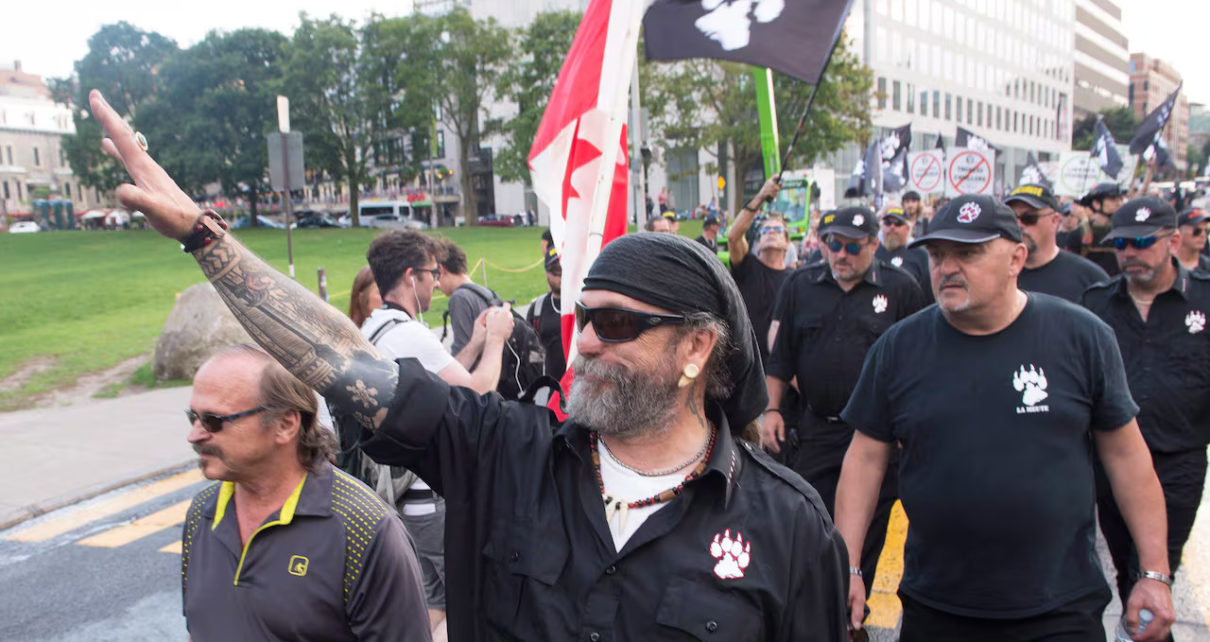
Despite active content moderation policies on major social media platforms, far-right extremism in Canada remains a resilient digital ecosystem. A 2020 Institute for Strategic Dialogue report identified 6,660 right-wing extremist channels, pages, groups, and accounts promoting white supremacy, anti-Muslim rhetoric, and “Great Replacement” conspiracy theories – with major clusters operating in western Ontario, Quebec, and Alberta. On Twitter alone, 6,352 Canadian users were identified as “closely connected to extremist accounts.” Alberta and Ontario-based fringe groups primarily communicate in English, making their content far more visible to standard moderation algorithms. Extremist actors in Quebec, in turn, leverage a distinct technical vulnerability: Big Tech’s heavy reliance on English-centric content filters. Organizations such as La Meute, Atalante Québec, Second Sons Canada, Soldats d’Odin, PEGIDA-Quebec, and Fédération des Québécois de souche mobilize followers by framing nationalism around the preservation of the Québécois identity.
Crucially, mainstream Quebec nationalism is a broad political movement rooted in democratic identity and language preservation. However, fringe groups distort these cultural themes, wrapping radical rhetoric in localized French terminology that automated AI filters struggle to distinguish from mainstream political discourse. While mainstream media platforms like Meta, YouTube, and X claim to maintain active and aggressive content safety moderation policies, several Quebec-based extremist groups exploit English-centric artificial intelligence (AI) models to continue recruitment and mobilization online.
The Failure of AI Moderation
Meta, X, and YouTube each hold their own policies surrounding the removal of hate speech. With a plethora of users and posts, these platforms have introduced AI moderators as a first line of defense to identify content that violates hate speech policies and remove or report it, sometimes flagging it for human investigation. Prior to AI, individual workers monitored and evaluated flagged posts. The transition to an automated triage function prioritizes speed and volume over contextual comprehension, delegating the critical initial assessment to algorithms that struggle to interpret linguistic nuance, localized political rhetoric, and coded intent.
Internal Meta files leaked in 2021 revealed that the company allocated 87% of its global budget for combating misinformation on English-language content, despite only 9% of its users being English-speaking at the time. While platforms keep their AI models closely guarded, research demonstrates that current natural language processing systems struggle to infer user intent or evaluate regional political context. When extremist rhetoric is rephrased as “historical commentary” or “political nationalism,” algorithms fail unless they are specifically trained on local socio-political context.
In Quebec, this algorithmic oversight creates a distinct security challenge. To avoid detection, radical groups frequently replace explicit hate speech—which standard keyword filters easily flag—with coded, pseudo-intellectual terminology. Standard terms like “sauvegarde de la culture” (preservation of culture) and “patrimoine” (heritage) are commonplace in mainstream Quebec public discourse and civic nationalism and refer to linguistic and historical continuity. However, extremist actors co-opt these terms, pairing them with concepts like “le Grand Remplacement” (The Great Replacement theory) and “remigration” to promote demographic panic and xenophobia. Because AI moderation models treat cultural defense terminology as benign political discourse, they fail to recognize when this language is weaponized to justify exclusion, allowing harmful content to pass undetected. The intentional use of these standard cultural terms as a signal, meant to be understood by sympathetic readers, while appearing neutral to automated filters.
The Digital Funnel: Mainstream Storefronts to Encrypted Echo Chambers
This linguistic evasion is not merely a workaround; it is the core engine of a multi-tiered recruitment pipeline. Quebec extremist groups use mainstream social media as the “top of the funnel.” On Facebook, X, and YouTube, they present sanitized public profiles centered on secularism and heritage preservation, allowing them to engage with users without risking account bans. Once contact is established, interested users are vetted and funneled—via direct messages or links—toward secondary, semi-private platforms like Discord or Odysee, and ultimately into end-to-end encrypted spaces like Telegram or Signal. In these private channels, the pretense of ‘heritage preservation’ is stripped away in favor of explicit white-supremacist propaganda. Algorithmic blindness on mainstream platforms allows extremist groups to maintain a permanent, unmoderated recruitment storefront in plain sight.
Expression or Extremism?
Addressing this structural vulnerability requires regulatory frameworks equipped to address non-English AI capabilities. In 2023, the European Union put the Digital Services Act (DSA) into place. The act requires “very large online platforms” to report and disclose “transparency reports” at a minimum, every six months, including information on content moderation teams. The reports must outline the qualifications and linguistic abilities of their moderation teams. They are further responsible for reporting content moderation practices, the amount of content they’ve removed, and the accuracy of their automated content moderation systems. Similarly, the 2019 “Online Harms White Paper” published in the United Kingdom created an independent oversight body tasked with enforcing rules, safety standards, and demanding transparency from major tech companies.
In 2024, the Canadian Government proposed Bill C-63 to create a new Online Harms Act, before the initiative’s effective death with the 2025 dissolution of Parliament. The bill aimed to enforce harsher penalties and guardrails for “content that incites violence or terrorism.” C-63 included the creation of a Digital Safety Commission to enforce rules and a Digital Safety Ombudsperson to support users, changes to the Criminal Code surrounding anticipated hate crimes, and provisions that allow internet hate speech complaints to be brought before the Canadian Human Rights Commission. Notably, the bill also put the onus on social media services to “act responsibly” in actively reducing harmful content on their services and publishing transparency reports. The bill faced extensive criticism due to its potential restrictions on the freedom of expression. It suffered from a fundamental technical issue: it treated platform safety as a uniform national concern without requiring algorithmic precision in French. As such, the framework would have done little to close the moderation gaps exploited by fringe groups in Quebec.
The solution isn’t straightforward or easy – Canada must balance protecting democratic discourse and safeguarding citizens’ freedom of expression while recognizing a persistent far-right extremist problem.
Online extremism cannot be solved through human moderation or legal definitions alone. Canada must enact concrete regulatory measures. First, establish independent, third-party audits which require platforms to disclose language capabilities of AI models with the same contextual precision as their English counterparts. Second, major platforms operating in Canada should maintain dedicated research and operating teams equipped to identify regional idioms and coded rhetoric. Finally, governments must mandate that platforms share language-disaggregated moderation metrics with researchers, exposing where AI models fail to catch cultural nuances. By holding tech monopolies accountable for language parity, Canada can close these technical loopholes without resorting to overbroad censorship.
Photo: La Meute’s co-founder, Patrick Beaudry, leads supporters on a silent march by Jacques Boissimot via The Canadian Press, August 21, 2017.
Disclaimer: Any views or opinions expressed in articles are solely those of the authors and do not necessarily represent the views of the NATO Association of Canada.