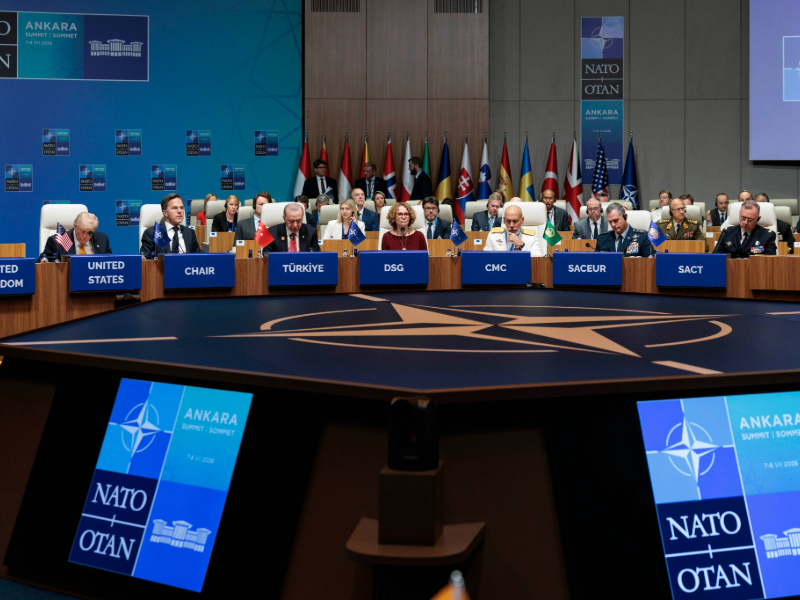
NATO’s relationship with its Indo-Pacific Four (IP4) partners, Australia, Japan, New Zealand and South Korea, now runs mainly through working-level defence industrial cooperation rather than summit diplomacy. This shift began under the joint framework agreed at the 2025 Hague Summit, but it operates as four separate bilateral tracks with no common defence industrial venue. The July 2026 Ankara Summit highlighted this limitation, as all four partners committed to deeper defence industrial cooperation, yet NATO still lacks a mechanism to turn that commitment into joint planning. NATO should close the gap with an annual joint defence industrial session for all four partners, built into the implementation plan for its new industry strategy due in October 2026.
Ankara’s clearest signal came from the IP4’s joint meeting with Secretary General Mark Rutte on July 7. South Korean President Lee Jae Myung was the only IP4 head of state present, marking the second consecutive summit without a full complement of IP4 leaders. More telling than the absences was who attended in their place: Japan sent its foreign and defence ministers, New Zealand its defence minister, and Australia its Minister for Defence Industry, a clear sign that Canberra sees the relationship’s value in industry. In about 30 minutes, participants covered Ukraine, China, North Korea, and Iran, and agreed to build “concrete cooperation” in defence industry, cyber, and technology; however, the read-out records no joint statement, deliverable, or follow-up mechanism. The next day, Allied leaders endorsed a new Strategy for Industry-NATO Cooperation that mentions partners only in passing. Ankara confirmed the IP4’s political commitment to industrial cooperation, but left its delivery to separate bilateral channels.
Working-level progress has done most of the heavy lifting to date. NATO opened its first defence industrial dialogue with South Korea in September 2025 and its first with Japan in October 2025, then ran second rounds of both during a May 2026 visit to Seoul and Tokyo by its Assistant Secretary General for Defence Industry. Australia’s first dialogue followed in April 2026, covering supply chain security, stockpiling, space, and co-development and co-production, building on a 2025 agreement that lets Australia join acquisitions run by NATO’s Support and Procurement Agency. In September 2026, the Chair of NATO’s Military Committee met Japanese and Australian counterparts in Victoria, Canada, at the Indo-Pacific Chiefs of Defence Conference. This momentum reflects growing demand, as the Hague commitment to spend 5% of GDP on defence by 2035 requires more production than European industry can currently supply. At the same time, Russia-North Korea military cooperation, which the partners flagged at Ankara, ties Indo-Pacific security directly to Ukraine. Together, these exchanges show the IP4 moving steadily toward resilience and interoperability with NATO, yet each advance has come through a separate bilateral channel rather than a shared one.
The cost of this fragmentation is clearest where partners’ agendas overlap. South Korea is now the second-largest supplier of arms to NATO’s European members after the United States, almost entirely through bilateral contracts, and Seoul has made it clear that it wants a role as a meaningful NATO partner, not a vendor. Its dialogue with NATO centres on production capacity, munitions and land systems. Meanwhile, Japan’s dialogue with NATO covers a different set of priorities, including uncrewed aerial systems (UAS), supply chains, and standardization, which it also negotiated separately without coordination with IP4 nations. Yet both seek a place in NATO’s multinational projects rather than one-off transactions, and both list supply chain security and space as priorities. In May 2026, NATO’s Assistant Secretary General identified this common agenda with both countries on a single trip, then discussed it in two separate dialogues. NATO has recognized the overlap but has no format to act on it together.
Australia shows what NATO is missing, as it is already an industrial hub within the IP4. South Korea’s Hanwha Group is building its Redback infantry fighting vehicle for the Australian Army in Geelong, and in April 2026 Canberra signed for three upgraded Mogami frigates from Japan’s Mitsubishi Heavy Industries. NATO’s planning does not yet capture any of this cooperation between partners. New Zealand has no industrial track at all; its partnership programme with NATO covers consultations, training, exercises and research, but not industry. As the United States Studies Centre’s Indo-Pacific Security Dialogue findings note, NATO and IP4 defence industrial ecosystems have not been systematically mapped against shared strategic requirements. The result is a “NATO+4” pattern, where each partner negotiates its own priorities with NATO, and no venue exists where all four compare capability gaps and industrial capacity.
Two constraints limit how far coordination can advance. The first is political: NATO’s outreach to the IP4 has advanced partly because it has stayed narrow, avoiding the appearance of a formal bloc that might stretch the Alliance’s North Atlantic mandate or provoke Beijing. France blocked a proposed NATO liaison office in Tokyo in 2023 on these grounds, and the United States Studies Centre’s dialogue found participants divided on whether deeper institutionalization would help the partnership or reduce its flexibility. The second is commercial: IP4 firms compete with one another, as demonstrated when South Korea’s Hanwha Ocean and Hyundai Heavy Industries bid against Mitsubishi Heavy Industries for Australia’s frigate programme before both were eliminated. Because firms that compete for the same contracts have little incentive to share commercially sensitive data, any coordination mechanism must work around that reluctance.
NATO does not need a new institution to close this gap. The implementation plan for NATO’s new industry strategy, due from the Conference of National Armaments Directors in October 2026, is the right vehicle. It should create an annual joint session of the Korean, Japanese and Australian dialogues under the existing Defence Industrial Production Board, with New Zealand included from the outset and the bilateral dialogues continuing alongside it. Kept at the working level and focused on the current agenda of supply chains, standardization, and production capacity, the session would work within both constraints. Politically, it adds no new office or mandate, since IP4 leaders and ministers already meet NATO as a group of four, as they did at Ankara. Commercially, it would focus on shared inputs, such as critical components, munitions and standards, rather than on individual firms contracting and pricing activities. Its output should be the annual map of IP4 industrial capacity against NATO requirements that the United States Studies Centre finds missing. New Zealand’s industrial contribution will be modest, but including it costs little and keeps all four partners moving together. Such an avenue would give the IP4 a way to deliver the commitment to deeper defence industrial cooperation they made together at Ankara.
Disclaimer: Any views or opinions expressed in articles are solely those of the authors and do not necessarily represent the views of the NATO Association of Canada.
Photo: Meeting of the North Atlantic Council (NAC) at the level of Heads of State and Government at the July 2026 NATO Ankara Summit. (Photo: NATO)