In January, U.S. President Donald Trump urged NATO members to lift defence spending from the long-standing 2 per cent goal to 5 per cent of GDP. This was met with sharp criticism in Europe, and NATO officials dismissed the idea as unrealistic. No ally, including the United States, spends anywhere near 5 per cent; only Poland approaches 4 per cent, and many countries are still scrambling to reach the original 2 per cent pledge. Trump’s demand, coupled with his warning that the United States might not defend allies who miss the target, created the sense that this was a hostile bargaining tactic, or a signal of just how far Washington intends to pull back from foreign conflicts, rather than a serious proposal.
However, history shows that when perceptions of threats rise sharply, what was once deemed as ridiculous can become the new baseline. Canada’s chief objective going into the recent NATO summit in The Hague was to drive a consensus that would continue to safeguard national security while preserving strong multilateral partnerships. Ottawa is especially concerned about emerging threat vectors: cyberattacks, coordinated disinformation campaigns, and advanced warfare. Meanwhile, growing uncertainty over the United States’ long-term commitment to NATO has underscored the need to diversify Canada’s defence relationships and balance ties with Washington, European allies, and Indo-Pacific partners, all while grappling with the longstanding challenge of meeting NATO’s defence-spending targets.
Defence had loomed large during the 2025 Canadian federal election amid escalating global conflicts and talk of U.S. retrenchment. Prime Minister Mark Carney promised to hit the NATO benchmark in the current fiscal year, five years ahead of the Trudeau-era target of 2032, by adding roughly $9 billion to the defence budget and boosting total outlays to about $44 billion.
He also made clear that 2 per cent is only a milestone along the way to more ambitious goals. At the NATO summit on 25 June, Carney committed Canada to the alliance’s evolving 5 per cent framework by 2035, earmarking 3.5 per cent for direct military spending and 1.5 per cent for defence-adjacent infrastructure investments and defence-industrial resilience. The plan rests on leveraging Arctic ports, critical minerals projects, and expanded drone production to meet those broader targets.
Prime Minister Carney inherits a defence portfolio weakened under the Trudeau government. From 2015 to 2024, Ottawa spoke of transforming Canada’s military but allowed it to drift. The Strong, Secure and Engaged policy did raise the spending baseline, yet targets were repeatedly missed, personnel goals eroded, procurements lagged, and the promised peace-keeping revival never materialized. These failures convinced allies that Canada was not serious, feeding the narrative that the country is a “free rider.”
Canada must now honour two defence-spending commitments, one due by March 2026 and another by 2035. This presents an opportunity to reverse the free-rider narrative through action. If Ottawa meets both targets, Canada’s diplomatic standing will rise, potentially paving the way for greater strategic autonomy from the United States.
For any ambitious policy to work, solid infrastructure is essential. In education, raising student achievement requires enough schools, qualified teachers, and reliable meal programs; these are the “cogs” that keep the system turning. Defence spending is similar. To reach the 2 per cent target, and eventually 5 per cent, Canada needs strong economic capacity. The government has begun lowering barriers to interprovincial trade, diversifying defence suppliers, and advancing the One Economy Bill, but major hurdles remain: limited fiscal room, slow procurement, a shortfall of 16,000 personnel, political reluctance, and outdated technology. If Ottawa fails to tackle these issues, military readiness will slip, and national security will weaken. Success, on the other hand, would strengthen NATO, bolster Arctic sovereignty, and spur advanced manufacturing at home.
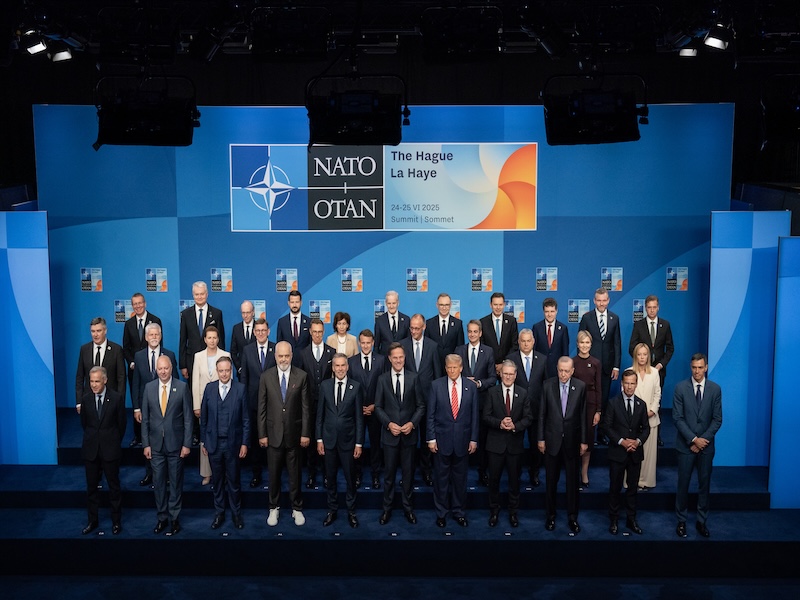
Photo: World leaders pose for the official family photo at the NATO Summit in The Hague (2025), Bart Maat via Ministerie van Buitenlandse Zaken. Photo courtesy of the Ministry of Foreign Affairs of the Netherlands. Licensed under Creative Commons Attribution-ShareAlike 4.0 International (CC BY-SA 4.0).
Disclaimer: Any views or opinions expressed in articles are solely those of the authors and do not necessarily represent the views of the NATO Association of Canada.