“Wouldn’t you do that if you were me?” replied U.S. President Donald Trump in early April when asked if he was considering withdrawing from NATO as retaliation for the alliance’s unwillingness to become embroiled in the Iranian War. These comments mark the latest development in the ongoing tensions between Washington and Brussels, as President Trump continues to misunderstand the function of the alliance and forget that its coveted Article 5 was only ever invoked in response to the attacks of September 11th, 2001. While President Trump’s threats have drawn much public attention and generated discourse over the future of NATO, there is another, less-broadcasted threat to the long-term stability of the alliance.
The rise of far-right populist movements in Europe presents a pacing threat to NATO’s model of consensus, specifically as these ideologies prioritize individual interests over those of a collective. Moreover, there has been democratic backsliding amongst member states such as Turkey and Slovakia, which is not only antithetical to the alliance’s founding principles but increasingly presents strategic vulnerability. For Canada, a country looking-in on this phenomenon, the predictability of NATO is a key aspect of its security calculation. This article presents a risk-based assessment of the far-right movement in France to understand the impact of this threat on alliance stability.
With its presidential election taking place next year, France faces a potentially significant change in government as the populist-right steadily builds momentum in the polls. The Rassemblement National (RN), championed by the controversial Marine Le Pen, is currently favoured to win the 2027 elections, casting an imposing shadow over NATO and its status quo. During her 2022 electoral campaign, Le Pen published 17 policy briefings on critical issues, 16 of which are currently available on the RN website. The unavailable policy paper, on defence, asserted that France would withdraw from NATO’s integrated military command to ensure greater sovereignty over decision-making, and further advocated for a restoration of relations between Russia and the West.
While this document was quietly removed from the Party’s website, this decision appears to reflect political calculation rather than any genuine ideological shift on the part of Le Pen or her protégé, the current RN President, Jordan Bardella. In recent years, both have adopted a more critical tone toward Putin and Russia’s invasion of Ukraine – a shift mirrored across much of Europe’s right-wing landscape after the 2022 full-scale invasion made overt proximity to the Kremlin politically costly. Despite this rhetorical repositioning, Bardella and Le Pen have sought to project a “hard on Russia” stance while continuing to contrast themselves with Emmanuel Macron. For instance, Bardella stated in 2024 that Ukraine must be able to defend itself and yet the RN has continuously voted against aid-packages and the provision of arms, while refusing to approve legislation that would limit French reliance on Russian energy.
The magnitude of impact that an RN victory would have on NATO is dependent on Marine Le Pen’s current legal battle with the French judiciary, which last year found her guilty of corruption and imposed a five-year ban on holding public office. This ruling, which Le Pen called a “political death sentence”, is currently in the appeal process with a final decision expected to be announced this summer. An unsuccessful appeal would render Le Pen ineligible for the 2027 Presidential election and would see Mr. Bardella as the candidate for the Rassemblement National, posing less of a risk to the cohesion of NATO. Bardella does not share the same level of skepticism as his predecessor when it comes to the North Atlantic Alliance and has acknowledged the necessity of a strong Europe that can repel the threat of Russia. Le Pen on the other hand prefers a Gaullist approach, viewing NATO through a pessimistic, zero-sum lens while underscoring the necessity of détente with the Russian Federation.
Le Pen’s more hardline view on European and trans-Atlantic security has a complementary effect on Bardella, making his stance on NATO and Ukraine seem much more digestible in comparison. It is important to note, however, that an RN victory would add a significant layer of complexity to the already difficult job of NATO’s Secretary General Mark Rutte. In a recent article, former NATO spokesperson Oana Lungescu provided valuable insight into the core function of the Secretary General, which is ultimately to preserve the alliance. In the context of Donald Trump’s second term, this has been a very hands-on task for the former Prime Minister of the Netherlands, with reports saying he speaks to Trump “multiple times a day”. There has been increased criticism amongst European officials, notably the French, over Rutte’s strategy of public praise for the US as a means of maintaining private channels to solve issues. If the job of Secretary General continues to require a one-dimensional focus on the appeasement of Washington, the rise of similarly contentious leaders in Europe will create a two-front challenge to alliance stability, that risks fracturing consensus and diluting commitments.
Despite Jordan Bardella’s modernized outlook on European security, the homogeneity of senior RN leadership on the issue is unclear. A senior French defence official told POLITICO that there is an ideological split in the party, with many remaining pro-Russian but understanding the electoral implications of this support. In the event of an RN victory in 2027, it is difficult to delineate the true beliefs of the party from its electoral facade, which may very well become disenchanted by a NATO apparatus devoted to American appeasement. Moreover, the economic backlash caused by a hawkish United States has the ability to make multilateral engagement appear costly and sacrificial, especially to a rightward populist movement based upon pragmatism and prioritized interests.
In this sense, while the stability of NATO seems to be dependent on the United States, there is an increasingly popular ideology in Europe that may have a similarly damaging effect. The efficacy of NATO’s deterrence lies in the minds of its adversaries, and increased friction amongst its core allies is likely to undermine the alliance’s perceived efficacy. The unpredictability of NATO’s coming threats requires predictability amongst its members, something that an RN victory would undermine. This is because the RN itself is inherently unpredictable, as the split between Le Pen and Bardella foresees very different versions of France and NATO. Ultimately, the influence of another disruptor within the alliance is strategically worrisome and makes the achievement of consensus, and the projective strength of deterrence elusive.
From the Canadian strategic perspective, the popularity of far-right movements amongst NATO allies is concerning, and the implications of parties like the RN’s electoral success are worth considering, especially as they diverge from Canadian interests. On Ukraine, for instance, Canada and France have been key allies in the pursuit of a lasting peace, yet an RN victory has the ability to harm this process – ultimately undermining a Canadian foreign policy objective that is anchored in a large Ukrainian diaspora. With significant political change among key defence allies, Ottawa must not find itself flat-footed to a changing equation that sees even its most willing allies become skeptical and self-interested.
While NATO’s adaptability remains a core strength, this uncertainty places a greater premium on leadership from stable and committed leaders. Canada has taken strong steps to increase its role in the alliance and deepen partnerships with like-minded allies, particularly in the Nordic region. In the face of growing internal divergence, Ottawa should further position itself as a consistent and reliable actor within NATO, both to reinforce collective defence and to help sustain allied cohesion on critical priorities such as Ukraine. In doing so, Canada can mitigate the risks posed by shifting political currents within the alliance and ensure that short-term electoral change does not undermine long-term strategic objectives.
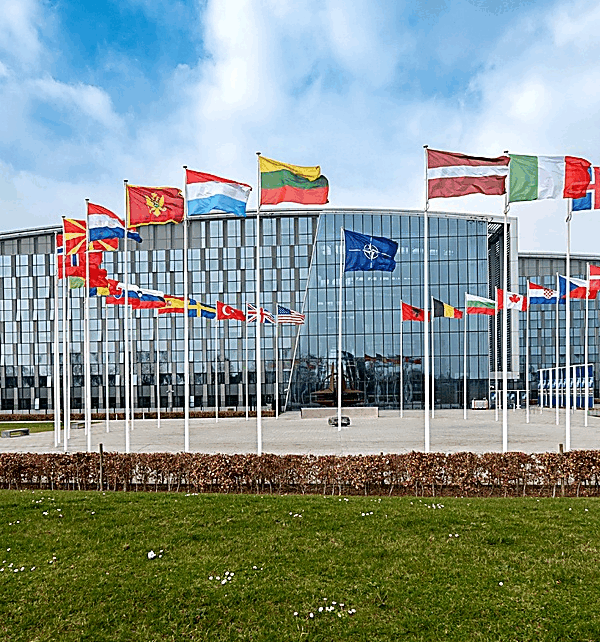
Photo Credits: https://commons.wikimedia.org/wiki/File:New_HQ_NATO_2.jpg
Disclaimer: Any views or opinions expressed in articles are solely those of the authors and do not necessarily represent the views of the NATO Association of Canada.