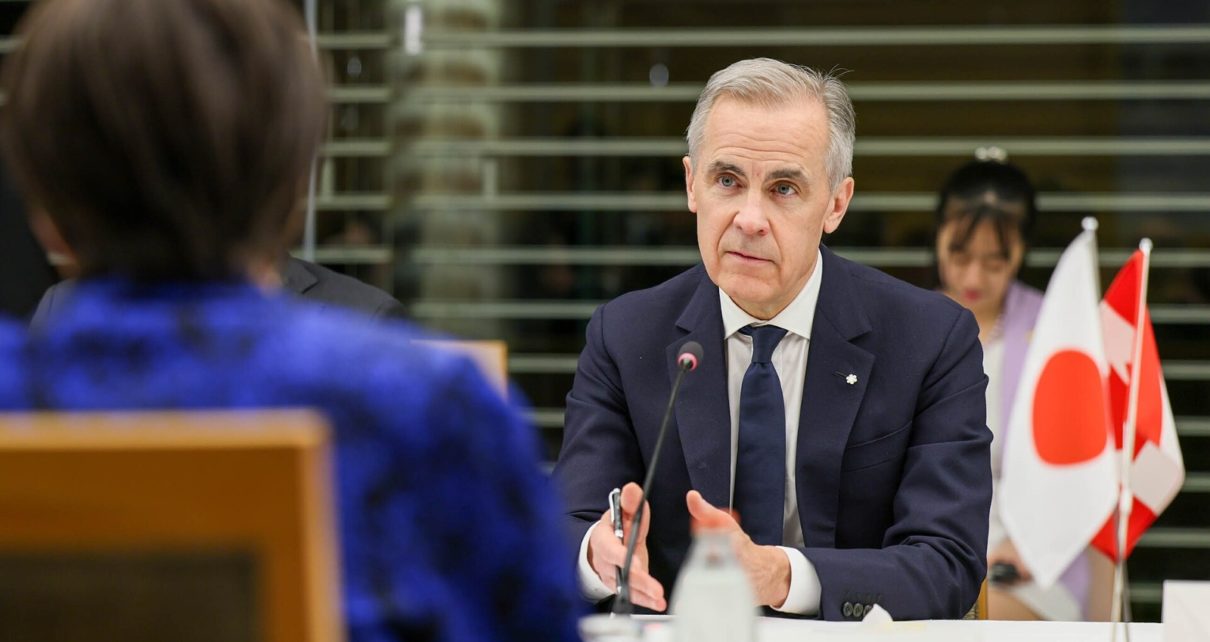
On March 6, 2026, Prime Minister Mark Carney stood beside Japanese Prime Minister Takaichi Sanae in Tokyo and signed a Comprehensive Strategic Partnership. Take just a glance at the press release and it is easy to see just how “comprehensive” it is; the agreement makes mention of everything from joint naval operations, to increasing clean energy cooperation and lowering carbon emissions, to expanding commercial and investment opportunities. A few years ago, each issue would have required separate negotiations and produced separate agreements, but in 2026 they’re all collaborated on at once — a testament to the new reality that Canada, and its allies, can no longer meaningfully treat them as separate from each other.
Earlier this month, Kaya Dupuis argued that Carney’s Davos speech exposed a gap in NATO’s mandate: Article 5 was not designed to protect allies from non-military threats. As economic integration and globalization have become integral for allies and adversaries alike over the past eighty years, what constitutes a threatening or coercive act has become harder to define. A tariff regime is not an act of war, a supply-chain cut-off is not an invasion, and aggressive use of investment screening, export controls, sanctions, or discriminatory procurement can all be defended as industrial policy, even when they are coercive. For instance, when Lithuania let a “Taiwan Representative Office” open in Vilnius in 2021, China did not threaten force. Instead, it quietly erased Lithuania from its customs system so that goods could no longer be cleared, rejected Lithuanian import paperwork, and banned products like beef and dairy on apparent sanitary grounds — leading the total value of exports to China to collapse almost entirely within a month.
This gap has not gone unnoticed within the Alliance, with former NATO Secretary-General Anders Fogh Rasmussen even calling for a new “Economic Article 5” to cover what the original treaty did not anticipate. In the meantime, NATO member states have developed their own responses. Canada’s answer has been to increasingly blur the line between economic and defence policy, and is using trade agreements as instruments for security.
Trade Doing Defence Work
Canada’s nascent strategy is to address economic threats with economic defence. In the nine years before Carney became Prime Minister, Canada concluded roughly three formal Comprehensive Strategic Partnerships or equivalent frameworks — with the European Union in 2016, South Korea in 2022, and ASEAN in 2023 — at an average of one every three years. In Carney’s first year in office, Canada has signed or elevated at least twenty economic and security deals over the last year. In each, Canada is aiming to build reciprocal supply-chain dependence, since a partner who needs what you produce is a partner with whom coercion is mutually costly.
This shift in strategy is reflected in agreement structure and language. The Canada-Japan partnership is organized around six priority areas, in this order: enhanced security and defence cooperation; economic security, supply chains, and technological resilience; trade and investment; energy and food security; Arctic, environment, and climate cooperation; and people-to-people, academic, and cultural exchanges. Earlier Canadian agreements did not share these defining features. Where security was mentioned in prior, commercially focused,deals, it typically appeared either as a national-security exception — a legal carve-out for each party to depart from its obligations on security grounds — or it was handled separatelyfrom commercial matters. The 2016 Strategic Partnership Agreement (SPA) with the EU, which was signed alongside the Canada-European Union Comprehensive Economic and Trade Agreement (CETA), is an example of the latter. Although CETA and the Canada-EU SPA emerged in approximately the same time period, the SPA is an independent agreement built largely around political dialogue rather than serving as a direct commitment to defence cooperation. However, the Canada-Japan partnership prioritises security alongside economic cooperation, and it names it first. The opening commitment is to deepen joint exercises and increasingly complex engagements between the Canadian Armed Forces and the Japan Self-Defense Forces, building on the Acquisition and Cross-Servicing Agreement, the Security of Information Agreement, and the Defence Equipment and Technology Transfer Agreement. The second is the establishment of a new bilateral Economic Security Dialogue, with the initial meeting this year, and so on.
Canada and Japan also signed three Memorandums of Cooperation on international emergency responses alongside commitments to industrial research and battery supply chains. The agreement commits both countries to modernizing the fifty-year-old Canada-Japan Joint Economic Committee around industries such as semiconductors, AI, and clean energy. Defence-industrial collaboration is named explicitly for frontier technologies, and critical minerals appear at every level of production from extraction and refining through to defence-industrial inputs.
Read in isolation, any one of those clauses appears unremarkable. But by bundling economic and defence policy they become interoperable. The trade clauses are written to do defence work in aiming to secure supply chains that defence-industrial bases depend on and looking to build reciprocal investment relationships that raise the cost of coercion for any third party. The defence clauses are written to promote commerce by opening procurement markets and attracting investment into Canadian defence-industrial capacity. Critical minerals sit at the centre of that structure. Abundant Canadian deposits of nickel, copper, cobalt, lithium, graphite, and rare earth minerals are the inputs every serious defence-industrial base now requires. The Canada-Japan partnership signed in Tokyo explicitly commits both governments to working more closely on critical minerals to secure reliable supplies.
This logic has also been applied with economic partners that may not be as politically aligned. Take Canada’s relationship with India for example. India is an economic partner that stands outside the Western bloc and has levied tariffs on Canadian goods that presently range from single-digit rates on most goods to triple-digit barriers on automobiles. While the Terms of Reference signed on March 2, 2026 may not eliminate those tariffs, it does commit both governments to negotiate them down and targets signing a full Comprehensive Economic Partnership Agreement by the end of the year. Bundling market access, energy, and defence into a single framework creates the conditions for interdependence — and, if those ties deepen over time, raises the cost of coercion on either side. So, while a $2.6 billion uranium contract between Saskatchewan’s Cameco and India’s Department of Atomic Energy (which was announced the same day) is not itself a traditional security tool, it signals the intent to build deeper bilateral economic ties in sectors of long-term strategic relevance.
However, a central question to this strategy is whether Canada can deliver on what these partnerships presuppose. By design, the agreements are forward-looking in their focus on building capacity where it is lacking, rather than to exporting existing capability. Whether the government’s efforts to alleviate the consequences of a burdensome regulatory environment will be sufficient to induce adequate investment is the fundamental test. For instance, despite holding large deposits, Canada supplies only about two per cent of global critical minerals output, while China controls roughly seventy per cent of refining capacity for nineteen of the twenty most critical minerals. In March 2026, witnesses before the House Standing Committee on National Defence told MPs that “the real strategic vulnerability today is not our geology — it is our processing capacity and supply chain dependence,” with Canadian minerals routinely shipped abroad for refining before re-entering domestic supply chains as finished inputs. The defence-industrial picture is similar in scale. As of 2022, Canada’s entire defence sector generated roughly $14.3 billion in revenue, and in 2025 just forty-five per cent of the Royal Canadian Navy’s fleet was available for use, with the air force and army at forty-nine percent. The Atlantic Council’s December 2025 assessment bluntly stated that, in its current state, Canada’s defence industrial base “will struggle to deliver” on its Hague commitment to spend five percent of GDP on defense by 2035. Carney’s February 2026 Defence Industrial Strategy and the new Defence Investment Agency are designed to close those gaps, but strategy documents do not, on their own, build refineries, shipyards, or skilled workforces. The empirical question is whether the diplomatic commitments are running ahead of the industrial base they are written against, and whether the agreements signed this year can be backed by Canadian capacity by the time partners expect delivery.
In all, the bundling of economic and security agreements reflects the changing international political conditions that have led to greater linkage between these respective concerns. Whether NATO as an institution can incorporate this shift is a separate question, but Canada has not waited for consensus to act. New agreements over the past nine months may provide substantial commercial benefit, but they are not a diversification strategy of a purelycommercial nature. Instead, they reflect a fundamental shift in Canadian foreign policy aimed at strengthening both Canada’s national security through defence-industrial capacity, and its economic security through more durable commercial partnerships and supply chains.
Photo: Japan-Canada Summit Meeting, Government of Japan. Licensed under CC BY 4.0.
Disclaimer: Any views or opinions expressed in articles are solely those of the authors and do not necessarily represent the views of the NATO Association of Canada.