Daria Synelnykova Previous Events

Charting Ukraine’s Pathway Toward a Just Peace with Canada & NATO Allies – Panel Report

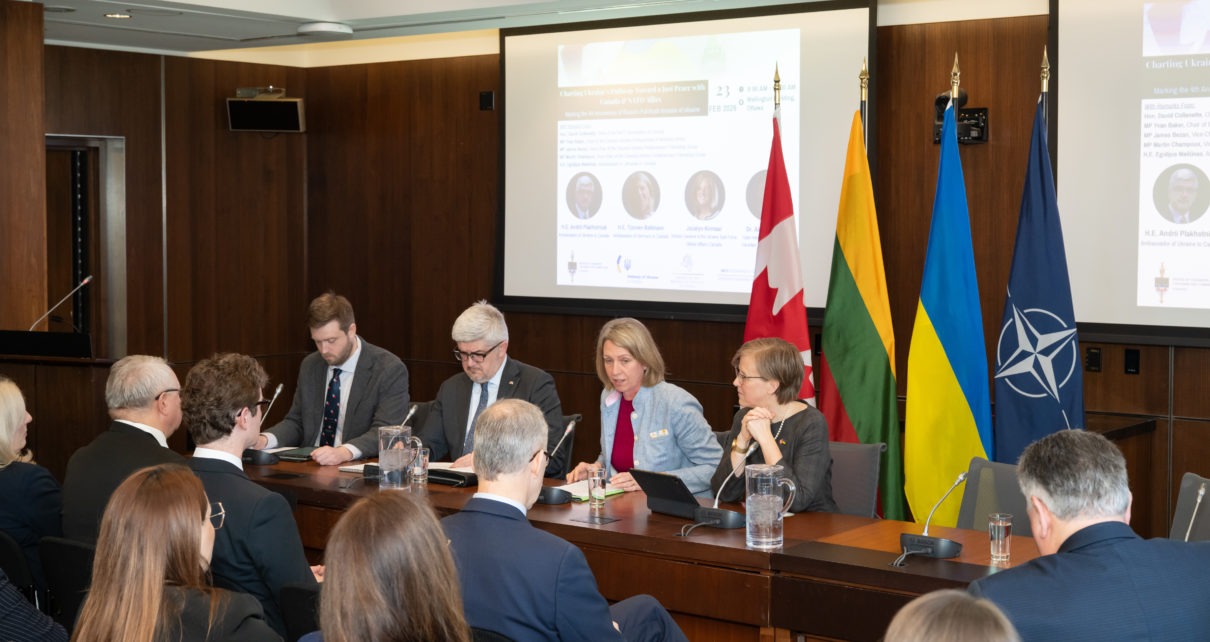
On February 23, 2026, the NATO Association of Canada (NAOC), in partnership with the Canada-Ukraine Parliamentary Friendship Group and the Embassies of Ukraine and Lithuania in Canada, organized a panel discussion entitled “Charting Ukraine’s Pathway Toward a Just Peace with Canada & NATO Allies”. The event was dedicated to commemorating the 4th anniversary of the full-scale invasion of Ukraine, which Russia launched on February 24, 2022. The panel took place in the Wellington Building in Ottawa. It brought together more than 150 senior government representatives, policymakers, defence leaders, politicians, diplomats, and members of the diaspora who reaffirmed their solidarity with Ukraine and discussed how to chart a sustainable and just path for the country’s post-war reconstruction. 

The event commenced with opening comments from the NAOC Chief of Staff, Bogdana Torbina, who reiterated the illegal, unjustified, and unprovoked nature of the Russian invasion of Ukraine. A seemingly straightforward truth – yet one that requires reminder four years into the ongoing conflict. The audience also heard from the former Minister of National Defence and current Chair of the NATO Association of Canada, Hon. David Collenette. Mr. Collenette acknowledged Canada’s success in maintaining strong support of Ukraine’s fight against Russian aggression across the political spectrum. Assistance to Ukraine supersedes ideological divides and represents the struggle for freedom, liberty, and democracy – values shared by all Canadians and other members of the NATO alliance. Mr. Collenette reminded the audience that the inviolability of these values will be threatened far beyond Ukraine’s borders if the country does not emerge victorious – a key message that was later reiterated by many speakers. 

Next, the audience heard from MP Yvan Baker, Chair of the Canada-Ukraine Parliamentary Friendship Group. Mr. Baker concurred with Mr. Collenette that Russia will not stop at Ukraine if it is allowed to win the war. Ukraine must take back all of its territory, while Russia must be brought to justice for the war crimes it continues committing. The path to a just and sustainable peace in Ukraine lies through providing Ukraine with the military support it needs to win on the battlefield. Just peace cannot be negotiated from the position of military weakness. MP James Bezane, Vice-Chair of the Canada-Ukraine Parliamentary Friendship Group, concurred with Mr. Baker’s statements. He asserted that while Canada and Allies should certainly continue praying for peace in Ukraine, we must also have a clear strategy to ensure Ukraine’s military victory. Mr. Bezan pointed to the astonishing resilience of both Ukrainian civilians and the Armed Forces. He highlighted unprecedented successes and the ingenuity of Ukrainian military operations, exemplified through the destruction of the Russian Black Sea Fleet with Ukrainian drones. Following Mr. Bezan, MP Martin Champoux, Vice-Chair of the Canada-Ukraine Parliamentary Friendship Group, provided his remarks in French. He reiterated that Canada must stand firm with Ukraine’s resistance to Russian brutal attacks by providing adequate humanitarian, military, and economic support. Hearing from MPs from across the political spectrum demonstrated Canada’s strong cross-party support for Ukraine and underscored the importance of unity in resisting Russian aggression.

Ambassador of Lithuania to Canada, His Excellency Egidijus Meilūnas, provided perhaps the most sobering remarks of the morning. Echoing previous speakers who all condemned the ongoing Russian war crimes and especially the continued targeting of civilians in Ukraine, he called on the audience to acknowledge a clear fact – Russia demonstrates no interest in making peace with Ukraine. Russia did not attack Ukraine out of fear of NATO expansion. The invasion was the result of Russia’s inherently imperialist mindset, reinforced by the impunity the country historically faced for acts of illegal aggression outside its borders. Ambassador Meilūnas highlighted the persistent warnings from NATO military and intelligence officials that this lack of accountability poses a very real risk of Russian encroachment upon NATO territory. The NATO alliance must reflect on its past mistakes and prevent such an outcome. It must strengthen sanctions on Russia and deepen the country’s international isolation, while helping Ukraine restore its borders and ensure Ukraine’s accession to the EU and NATO.

The morning panel of the event was moderated by Dr. Alexander Salt, Triple Helix Postdoctoral Fellow at the Canadian Global Affairs Institute. The discussion featured three panelists: His Excellency Andrii Plakhotniuk, Ambassador of Ukraine to Canada; Her Excellency Tjorven Bellmann, Ambassador of Germany to Canada; and Ms. Jocelyn Kinnear, Director General of the Ukraine Task Force at Global Affairs Canada. Much like during the introductory remarks, the speakers acknowledged the immense resilience of Ukrainians in the face of Russian brutal aggression. Here, Ms. Jocelyn Kinnear underscored that resilience does not imply Ukrainians should be expected to survive whatever catastrophic circumstances they face. Ukraine has learned to live under constant Russian attacks on civilians, with no electricity or heating during harsh winters, all while sustaining over 1,000 kilometers of active frontline. However, endurance should not be interpreted as infinite invulnerability. Ukraine requires sustained support from Canada and its other Allies. 

All panelists agreed that unity is critical in the allied response to the conflict. Ambassador Bellmann underscored the difficulties of achieving unanimity on certain issues within the European Union (EU). She cited a recent example of the EU’s inability to decide on seizing Russian assets and directing them toward financing Ukraine’s war effort. Ambassador Bellmann, however, noted that the EU members concurred to extend a permanent freeze on these assets. She reassured the audience that Germany will continue lobbying for the seizure of Russian funds and similar resolute measures until coming to terms with just peace becomes the only viable economic and military option for Russia. All panelists agreed that Ukraine’s allies must provide the country with strong collective security guarantees as well as establish binding bilateral security treaties. They must also ensure that Ukraine’s voice is loud and clear at the negotiating table. Sustainable peace can only be achieved if it follows the principle “nothing about Ukraine, without Ukraine.”

The conversation on seizing Russian frozen assets naturally segued into discussing Ukraine’s post-war reconstruction – a lengthy and costly process given the scale of the damage inflicted daily on Ukraine. Here, Ambassador Plakhotniuk argued that economic cooperation with Ukraine must not be postponed until the war is over. He cited Ukraine’s vibrant technological defence business ecosystem as a productive area for immediate investment. Ukraine is at the forefront of developing and manufacturing emerging defence technologies, and NATO allies have much to learn from this space. Despite the war, Ukraine is also rapidly undergoing institutional and anti-corruption reform to meet the NATO and EU standards – a process that characterizes Ukraine as an already reliable partner for business. Ms. Kinnear agreed with Ambassador Plakhotniuk’s statements by drawing on Canada’s recent efforts to build a favorable investment environment in Ukraine, which can flourish both during the war and upon Ukraine’s victory. 

Bringing the event to its end, in his concluding remarks, Mr. Collenette agreed with the need to take Ukraine’s reconstruction seriously. NATO must plan for the post-war recovery now. While Russia will bear a vast burden in rebuilding Ukraine, the sheer scale of destruction will also require a firm financial commitment from all Western allies.

Author

  • Daria is a Program Editor Team Lead at the NATO Association of Canada. She coordinates the work of the publications team, which consists of senior editors, program editors, and junior research fellows. Daria initially joined NAOC as a Junior Research Fellow under the Security, Trade, and Economy program.Outside of NAOC, Daria is a Presidential Fellow at the Center for the Study of Presidency and Congress (CSPC), a Washington D.C.-based think tank. There, she conducts research on U.S. foreign policy, focusing on the American response to the Russian invasion of Ukraine.Daria is a third-year Lester B. Pearson Scholar at the University of Toronto, studying International Relations and Peace, Conflict and Justice. Previously, she served as a global health research assistant at the Factor-Inwentash Faculty of Social Work and interned with the United Nations Special Rapporteur on the human rights of internally displaced persons.

    View all posts
Daria Synelnykova
Daria is a Program Editor Team Lead at the NATO Association of Canada. She coordinates the work of the publications team, which consists of senior editors, program editors, and junior research fellows. Daria initially joined NAOC as a Junior Research Fellow under the Security, Trade, and Economy program.Outside of NAOC, Daria is a Presidential Fellow at the Center for the Study of Presidency and Congress (CSPC), a Washington D.C.-based think tank. There, she conducts research on U.S. foreign policy, focusing on the American response to the Russian invasion of Ukraine.Daria is a third-year Lester B. Pearson Scholar at the University of Toronto, studying International Relations and Peace, Conflict and Justice. Previously, she served as a global health research assistant at the Factor-Inwentash Faculty of Social Work and interned with the United Nations Special Rapporteur on the human rights of internally displaced persons.