By Anastasia Crook
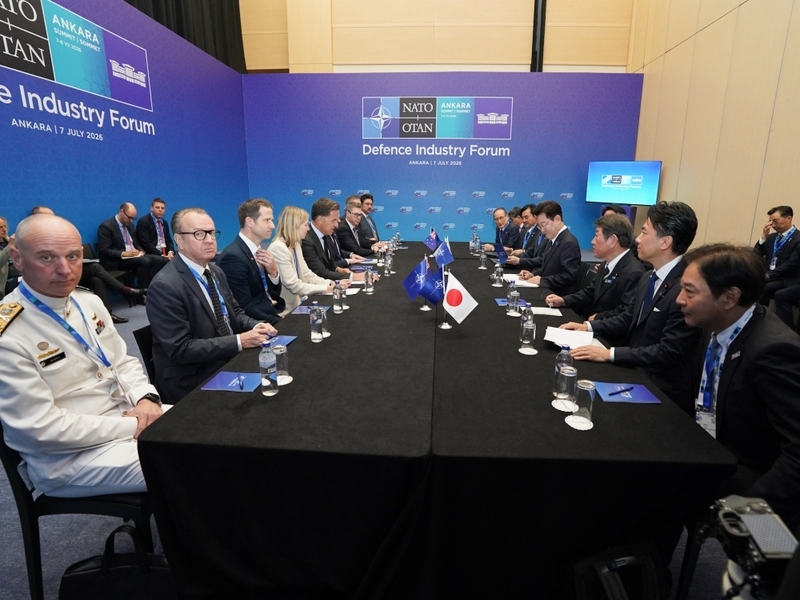
On July 7, 2026, NATO Secretary General Mark Rutte met with representatives of the IP4 (Japan, South Korea, Australia, and New Zealand) during the alliance’s Ankara summit, which brings together heads of state and government from all 32 member nations for geopolitical and military decisions. The IP4 are not NATO members, but have held guest status at NATO’s annual summits since 2022. IP4 members are also invited to side conferences such as this year’s NATO Summit Defence Industry Forum, the thirty minute meeting in Ankara covering Ukraine, China, North Korea, and Iran. This NATO-IP4 relationship allows European allies to engage in the Indo-Pacific without formalising a global NATO role. Asia is evidently a growing collaborator to NATO, but scepticism of “selective engagement” arose in the absence of IP4 leaders at the NATO’s 2025 Summit in The Hague, alongside reports of US reluctance to formalise the IP4 role at the Ankara Summit. NATO’s Indo-Pacific engagement, in other words, is being extended carefully and selectively, even toward partners it has already invited into the room; this caution becomes more consequential once Taiwan enters the picture.
The war in Ukraine, and growing tension across the Taiwan Strait, has made the connection between Taiwan’s security and Europe’s own harder to ignore. NATO’s 2025 Allied Cooperation in the Indo-Pacific recognises their IP4 allies’ and alliance members’ own security stakes; it states plainly that a Chinese use of force against Taiwan would carry direct economic and security consequences for Europe itself. And yet, for an island named so explicitly in its Asian affairs, Taiwan has never been part of the conversation happening about it. The exclusion comes from how NATO itself is built institutionally, this is not a matter of geography, nor of Asian nations being unable to take a seat at NATO’s table, given that the IP4 are invited as guests. Many member states maintain substantial trade relationships with the island and share its commitment to democratic government, an alignment that, on paper, resembles the basis for NATO’s relationship with the IP4 countries. Individual lawmakers have visited Taipei on their own initiative, recently including Canadian MP Michael Chong in May and former Finnish Prime Minister Sanna Marin in August, among several others.
NATO’s Individually Tailored Partnership Programmes allows the IP4 to attend summits and cooperate on cyber defense and infrastructure security, however, these programs are open only to recognized states. Taiwan’s diplomatic status is disputed by most of NATO’s 32 members, who maintain some version of a One China policy recognizing Beijing rather than Taipei. As NATO can only act collectively when all 32 members agree, the most cautious members on China policy, notably France and Germany given their economic ties to Beijing, sets the limit on the alliance’s approach. NATO’s joint statements on China have stayed limited to broad language of “systemic challenge”, noting the country is presenting challenges to the rules-based international order. At Ankara, Rutte reaffirmed NATO’s founding principle that “an attack on one member is an attack on all,” the IP4 were in the room to discuss concerns about the region directly, specifically on China, North Korea and Iran. Meanwhile Taiwan, the island where NATO’s analysts have linked to European security, was not.
What has filled the NATO-Taiwan gap has been individual choices made by member states, yet Canada has shown how unreliable it can be. After eleven transits of the Taiwan Strait between 2018 and early 2025, Canadian warships did not cross again until May 2026, when HMCS Charlottetown made the passage just days before a visit to Ottawa by China’s foreign minister, despite a warning from Beijing that the transit would damage the two countries’ improving relationship. This way of bilateral gesture to reach Taiwan fails as a stand in for a collective NATO position. Historically, NATO’s silence on Taiwan was low cost because Taiwan’s security operated in the shadow of American security guarantees. NATO-Tawiwan security also operated alongside that guarantee. With President Trump describing a pending fourteen billion dollar arms package for Taiwan as a “very good negotiating chip,” that guarantee is looking less certain. This marks a departure from decades of American policy that treated Taiwan’s defence support as separate from broader negotiations with Beijing, and it means NATO can no longer treat Taiwan’s security as Washington’s responsibility alone.
Given the gap between Taiwan’s contested diplomatic status and its substantive ties to NATO members, technical cooperation and creating a parliamentary channel stands out as realistic options for the alliance to pursue. As technical cooperation does not require recognized statehood or a decision from the full alliance, individual member states could extend it to Taiwan through the same informal channels they already use for quiet defense cooperation with Taipei. Extending this cooperation would look similar to NATO’s offers to the IP4: covering cyber defence, resilience against disinformation, and protection of critical infrastructure, to Taiwan on a bilateral basis.
Establishing a formal channel between the NATO Parliamentary Assembly and Taiwan’s Legislative Yuan is another strong option. The Parliamentary Assembly (PA) operates independently of the North Atlantic Council and reaches its own decisions by majority vote among elected representatives, rather than by government level consensus. In the past, the PA has been able to build formal relationships with non-member states in contested circumstances before, including the Ukraine-NATO Interparliamentary Council, created in 2002, and the Georgia-NATO Interparliamentary Council, created in 2009 following the 2008 Russia-Georgia conflict.
Currently, engagement depends on which lawmaker decides to visit Taipei, as with Chong’s trip. A standing parliamentary body would institutionalize that engagement instead of leaving it to whoever happens to be motivated at a given moment, formalizing exchanges and opening a channel for the kind of expertise both sides increasingly need to share, particularly on disinformation and cyber intrusions, without requiring agreement from all thirty-two member governments. Both options are worth pursuing now, while NATO has already stated, in writing, that Taiwan’s economic and security fate is tied to Europe’s own.
Disclaimer: Any views or opinions expressed in articles are solely those of the authors and do not necessarily represent the views of the NATO Association of Canada.
Image Credit: Meeting between NATO Secretary General Rutte and Indo-Pacific Partners in Ankara, Turkey, July 7, 2026. Photo by the Ministry of Foreign Affairs of Japan. Accessed via the Ministry of Foreign Affairs of Japan website. Accessed August 10, 2026. Public Data License (Version 1.0)

