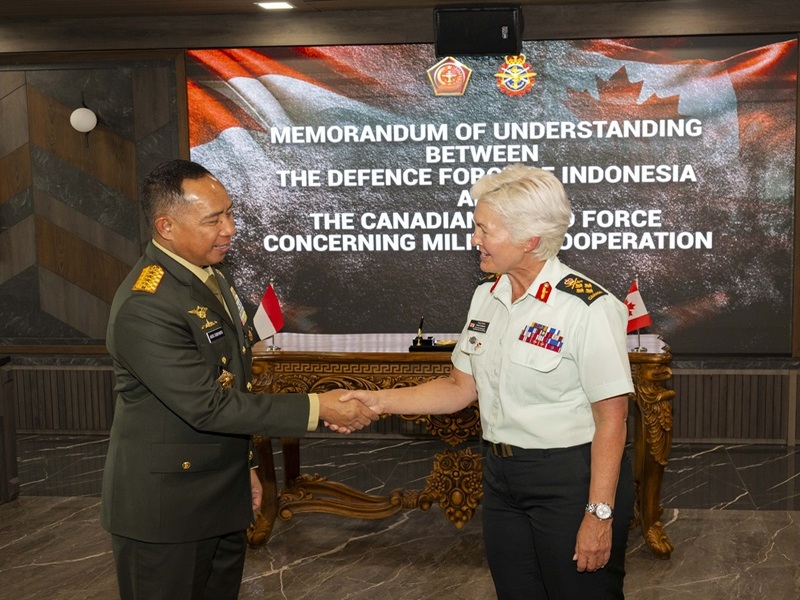
In August 2025, Canada formalized its defence relationship with Indonesia through the signing of a Military Cooperation Memorandum of Understanding (MoU) between the two countries. The agreement entails “structured collaboration in joint exercises, maritime security, capacity-building, and professional exchanges”. As fellow Pacific nations, Canada and Indonesia share common interests in formally committing to enhanced maritime security.
Historically, Canada-Indonesia relations have been sporadic. While Canada was one of the first countries to recognize Indonesia’s independence in 1949, Ottawa’s awareness of the strategic importance of the archipelago has evolved more slowly than might have been warranted by Indonesia’s weight as a regional and global actor. Until 2010, Canada was only occasionally focused on its bilateral relationship with Indonesia – it was a more passive ally in the eyes of Jakarta in comparison to its politically assertive neighbour, the U.S. Only after the economic crisis of 2008 and after Indonesia underwent democratic and economic reform amidst its elections in 2009 did Canada upscale its relationship with Indonesia. Indonesia’s reform marked its upward trajectory as an upper-middle-income and newly industrialized country. More recently, in 2024, Indonesia became Canada’s largest export market in Southeast Asia and a significant investment destination. Indonesia now possesses the largest economy in Southeast Asia, with growing opportunities for Canadian exporters and investors.
Recognizing this growth, Canada has moved from passive observation to active partnership with Indonesia, pursuing formal agreements that advance shared priorities in trade, investment, and defence. Concretely, the Canadian and Indonesian Governments signed three MoUs – one for trade, business, and defence, respectively – between the two countries. The first MoU is the Indonesia-Canada Comprehensive Economic Partnership Agreement (ICA-CEPA), which provides legal certainty for the expansion of market access for both nations. The second MoU is for bilateral cooperation in Commerce, Trade, and Investment, and sets out to promote intensified economic cooperation between both nations through the ICA-CEPA. Lastly, the third MoU on cooperative defence was signed by both nations’ defence ministers, and will cover Canada’s participation in the Super Garuda Shield joint military exercises, the implementation of regular defence dialogues, and a long-term relationship defined by the collective strengthening of their military industries. Indonesian President Prabowo further stated his expectation to specifically strengthen defence collaboration with Canada by sending Indonesian youth to Canada for learning and training.
From Indonesia’s perspective, taking a first step to formally collaborate with Canada signals intent and a willingness to exchange and mutually foster resilience against traditional and hybrid threats, especially in consideration of the fact that military expansion has been a major policy priority under President Prabowo’s rule since August 2025. For Canada, fostering defence ties with Indonesia anchors its first regional defence strategy with a highly strategic partner. Indonesia is often considered the de facto anchor of ASEAN, and a pivotal swing state in the competition of great powers (i.e, China and the U.S.). As an archipelagic nation that controls critical maritime shipping lanes, a rising upper-middle-income economy, and a key supplier of critical minerals, Indonesia is strategically and economically important for any potential ally. Operating bilaterally with Indonesia gives Canada access to strategic defence opportunities that would otherwise be out of reach.
By securing ties with a key Indo-Pacific partner and leading member of ASEAN, Canada can work with Indonesia to uphold the international legal order whilst ensuring security across both nations through mutually increased military investment and enhanced maritime domain awareness. Canada and Indonesia can collaboratively uphold peace and stability against threats of terrorism and Islamist extremism – a prevalent issue faced by both nations. More broadly, this strategy advances Canada’s goal of strengthening security presence in Southeast Asia, becoming integrated into the region’s evolving security networks, and increasing its presence within the region to leverage the economic benefits that come from its partnerships. Furthermore, the MoU between Indonesia and Canada fits within the framework of the Indo-Pacific Strategy, released in November 2022, which is Canada’s set of initiatives to strategically engage the Indo-Pacific region in areas of security, trade, and sustainable development. The MoU does this by supporting the goals Canada has outlined in its Indo-Pacific Strategy, particularly Objective 1 – to promote peace, resilience, and security in the Indo-Pacific. With a defence pact with Indonesia – a country with which Canada shares the Pacific Ocean – it can ensure the prosperity, stability, and security of Canadians.
For Indonesia, this landmark agreement is historical in that it ensures regional security along its East coast. This is incredibly important given that Indonesia is completely surrounded by water as the world’s largest archipelagic state. Indonesia is home to key maritime routes, such as the Strait of Malacca – a vital route in global trade. The Strait of Malacca manages 30% of global trade and serves as a key corridor linking the Indian and Pacific Oceans. Having a capable ally like Canada can help Indonesia protect its valuable waters, especially considering that its maritime shipping lanes, such as the Strait of Malacca, would be threatened in the case of a superpower war over the South China Sea or Taiwan.
An example of Canada’s support for Indonesia’s maritime security is its involvement in the Indonesian-led exercise, the Super Garuda Shield, where Canada engaged and will continue to engage in humanitarian assistance and joint operations through the MoU. Canadian Armed Forces participated in training activities, including humanitarian relief, joint land strikes, amphibious landings, and airborne operations alongside 6,500 troops from 12 nations. Its involvement in the exercise underscores a shared commitment to regional security and ensures a free, open, and safe Indo-Pacific. Moreover, given Indonesia’s various ethno-religious divisions, the risk of conflict underscores the need for deeper Canadian engagement in times of need. Canada, drawing on its history of supporting peace through capacity building, defence cooperation, diplomacy, and aid, can play a constructive role in fostering Indonesia’s political stability and socio-economic development.
As a non-aligned country that hedges between Western and non-Western powers, forming an operational relationship with Canada allows Indonesia to pursue a stronger balance between powers, reaping the benefits of both sides. However, while this means that Indonesia is not particularly loyal to either Western or non-Western powers, it also means that the value of Canada as a reliable partner lies in its ability to practically complement broader initiatives that Indonesia may have with Australia, Japan, and the U.S., without forcing strategic alignment towards them. Success from this partnership relies on Canada’s ability to mould itself to fit within Southeast Asia’s security networks without ‘rocking the boat’ and causing instability in the region. The same goes for Indonesia, where success in joint capacity-building stems from its ability to complement Canada’s own initiatives and values.
Since the beginning of President Trump’s second term, U.S foreign policy has exposed Canada’s dependence on NATO and NORAD, but Canada is now hedging with partners like Indonesia to reclaim agency and shape its own security profile. In the context of Canada’s new foreign agreements, the MoU between Canada and Indonesia takes on an even greater significance. It embodies the new nature of Canada’s strategic direction. By integrating itself into Southeast Asia’s security networks through its inaugural defence cooperation with Indonesia, Canada is both 1) proactively leaving its footprints by building allyship in the Indo-Pacific region and 2) reactively cultivating resilience against the unpredictability of the U.S. Rather than remaining an extension of U.S. strategy, Canada is repositioning itself as an independent and credible partner.
Given the many strategic geopolitical benefits of engaging with the Indo-Pacific, Canada should deepen its engagement with Indonesia and use the MoU as a stepping stone towards fostering other bilateral deals within Southeast Asia and the Indo-Pacific through institutions like ASEAN.
The Maple Leaf – National Defence (2025), Government of Canada
Disclaimer: Any views or opinions expressed in articles are solely those of the authors and do not necessarily represent the views of the NATO Association of Canada.