Canada’s vast coastline and three-ocean geography make submarines an important part of its ability to monitor and protect its waters. Only one of Canada’s four Victoria-class submarines is currently seaworthy, and yet, Ottawa is counting on this ageing fleet to bridge the country to a new generation of submarines, with the first four expected to arrive in 2034. The government argues that this timeline will avoid a capability gap, since the new boats are scheduled to arrive one year before the Victoria-class retires in 2035, but that one-year overlap leaves little room for the delays and disruptions that can accompany major defence projects. Canada’s plan to maintain an undersea capability during the transition depends on the new submarines arriving by 2034. If that timeline slips, Canada could face a submarine gap as Russian and Chinese activity in the Arctic continues to increase. Canada has already experienced a gap in submarine capability, when issues with the Victoria-class fleet left the country with few working submarines for years.
The one-year margin is more uncertain than the government’s timeline suggests. Canada has chosen Germany’s Thyssenkrupp Marine Systems (TKMS) as its preferred supplier, but negotiations will likely not finish until late 2027. The 212CD is a new model that has not yet entered production, so Canada’s faster schedule partly relies on TKMS reallocating submarines originally planned for German and Norwegian orders. This means Canada’s 2034 timeline is partially contingent on those countries accepting changes to their own delivery schedules. If their naval priorities change, Canada could lose the flexibility that makes the 2034 date possible.
Canada’s recent defence procurement history demonstrates these risks. The Auditor General reported that infrastructure issues in the F-35 program delayed the fighter fleet’s planned readiness from 2028 to 2031. While the F-35 program is different from building submarines, it shows how larger defence projects can face delays. With the F-35s, Canada could keep using its old CF-18s while waiting for the new planes. For submarines, there is less backup, since only one of the four Victoria-class submarines can currently operate. Canada’s last attempt to replace its submarines shows that this risk is real. Canada bought the four Victoria-class submarines from the UK in the late 1990s as a cost-effective, second-hand replacement. In 2004, a fire on HMCS Chicoutimi killed one officer, and the submarine was not ready to use again until 2015. These issues left Canada with few working submarines for years, showing how delays and technical problems can create a capability gap during a fleet change.
A loss of submarine capability would create two problems for Canada: weaker detection and deterrence near its waters and reduced support for NATO surveillance and anti-submarine missions. At home, Canada would struggle to detect and deter foreign submarines near its waters, including areas with important undersea infrastructure. This concern is prevalent because activity in the Arctic and North Atlantic is increasing. The impact would also go beyond Canadian waters. Undersea surveillance and anti-submarine warfare are important NATO capabilities, especially as the Alliance focuses more on the Arctic and the Greenland-Iceland-United Kingdom (GIUK) gap. Regaining this capability requires more than acquiring new submarines, as both construction and crew training take years. The loss of operational experience may further prolong the capability gap, even after new submarines are delivered. Therefore, a temporary loss of submarine capability is more challenging to address than a delayed fleet replacement.
The bigger concern is what Canada could lose in the years before the new submarines arrive. China has maintained a research presence in the Arctic, including vessels conducting seabed and marine-environment research that could improve its understanding of the region beneath the surface. In September 2026, Rear Admiral Bob Little, Commander of the US Coast Guard’s Arctic District, reported that four Chinese research vessels had operated near Alaska so far in 2026, compared to five in 2025. He warned that such missions could give China military advantages. The main concern is China’s ongoing collection of information in an area where Canada has limited ability to monitor undersea activity.
Russia is an even more established undersea threat. Russian submarines have been active in the North Atlantic, sometimes near key undersea infrastructure, and the GIUK gap remains a key route for tracking submarine movement between the Arctic and the North Atlantic. In response, NATO has launched Arctic Sentry, a new effort to strengthen its position across the Arctic and High North.
Canada’s main challenge is keeping up constant underwater surveillance. The Arctic is difficult to monitor because it is so large, covered in ice, and has a tough acoustic environment. Canada has tried under-ice acoustic surveillance and is now developing a Canadian Arctic Suite of Sensors, which will use both fixed and autonomous sensors to detect potential submarine intrusions better. The government is also adding four long-range marine radar sites and buying underwater drones to improve maritime awareness. Even with these efforts, Canada still risks a submarine capability gap. The new Arctic surveillance system is not finished yet, and submarines remain important for monitoring what happens under Arctic waters. If Canada loses its submarines before the new system is ready, it will lose a key way to monitor undersea activity while waiting for it. This could create a larger surveillance gap during the transition to the new fleet.
Building a submarine at home is not a practical short-term option either. Canadian shipyards have not built submarines since the First World War, and the small fleet size makes starting a new production line hard to justify. Canada does not have to choose between passively waiting, hoping that the program is delivered on time, and building a completely new submarine fleet from the ground up to substitute capability in the meantime. Poland, for example, has taken a quicker route by leasing Sweden’s HMS Södermanland while it waits for its new submarines. Canada has not announced a similar interim plan. Instead, Canada should pursue lower-cost stopgap measures that help cover the capability gap while the new fleet is being built. This could mean speeding up work on underwater sensors and autonomous systems for Arctic surveillance, or leasing a submarine to maintain a crewed undersea presence and deterrence. These two options would serve different roles: sensors could help Canada detect activity under the ice, while a crewed submarine would offer the mobility and deterrence that unmanned systems cannot fully provide. Canada should put a stopgap in place now to protect its undersea capability if the 2034 delivery schedule slips.
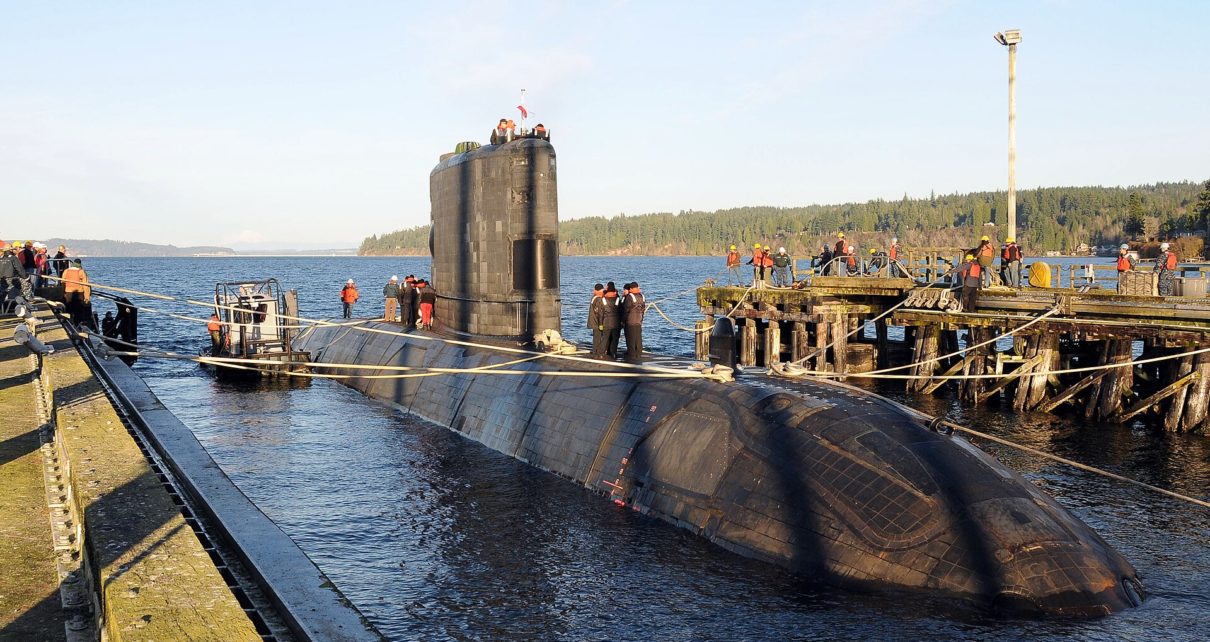
Photo Credit: U.S. Navy photo by Lt. Ed Early, “HMCS Victoria (SSK 876) arrives at Naval Base Kitsap-Bangor,” December 12, 2011. Public domain, via Wikimedia Commons.
Disclaimer: Any views or opinions expressed in articles are solely those of the authors and do not necessarily represent the views of the NATO Association of Canada.