Sudan has descended into one of the world’s most severe humanitarian crises of the moment, with more than 11 million people internally displaced, over 21 million facing acute food insecurity, and several areas assessed at emergency orfamine-level conditions. The war that precipitated this crisis began in April 2023 as a power struggle between the Sudanese Armed Forces (SAF) and the Rapid Support Forces (RSF) following the collapse of the post-Bashir transition and a failed attempt to integrate the RSF into the state security apparatus. What initially appeared as an internal military confrontation rapidly escalated into a nationwide conflict, reshaping Sudan’s political, territorial, and economiclandscape. By 2024–2025, the war had hardened into a de facto territorial division of the country: The SAF controls much of eastern and northern Sudan, including Port Sudan and the Red Sea corridor, while the RSF has consolidated control across most of Darfur and large parts of Kordofan and Khartoum through sieges, coercion, and control over roads, markets, and supply routes.
The durability of Sudan’s conflict, despite economic collapse and near-state failure, is rooted in a political economy builtaround gold extraction. The RSF leadership has direct stakes in gold production, and the war has expanded the use of coercion as an economic tool. In those places where the RSF controls territory, road access, market access, and civilian movement are taxed, while mining areas and surrounding communities are coerced or forcibly displaced. Local traders are compelled into compliance, allowing the RSF to control not only extraction but the entire chain that moves gold from mine to buyer. This supply chain extends beyond Sudan’s borders, which is where the United Arab Emirates becomes an important actor shaping the war. UAE-linked corporate infrastructure and financial services appear repeatedly in the RSF’s commercial ecosystem, providing company structures, banking access, trade cover, and entry into a global gold marketplace that enables external monetization of conflict gold.
Moreover, evidence indicates that eastern Chad functions as a key transit corridor sustaining RSF battlefield capacity, with repeated cargo flights to Amdjarass Airport under investigation as part of RSF supply flows into Darfur and surrounding regions. The same permissive border ecosystems facilitate the outward flow of gold. However, Chad closedits border with Sudan on the 24th of February following clashes near al-Tina, potentially disrupting a corridor that had supported RSF supply flows. Southern Libya has become a critical logistics node and access route for fuel and vehicles, especially after the RSF’s expansion toward the Sudan–Libya–Egypt border triangle, which opened additional corridors through southeastern Libya and northern Sudan. These logistical pathways also support the importation of manpower.As an example, the NGO Sentry documents a recruitment chain in which a UAE-based security firm contracted a Colombian recruitment agency to supply hundreds of former soldiers for work in Sudan, with contracts and payment structures routed through offshore mechanisms. Some recruits reported receiving drone-related training in Abu Dhabi before rotating through Somalia, illustrating how external commercial and security networks are integrated into the RSF’s coercive capacity. However, the UAE denies direct involvement.
The consistency of logistical routes, commercial linkages, and financial access makes external enablement a credible driver of the conflict. Sudan’s civil conflict is not simply a domestic-actor story. The war is sustained through multi-patron enablement, meaning that no single sponsor or supply line is decisive. Instead, overlapping networks of routes and intermediaries keep the war economy running even when one corridor is disrupted.
Coercion in Sudan is geographically specific depending on whether the goal is to starve a town into submission, empty a territory, capture a corridor, or turn a civilian economy into a revenue stream. The clearest example is the siege of El Fasher. This city was assessed by the Integrated Food Security Phase Classification system at IPC Phase 5 (Famine) in September 2025, with this condition projected to persist into early 2026. The driver was a prolonged siege and near-total blockade of the city. An earthen berm was constructed around the city to control movement, civilians faced severe risk when attempting to leave, and goods were routinely prevented from entering. As markets collapsed, shortages of food, medicine, and clean water decreased, while bombardment damaged critical infrastructure. Even where food was available, armed actors buying up supplies further drove scarcity. Prices of sorghum, a food staple in the area, reportedly rose by around 300 percent between June and July 2025, and humanitarian access was described as virtually non-existent. A similar pattern appears in Kadugli in South Kordofan, also assessed as plausibly facing IPC Phase 5 conditions. The town depends on a small number of arteries from Al Obeid, Dilling, and South Sudan.
A second coercion technique is violent displacement and camp shock, most visible in North Darfur, where attacks and access restrictions collapse markets and trigger mass movement into already fragile areas of refuge such as Tawila. The seizure and assault on Zamzam camp in April 2025 was not only a mass casualty event. It also drove large scale displacement from what had been Sudan’s largest displacement site, with more than 500,000 residents before the attack, and it followed months of restrictions on food and essential goods entering the camp. The humanitarian effects are measurable. In North Darfur, IPC analysis reports extreme malnutrition and mortality indicators, including Global Acute Malnutrition rates of 22 percent in Tawila with Severe Acute Malnutrition at 6.2 percent, and severe constraints on basic services such as water access, including very low per-person water availability among displaced populations. A third technique is ethnically targeted cleansing, concentrated in West Darfur, particularly around El Geneina, where violence and forced expulsions were used to permanently reconfigure who can live where. Human Rights Watchdocuments an ethnic cleansing campaign targeting Massalit and other non-Arab communities, with killings and mass displacement used to establish armed control through fear and demographic rupture.
The RSF is not the sole actor responsible for civilian harm. Human rights organizations report that the SAF have carried out airstrikes, artillery shelling, and ground offensives in populated areas, resulting in the destruction of civilian infrastructure, civilian casualties, and displacement. Together, the actions of both the SAF and the RSF have contributed to the collapse of civilian protection, the spread of famine conditions, and one of the largest displacement crises in the world.
The Sudan crisis exposes a policy coherence challenge in Canada’s values-based realism. While Russia’s invasion of Ukraine triggered sanctions driven by both moral condemnation and strategic alignment within the Euro-Atlantic security order, Sudan, which lies outside Canada’s alliance framework, has prompted primarily humanitarian assistance rather than comparable economic enforcement. This divergence reflects strategic prioritization, yet it becomes harder to defend when economic partnerships intersect with actors linked to ongoing atrocities and when commercial engagement overlaps with documented conflict networks.
Canada has authorized military exports to the United Arab Emirates in recent years, while investigations have documented Canadian-origin equipment in RSF hands and linked the UAE to the RSF’s broader supply ecosystem. There is no public proof of direct Canadian exports to Sudan, yet the convergence of export flows and diversion risk creates a coherence issue. Values-based realism does not require disengagement from the UAE, but it does justify sectoral differentiation: Canada can deepen economic integration in civilian sectors while applying stricter scrutiny or restraint to military exports where credible diversion risks exist. Sudan thus becomes a test of whether economic strategy and humanitarian commitments can be aligned in practice.
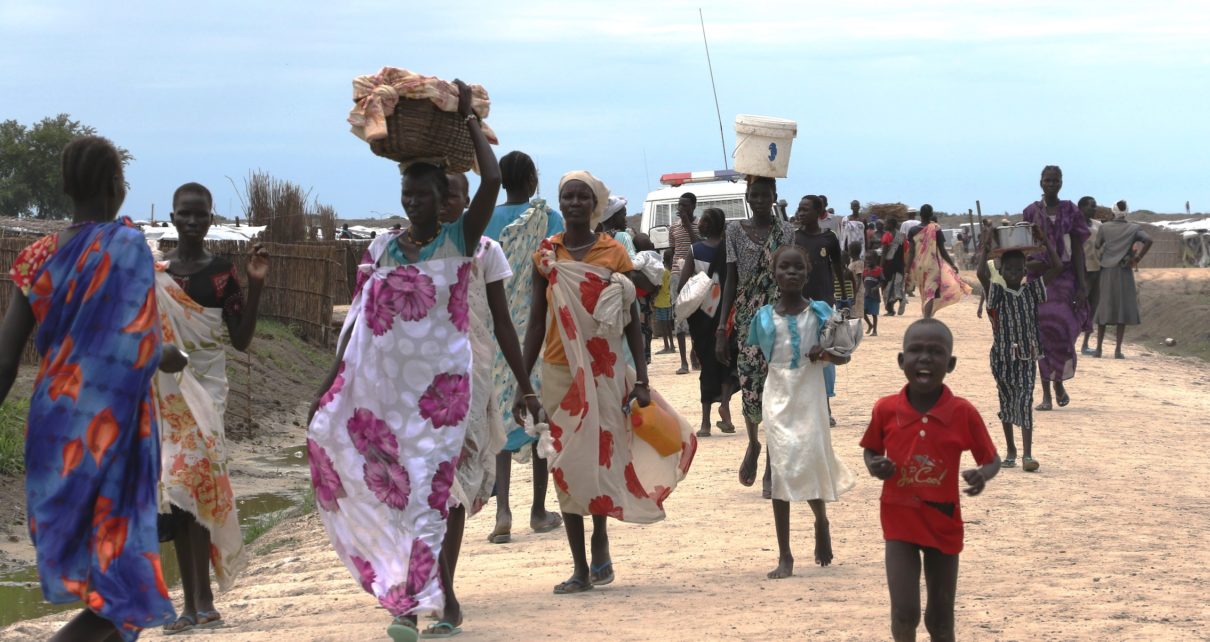
Photo: Sudanese refugees (2015) EU Civil Protection and Humanitarian Aid via Flickr. Public domain.
Disclaimer: Any views or opinions expressed in articles are solely those of the authors and do not necessarily represent the views of the NATO Association of Canada.