March 16, 2026 marks one year since Mark Carney took office as Prime Minister of Canada, following his victory in the 2025 Liberal Party leadership race. Subsequently, in a rare federal election where foreign policy was the most salient issue, Carney promised to revitalize the Canadian Armed Forces and meet NATO defence spending guidelines while reinforcing Canada’s relationships with its non-US allies and partners.
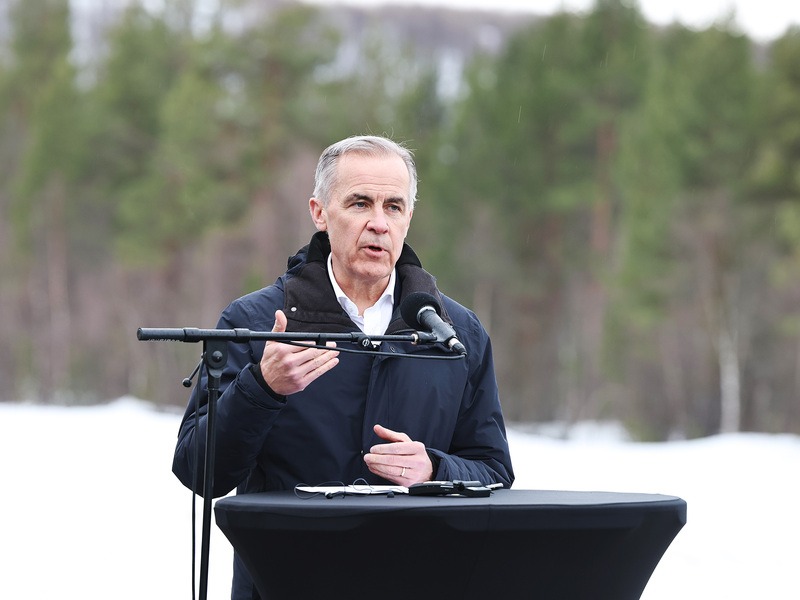
The zenith of Carney’s first year was his widely lauded speech at the World Economic Forum in Davos, given on January 20, 2026. In his speech. Carney argued in reference to the world order that, “we are in the midst of a rupture not a transition … we know the old order is not coming back.” Carney outlined a Canadian foreign policy which would emphasize cooperation with middle powers to resist pressure from great powers, while pursuing ‘variable geometry’ – creating specific coalitions with like-minded states in the resolution of specific issues. The speech garnered praise from fellow democratic leaders across the West, as well as across party lines at home.
Many glowing historical comparisons have been drawn to Carney’s Davos oration, but there is one notable omission. Three days after Russia launched its full-scale invasion of Ukraine in February 2022, the then-Chancellor of Germany, Olaf Scholz, addressed the Bundestag to thunderous applause with the proclamation, “we live in a Zeitenwende.” Translated variably as ‘inflection point’, ‘turning point in time’, or ‘watershed moment’, Zeitenwende became one of the defining political expressions of 2022. In this landmark speech, Scholz admitted the failure of Germany’s policies of accommodation towards Russia and promised to fundamentally transform Germany’s defence posture with a generational investment in security. Zeitenwende seized the mood of the moment, and Scholz became the harbinger of a changed world order.
Scholz and Carney are both technocratic leaders of centre-left parties who made their international debuts with zeitgeist-capturing speeches. In both speeches, Scholz and Carney place renewed emphasis on defence and security amid a rupture in the world order. Extraordinary political rhetoric, however, necessitates extraordinary political action. Ultimately, Scholz failed to transform his Zeitenwende promises into meaningful change in German defence policy. His 100-billion-euro boost to defence spending could not fill the capacity gap created by years of chronic underinvestment.
In the end, Scholz prematurely left office in early 2025 after losing an early election caused by a dispute within his governing coalition, one of the rare postwar German leaders to suffer such a fate. His legacy and that of the Zeitenwende speech have been defined by his failure to bring Germany the defence policy transformation he identified as necessary.
Unlike with Scholz’s speech, however, Davos was not the first time Carney shared his prognostication that the world order is experiencing a rupture. Nor was his oft-cited phrase, that Canada “[sees] the world as it is, not as we wish it to be” borne of the Davos speech. Carney’s belief – that the United States has become a force for disorder against which its partners can only hedge – has been an established part of his articulated worldview.
Indeed, aspirations of greater middle power cooperation in the face of great power coercion are not an innovation of the Carney doctrine, but have been part of traditional Pearsonian internationalism – a mainstay of the Liberal Party’s foreign policy – for decades. This too has been recognized internationally, with one European commentator writing that, “talking about ‘middle powers’ is as Canadian as maple syrup.” Additionally, Carney’s invocation of Vaclav Havel, whose writing dealt with the totalitarian nature of Eastern European communism, has attracted criticism from commentators at home and abroad for drawing an inappropriate parallel between Cold War-era communist subjugation and Canada’s voluntary membership in the American “empire by invitation.”
To Carney’s credit, however, he has created new institutions which would be responsible for delivering a long-term military transformation. The Defence Investment Agency, created in October 2025, is meant to streamline the historically sluggish and bureaucratically burdensome Canadian Armed Forces procurement process. Canada’s accession to Security Action for Europe (SAFE) makes it the first non-European country to be granted such a privilege, delivering on a government throne speech promise to integrate Canada into the European Union’s ReArm Europe/Readiness 2030 plan. Most ambitiously, the Carney government’s Defence Industrial Strategy aims to produce 70 percent of Canada’s defence materiel domestically within a decade.
His $8.8 billion defence spending boost over the next five years pales in comparison to figures from European NATO allies, but remains an extraordinary sum for a country which has earned the ire of its allies for its historically paltry defence spending. Carney’s frequent international trips, including landmark visits to China and India to reset previously fraught relationships, demonstrate an earnest resolve to restore Canada’s international image as a serious trade and security partner.
His affirmation that Canadian defence policy must become less reliant on the United States, however, is challenged by Canada’s outstanding order for American F-35s and the demands of NORAD. The Royal Canadian Air Force has an acute need for modern, fifth-generation fighters, for which the F-35 is the only realistic option.
A contract negotiated under the Trudeau government commits Canada to purchase 88 F-35s. In spite of this, Carney launched a review of the contract shortly after entering office in March 2025, inspiring calls for Carney to break off the F-35 contract or to field a mixed fleet of some F-35s and fourth-generation European fighters as a political statement. Subsequently, by quietly paying for 14 more F-35s, the Carney government has seemingly weathered this pressure, caused in part by its own foreign policy rhetoric, in tacit recognition of Canada’s geostrategic reality.
In betting big on defence spending as an economic stimulant, Carney is making the same wager as many European governments who find themselves caught between the Scylla of intensified Russian aggression and the Charybdis of populist nationalism. Defence spending-driven economic growth appears extremely attractive to national leaders who wish to defeat both challenges in one stroke, founded on the assumption that ascendant populist nationalism in Europe is caused in part by economic stagnation.
Though Canada suffers too from a laggard economy with few signs of improvement, Carney faces a somewhat different dilemma. His posture towards the Trump administration is a great deal more aggressive than that of some European allies and of NATO, which is something he must balance with the reality of Canada’s necessary collaboration with the United States on matters of continental interest. The F-35 procurement debate illustrates this well, with Carney forced to adopt a continentally necessary policy which may otherwise appear to contradict his stated doctrine.
Carney’s vacillatory response to the US and Israel’s decision to strike Iran also highlights this dilemma. His proclamation, “we will stand by our allies, when it makes sense,” contrasts greatly with his unwavering commitment to NATO’s Article 5 in his Davos address. Navigating this gap between oppositional rhetoric and necessary cooperation will doubtlessly remain a salient challenge for Carney throughout his premiership.
The Carney doctrine represents a continuation of Canada’s tradition of lofty foreign policy ambitions. In an increasingly anti-American Canada, Carney is well-served domestically by his aggressive line against the Trump administration’s most egregious actions. Whether this will limit his manoeuvring capacity in future negotiations remains to be seen.
In defence policy, Carney’s concrete steps towards increased spending and aggressive procurement again face a potential challenge in his own foreign policy rhetoric. Beyond the unenviable position of navigating an unpredictable US relationship and an increasingly turbulent world, the prime minister must live up to the expectations he set for himself in Davos or risk the same fate as other leaders who offered zeitgeist-capturing words but were politically unable to deliver.
Image credit: World Economic Forum Annual Meeting (2026) by World Economic Forum via Flickr. Licensed under CC BY-NC-SA 4.0.
Disclaimer: Any views or opinions expressed in articles are solely those of the author and do not necessarily represent the views of the NATO Association of Canada.