Food Resilience as a Security Obligation
During conflict, societies rely on secure food and water supplies to keep daily life functioning, so safeguarding them is essential to national security. NATO addresses this need through
Article 3 of its founding treaty, which requires Allies to sustain their ability to resist attack.
In September 2026, NATO re-examined its seven baseline requirements for national resilience, which cover areas such as government continuity, energy, health, and transport. Among the most vital is the requirement on food and water, which makes allies responsible for keeping supplies secure against interruption and deliberate harm. For import-reliant countries, that responsibility can extend to the global supply chains that carry food across borders, so a disruption abroad becomes a security concern at home.
The war in Ukraine shows that risk. Since 2022, Russia has repeatedly attacked Ukrainian ports and ships, and officials warned that Russia’s blockade of those ports endangered food supplies worldwide. The three Odesa-region ports that ship more than 90% of Ukraine’s agricultural exports took the most direct damage, and in July 2026 Ukraine’s leading farmers’ organization reported that Russian attacks had cut its grain export capacity by about a third. Because agricultural exports are Ukraine’s largest source of foreign currency, damage to the ports can weaken farm incomes and national revenue at the same time, undermining the food sector the country must rely on during a war. A limited truce has so far failed, and more than 210 strikes on merchant ships were recorded in the Black Sea between July and September 2026. Ukraine illustrates the modern consequences of disrupted food supply chains and underscores the importance of preparing for such crises in advance. That preparation depends on the strength of the farms a country can fall back on.
Canada’s Acknowledged Dependence on Imported Food
In June 2026, the federal government released its National Food Security Strategy, a package of investments and policy changes meant to address that exposure by helping Canada rely more on its own farmers than on foreign supply. The announcement states plainly that “a country’s sovereignty depends on its ability to feed itself, fuel itself, and defend itself,” and it concedes that “our food chains rely too heavily on foreign suppliers.” Despite ranking as the world’s ninth-largest exporter of agri-food products, Canada is simultaneously the world’s eleventh-largest importer of these same goods, leaving Canadians dependent on foreign supply for 88% of the fresh fruit and nuts and 72% of the vegetables they consume. Rebuilding domestic supply depends on farms that can stay in business, yet many of those farms sell into highly concentrated markets that may be squeezing their incomes. Although several factors contribute to Canada’s reliance on imports, this article focuses on buyer and processor concentration and its potential effects on Canadian farmers.
How Buyer Concentration May Squeeze Farm Incomes
Among the factors constraining farm incomes and domestic agricultural growth is the imbalance of power between farmers and the firms purchasing their products. Economists link this to oligopolistic concentration, a market structure in which a small number of dominant firms hold outsized control over the agricultural sector and can “distort markets by exercising both seller power—raising the prices they charge—and buyer power—depressing prices paid to farmers and workers.” That buyer power can squeeze the margins of the farmers who sell to these firms, and researchers argue that many Canadian producers now struggle to break even, meaning their income barely covers operating costs.
The imbalance shows up in how little of each food dollar reaches the farm. Of every dollar Canadians spent on food in 2021, only about 17 cents went to farmers, on average, while the other 83 cents paid for processing, transport, retail, and food service. A few examples offer a snapshot, among several, of the growing control that large companies hold over agricultural markets. Three plants handle over 95% of the beef sold in Canada, and between 2016 and 2021 meatpackers’ share of the retail price rose from 51% to 59% while farmers’ share declined. Pork follows a similar pattern, with Maple Leaf Foods and Olymel operating half of Canada’s hog processing capacity. More tellingly, farmers themselves are concerned, with 90% of the 593 surveyed in 2023 reporting worry about consolidation in their industry.
The Competition Act’s Enforcement Gap
Canada’s Competition Act is supposed to prevent this kind of consolidation by catching large mergers before they damage competition. According to the Canadian Anti-Monopoly Project, the Competition Bureau, which reviews mergers, has examined at least 27 food-sector transactions since 2001 without ever successfully blocking one, and when it did act, its remedies were limited to narrow divestitures. Grain handling shows how far this has gone. Before 1997, farmer-owned co-operatives controlled about 60% of Canada’s grain handling capacity. Today, three private companies control more than 80% of it.
Bunge’s US$8.2 billion acquisition of Viterra, one of Canada’s largest grain handling companies, is a modern case in point. In November 2024, the Competition Bureau concluded that “the undertakings proposed do not remedy the competitive harm that is likely to result from the Merger,” adding that “were these undertakings to be proposed to the Bureau in the normal course of a merger review I would not accept them.” This review followed a separate public interest process under the Canada Transportation Act, in which the Bureau reports to the Minister of Transport, and Cabinet makes the final decision, rather than the usual merger review. In January 2025, Cabinet approved the merger with conditions despite the Bureau’s assessment. Following that decision, the Canadian Federation of Agriculture put it bluntly: “at the end of the day, it is the farmers who will pay,” a warning that the cost of reduced competition may fall on the producers who sell to these firms.
Protecting Competition to Protect Food Supply
Canada cannot rebuild its domestic food supply without farms that can stay in business, and concentrated buyers may be making that harder. As seen throughout this article, large buyers hold considerable power over prices, enforcement has not stopped the mergers that add to it, and farmers themselves report concern. That power may extend to what farmers grow, since a study of Canadian farm economics suggests that operations able to supply large, consistent shipments that buyers prefer win price breaks and favourable terms, which may give farmers a financial reason to grow bulk crops instead of a wider mix.
Canada’s crop base is already narrow, with just two crops, canola and wheat, dominating Canadian crop earnings, and leaving Canada more exposed to trade shocks than a more varied mix would. The farm sector shows the same imbalance, with Statistics Canada recording more than five grain and oilseed farms for every fruit, vegetable, melon, or tree nut farm, 65,135 against 12,177. The Agricultural Producers Association of Saskatchewan argues that consolidation deserves scrutiny when it may reduce producer choice, and stronger merger reviews, which the Canadian Anti-Monopoly Project recommends, would be a reasonable place to start. Protecting competition among buyers may help farms stay in business. Ukraine’s experience shows that this preparation has to come before a crisis, because those farms are the domestic supply Canada would need to feed its people if imports were disrupted.
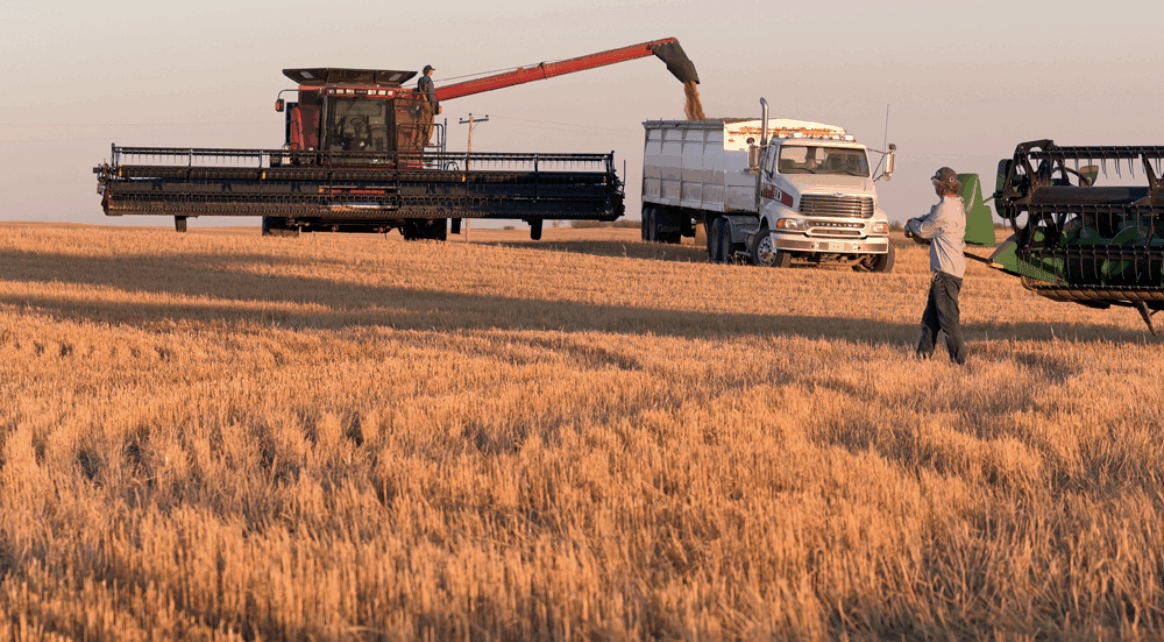
Cover Photo: “Wheat harvesting operations in Saskatchewan” (n.d.), via The Western Producer. File photo. © The Western Producer.
Disclaimer: Any views or opinions expressed in articles are solely those of the authors and do not necessarily represent the views of the NATO Association of Canada.