As the 2023-2026 cycle of Individually Tailored Partnership Programmes (ITPPs) between NATO and Australia, Japan and South Korea draws to a close, it is worth examining how the alliance is approaching the varying interests of its Indo-Pacific partners. NATO formed ITPPs with Indo-Pacific 4 (IP4) partners Australia, South Korea and Japan in 2023, and New Zealand in 2024. These programmes coordinate NATO’s engagement with its partners individually, facilitating information exchange and improving interoperability and coordination. Despite growing recognition that the Euro-Atlantic and Indo-Pacific security theatres are interconnected, an operationalized IP4 partnership or cohesive NATO-IP4 Indo-Pacific security agenda has yet to emerge.
A major barrier to such integration is the different national strategic priorities and distinct threat environments each partner faces. The ITPPs’ highly customized natures have drawn criticism for hindering the development of a shared NATO-IP4 security agenda. However, pushing for a unified NATO-IP4 security agenda is unrealistic given the differences in threat perception and strategic priorities among the IP4, which the ITPPs are designed to accommodate. Lessons from the Turkey-NATO relationship highlight that the alliance can accommodate a lack of total alignment on all strategic priorities.
The IP4 ITPPs vary considerably in both content and ambition. The ITPP with Japan is the most comprehensive and ambitious, placing strategic emphasis on China, Russia, and North Korea. South Korea’s, by contrast, is more moderate in scope, reflecting a delicate political relationship with China and a “low-key but determined approach to cooperation”. The agreement is “less rhetorical and more action-oriented,” facilitating greater interoperability and increasing independence without mentioning China. The ITPP with New Zealand reflects a primary strategic emphasis on resilience and climate security rather than on deterrence, the defence industry, or a regional power like China or North Korea. New Zealand’s defence cooperation with NATO has typically been described as less developed than the rest of the IP4 due to its dependence on China for trade and its focus on the South Pacific. While the agreements with Australia and Japan express a strong emphasis on hard security components, the approaches in the agreements with South Korea and New Zealand are described as limited and minimal. China-related framing varied greatly between the agreements, ranging from explicit and direct to indirect, due to the countries’ differing threat perceptions and strategic priorities.
Calls for greater institutionalization of NATO-IP4 cooperation have been made. Institutionalization of NATO-IP4 cooperation in the form of, for example, an Atlantic-Pacific Partnership Forum, has been suggested as a hedge against changing domestic political attitudes toward cooperation with NATO. Critics have argued that the ITPPs “institutionalize asymmetric levels of ambition” and have hindered the “operationalization of NATO-IP4 cooperation.” Although the desire to further institutionalize NATO-IP4 cooperation is understandable, criticism that the tailored agreements make it difficult to pursue a unified security agenda is unfair.
The IP4 have different appetites for engagement and different strategic priorities, from cyber defence to climate security. The partners’ differing threat assessments of China, along with Russia and North Korea, present another major barrier to deeper formal NATO-IP4 cooperation. The ITPPs may institutionalize asymmetric levels of ambition and interests, but they do not create them. Pushing Cold War-era expectations of uniform alignment on every issue exhibits a misunderstanding of the nature of security cooperation today. Expecting South Korea and Japan to espouse identical stances on China, for example, erases differences in their strategic priorities and threat environments. South Korea’s low tolerance for risk in its relations with China contrasts with Japan’s willingness to describe China’s external posture as its “greatest strategic challenge”. Japan is in active dispute with China over the Senkaku Islands in the East China Sea, while North Korea remains South Korea’s most pressing threat. Additionally, South Korea suffered economic retaliation in 2016 following the deployment of its Terminal High-Altitude Area Defense (THAAD) systems, and may fear further antagonizing China through deeper NATO cooperation. This wide divergence in strategic priorities and threat assessments across the IP4 means a genuinely coherent strategic agenda, especially regarding China, is unlikely to carry much practical weight.
Pursuing a unified NATO-IP4 security agenda is unrealistic and does not make deeper cooperation less worthwhile. NATO’s accommodation of Turkey’s divergent threat perceptions and national priorities demonstrates why the pursuit of such a unified agenda is not just unrealistic, but unnecessary. Turkey’s European partners have long tried to keep it from pulling away from the West. Despite being a NATO member, the country has pursued a policy of strategic autonomy largely because of its unique geography. Turkey’s proximity to Russia, Iran, and Syria has pushed it to balance between powers, such as a recent signing of a mutual defence treaty with Pakistan and Saudi Arabia. The country supplied Ukraine with drones and recognized its territorial integrity, while, simultaneously, refusing to participate in Western sanctions on Russia. Turkey’s policy of strategic autonomy has also fuelled arguments that it erodes alliance cohesion, including when it bought the S-400 missile system from Russia, resulting in the United States suspending it from the F-35 program. However, while Turkey’s maintenance of relationships that cut across geopolitical lines has frustrated its NATO partners, it has also provided some benefit, including its attempts to mediate talks between Russia and Ukraine.
The country’s foothold in both Asia and Europe, access to the Mediterranean and Black Seas, and its massive military capacity and growing defence industry make it a valuable NATO partner in an increasingly fractured security landscape. If NATO cannot expect total alignment from Turkey, even as a NATO member located partially in Europe, it cannot expect total alignment from the IP4 on issues relevant to NATO. The ITPPs’ tailored and limited design accommodates this lack of total alignment, both among the IP4 partners and with NATO, letting each partner cooperate where its specific interests overlap with those of the alliance.
Future NATO-IP4 cooperation should focus on deepening cooperation in each partner’s own ITPP priorities, from maritime security to information integrity, rather than on the pursuit of a unified security agenda. Long-term strategic cohesion can be built from the bottom up by assigning liaisons from each IP4 country to NATO headquarters, building connections between NATO and IP4 lawmakers, reducing barriers to information sharing, and encouraging regular meetings among IP4 countries.
Disclaimer: Any views or opinions expressed in articles are solely those of the authors and do not necessarily represent the views of the NATO Association of Canada.
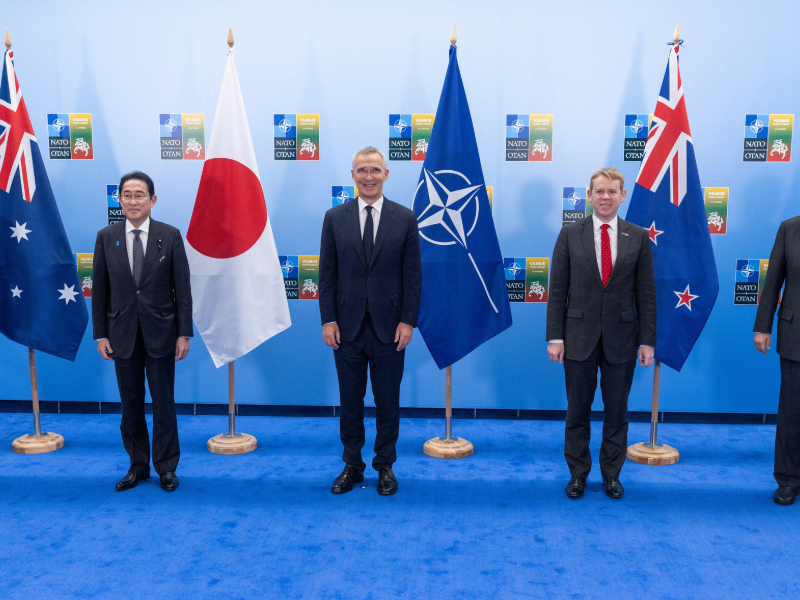
Photo source: Former NATO Secretary General Jens Stoltenberg with the leaders of the Indo-Pacific Four nations at the Vilnius Summit (12 July, 2023), by NATO via Flickr. Licensed under CC BY-NC-ND 2.0