The Defence Innovation Accelerator for the North Atlantic, or DIANA, is a unique body of NATO that was launched at the 2021 Brussels Summit. It is premised on increasing interoperability and cooperation amongst member states through advancing innovative, dual-use technological solutions. It aims to address rising threats to the Alliance arising from emerging and disruptive technologies (EDTs). NATO’s DIANA presents a unique and exciting opportunity for academics, business innovators, and the private sector in Canada and across the Alliance to connect with government, militaries, and industry partners while advancing NATO’s collective security and defence capabilities. Specifically, it offers a key platform for women in science, technology, engineering, and mathematics (STEM), and advances women’s involvement and participation in these fields and across NATO-allied states.
DIANA operates in regional offices in Estonia, the United Kingdom, and Canada, and over 20 accelerator sites and 180 test centres located at partner institutions across the Alliance. Through these diversified sites, it aims to facilitate connections between innovators, investors, and industry partners. To do this, DIANA issues public challenges that invite private-sector and academic institutions to submit proposals for technologies, with both commercial and defence usages, that address an identified threat. These are based on emerging defence or security problems in key areas of interest, including artificial intelligence (AI), quantum and biological technologies, space, and manufacturing. For example, in 2023, the focus areas were energy resilience, sensing and surveillance, and secure information sharing. The chosen proposals for the Accelerator Programme gain access to state-of-the-art facilities and an extensive network of connections in the public and private sectors within technology and science industries. In addition, the company would have further access to monetary grants, funding, and support from the NATO Innovation Fund to develop their business and technology to align with the Alliance and industry needs.
Specifically, DIANA presents an opportunity for Canada to enhance its defence innovation aims and contribute to NATO’s defence and security goals. Canada currently hosts one of three regional offices for DIANA operations, in Halifax, Nova Scotia, with 16 test centers in the country. In the 2026 Accelerator Programme cohort, 22 of the 150 innovative companies selected were Canadian and will have access to more than 200 test centres across NATO states. With strong engagement across academia, the private sector, the Canadian Armed Forces (CAF), and the Department of National Defence (DND), Canada is well-positioned to support NATO DIANA in trialling and adopting new technologies.
DIANA’s Accelerator Programme can be a valuable opportunity to support NATO’s Women, Peace, and Security (WPS) agenda by providing mechanisms that help women in STEM, defence, and security sectors launch their startups or projects by receiving financial backing and industry support. Currently, it is broadly understood that women are underrepresented in STEM fields; in Canada, women make up less than one quarter of the individuals employed in STEM careers. However, there is considerable value in addressing problems and finding solutions from multiple perspectives, where the inclusion of women is imperative for innovation. Women in STEM are a large untapped resource, and their addition to the workforce could offer significant benefits to the field. Furthermore, women constitute a lower percentage of the military workforce compared to their representation within civilian defence workforces. DIANA offers additional support to women contributing to security and defence in a non-military manner, thereby building and maintaining “synergies” between military, gender equality, and civil society.
Increasing visibility and representation are important components to increasing women and girls’ participation in STEM fields. Jyoti Hirani-Driver, Chief Operating Officer of DIANA, notes that “women in scientific leadership face a visibility gap[,] not just in recognition, but in opportunity.” This sentiment is echoed by Heather Desserud, the Director of Communications at DIANA, where early in her career, “good female role models were invisible, and this impacted [her] ability to map [her] own career path in both national security and innovation.” Desserud now “mentor[s] women in science, technology, and defence, helping them push past barriers and claim their place at the table.”
Notably, NATO has made efforts to support women and girls in STEM. In early 2026, the Science and Technology Organization announced its third annual Women and Girls in Science Challenge, which calls for young women from NATO member states who are studying or have graduated from STEM fields, to create innovative solutions to fictional but relevant scenarios related to security and defence. This challenge, and other similar programs such as DIANA, are essential platforms that foster civilian engagement and elevate innovative solutions.
DIANA’s mission of tackling new challenges by driving forward innovative solutions highlights the need to include diverse voices and ideas to address these emerging threats. The program is positioned to be a vital resource not only for women in STEM but also for innovation that would otherwise go unsupported or unexecuted. DIANA’s network connects entrepreneurs, industry professionals, academics, and institutions across the Alliance, with government and military sectors, where the coordination between the military, political, and civilian sides of NATO is imperative. A lack of visibility and available networks is identified as a major challenge for women in STEM; considering this, DIANA should prioritize proposals from projects that are led by women or have gender parity, in accordance with NATO’s goal of integrating the WPS across all its core tasks. For additional support, cooperation with NATO’s Civil Society Advisory Panel (CSAP) on WPS can facilitate further engagement and build connections with civil society, accessing a breadth of expertise from a diverse range of backgrounds. Concurrently, women entrepreneurs, leaders, and scientists in STEM fields should capitalize on NATO’s DIANA as a platform to elevate their ideas, where the collective defence and security of the Alliance would benefit.
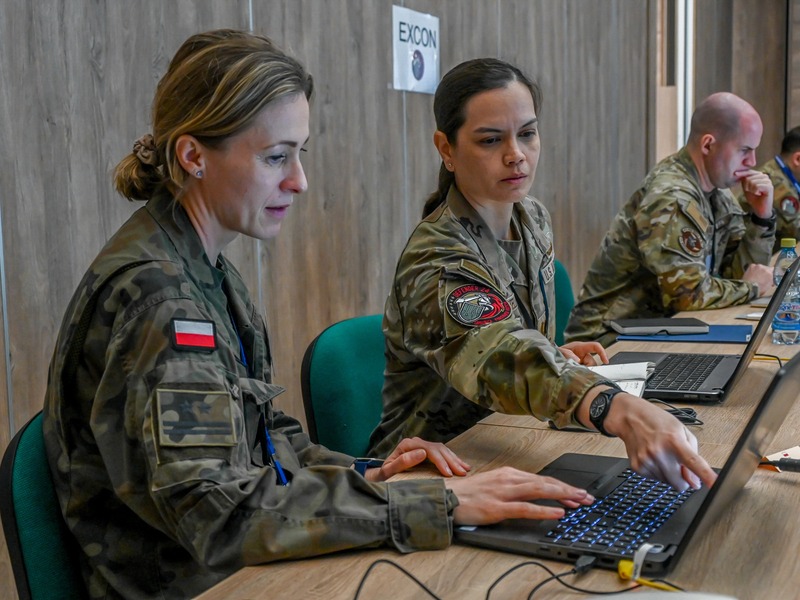
Photo: U.S. Air Force photo by Staff Sgt. Laura Virtue. Source: Public domain, via Wikimedia Commons
Disclaimer: Any views or opinions expressed in articles are solely those of the authors and do not necessarily represent the views of the NATO Association of Canada.





.jpg)
