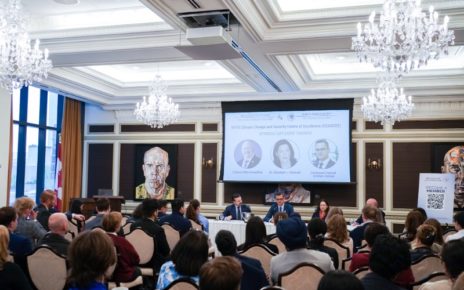
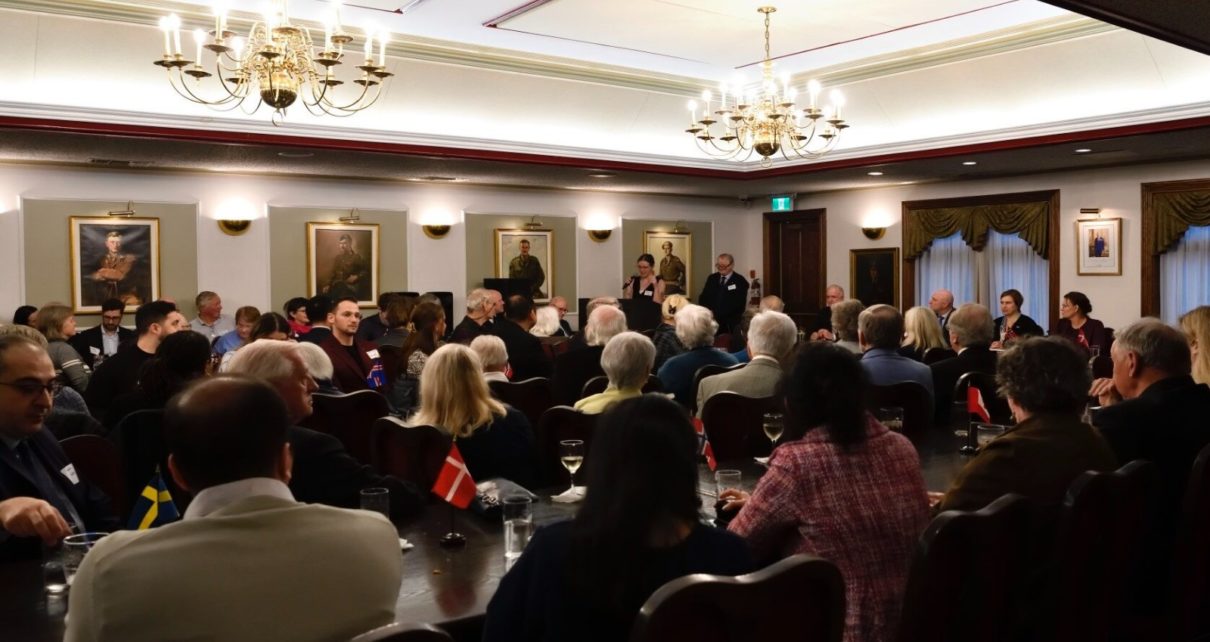
On April 16, 2026, the NATO Association of Canada (NAOC), in collaboration with the Arctic Circle and the Canadian Nordic Society, hosted an event focused on Arctic Security and the strategic lessons offered by Nordic nations. Held at the National Capital Region’s Officers’ Mess in Ottawa, the event convened approximately 130 distinguished guests representing government departments, industry leadership, the military, the foreign service, and Parliament.
The symposium was designed to discuss Canadian-Nordic relations with a specific emphasis on the Arctic, seeking to identify mutual learning opportunities within an increasingly changing world. With climate change and renewed geopolitical tensions, the Arctic has changed from a low-risk area to a region with significant challenges as well as opportunities, and increased collaboration between Canada and Nordic countries is an essential component of ensuring preparedness for future changes.
Proceedings commenced with introductory remarks from the Honourable David Collenette, former Minister of National Defence and Chair of the NAOC. His address reflected on the profound shift in the global security environment, noting that the era of the “peace dividend” has given way to a period requiring urgent securitization, as seen by events such as the invasion of Ukraine. He emphasized that Canada can no longer afford a passive stance toward defence, particularly within the Arctic, and identified recent government investments as a vital acknowledgement of this new reality. Furthermore, he highlighted the specialized expertise Nordic countries possess regarding Arctic affairs and defence, and the unique role that they are situated in, given their geographic proximity to Russia as well as other NATO allies.
The keynote address was delivered by the Honourable Senator Pat Duncan of Yukon, who underscored the importance of circumpolar cooperation. The Senator placed a strong emphasis on the human dimension of the North, mentioning the Arctic Games as a prime example of the cultural bonds that unite Arctic nations, including Nordic peoples. Her remarks focused on the deep connection shared across the region, and on the important role that younger generations will play in protecting the peace that the Arctic has known in recent decades. Emphasizing the important lessons that Canada and the Nordic countries can share with one another, she expressed a hopeful vision for future generations to uphold.
The panel discussion featured Her Excellency Signe Burgstaller, Ambassador of Sweden; Her Excellency Hanne Ulrichsen, Ambassador of Norway; and Eric Laporte, the Executive Director of Defence and Security Relations at Global Affairs Canada. The session was moderated by Murray Brewster, Senior Reporter on Defence and Security for CBC News.
Conducted under Chatham House rules, the panel noted that the Arctic is not a monolithic entity. The North is composed of diverse regions with distinct populations, geographies, and local circumstances. Unlike the geography of the Nordic countries, Canada’s Arctic region is incredibly vast and much more hostile to work within. Despite these differences, there is still much we can learn from each other. The panel even noted that Canada is frequently regarded as the most “Nordic” of the non-Nordic nations.
A central theme of the discussion was civil preparedness and the expansion of capacity in the North. The participants highlighted that preparing populations for war and hybrid threats is essential, as is the integration of Northern communities into the security framework. Canadian models like the Arctic Rangers help establish sovereignty and deterrence through grassroots collaboration, while Nordic nations lead on broad-based engagement with their populations on the importance of preparing for national emergencies. The panel further advocated for the procurement and construction of dual-use infrastructure such as roads, runways, ports, universities, and means of economic growth to facilitate both military readiness and civilian habitation.
The panel also addressed the significant deepening of relations between Canada and its Nordic counterparts. The security architecture of Europe and the Arctic was fundamentally altered following the Russian invasion of Ukraine, leading to the NATO accession of Sweden and Finland. With all Arctic states except Russia now united within a single alliance, Arctic policy and defence have reached an unprecedented level of alignment. Canada has intensified its Nordic engagement through the Arctic Council, which, although down from eight to seven participating members due to the pause on Russian cooperation, remains a key forum for collaborating on Arctic issues. Defence procurement and high-level diplomatic exchanges, such as the recent visit of the Finnish President to Ottawa, have served as other pathways to deepening security relationships with Nordic allies. These developments underscore the growing necessity for robust Middle Power integration.
The discussion concluded with a call for nations to collaborate on essential Arctic priorities, including the preservation of the international rules-based order and the development of technical interoperability. This includes the sharing of common resources, intelligence, and domain awareness, alongside a commitment to academic and scientific research centred on climate change mitigation.
While acknowledging the long road ahead for international Arctic affairs, the event emphasized that through increased investment, mutual learning, and dedicated Canadian-Nordic leadership, the region can remain stable and peaceful for future generations.