NATO’s policy on Women, Peace, and Security (WPS) highlights several mechanisms through which gender equality is important to the sustainability of peace. It posits that in order to effectively prevent and counter threats to the Alliance, countries must promote women’s meaningful participation in crisis management and prevention at all levels. This is necessary for ensuring NATO adversaries, such as Russia, are unable to weaponize gender narratives and disinformation to destabilize democratic societies. Authoritarian leaders such as Vladimir Putin, often weaponize misogynistic narratives and disinformation to undermine female candidates in foreign elections and attack democratic norms. NATO’s WPS policy framework recognizes that women play fundamental roles in protecting peace and security, and are often at the frontlines in the battle to consolidate societal resilience amidst crises and security threats; institutionalizing women’s meaningful participation and decision-making as a critical pillar of NATO’s peace mandate in the Euro-Atlantic arena. This framework echoes the reality that when women are granted the platform to lead, wide-ranging benefits to the international community ensue. Women’s leadership is fundamental to protecting peace and security, and this is most embodied through women’s political participation. Progress toward women’s equal political representation, otherwise referred to as parity, has grown consistently over recent decades. Women have increasingly been elected into governments across the globe. This trend has, however, begun stalling in recent years. This risks threatening norms of peace which NATO’s WPS policy aims to officialize by uplifting gender equality. To foreground peaceful outcomes amidst a growingly volatile international arena, NATO countries must encourage women’s access to political representation and address systemic barriers that prevent women’s substantive political contributions once elected.
Women’s representation in political leadership is fundamental to establishing norms of peace domestically that can be transmitted to the interstate level. One measure through which this can be examined is through partisan hostility. A study conducted in 2015 in the United States revealed that women senators work across the aisle more frequently than their male colleagues, and are more likely to cosponsor legislation with members of the opposite party. The average female senator in 2015 had cosponsored 3.79 bills with each female senator of the opposing party. Contrastingly, the average male senator had cosponsored only 2.16 bills with each male senator of the opposite party. This is just one of many findings which led the study to conclude that women’s political representation can lead to more effective governments, as women in power not only work more frequently with one another but also more frequently across partisan lines, passing more legislation than their male counterparts. Because women are more likely to seek out common ground, greater representation of women in politics is correlated with lower partisan hostility. Women in office do not just change who speaks but also the fabric of politics. Having sustained and cohesive political will is central to achieving positive outcomes, and women are more likely to help forge the inter-partisan bridges that encourage this. This cross-partisan cohesion is a fundamental condition for the societal and political resilience that NATO’s WPS agenda aims to operationalize through gender equality initiatives.
As per democratic peace theory, norms of peaceful cooperation inside a country can make conflict between countries less likely in the international system. Because women play an important role in strengthening the norms of peaceful cooperation domestically, these norms also strengthen interstate peace and security.
This logic can also be applied to resolving interstate conflict, as peace accords are more likely to be implemented and endure when women are signatories. A study in 2018 revealed that agreements with women signatories scored a median implementation rate of 89.3% compared to 76.9% for agreements excluding women. This is evident in negotiations between the United Kingdom and Northern Ireland, where female representatives of the Northern Ireland Women’s Coalition were advocates for victims’ rights and reconciliation in formal negotiations. Female delegates informed civil society networks about proposals and developments to the negotiations, strengthening the agreements’ perceived legitimacy and implementation. Women’s participation in peace negotiations ultimately produces more comprehensive resolutions, stronger implementation rates, and more durable peace. These positive outcomes can be sustained when initiatives that centre gender equality also entrench women’s political representation. NATO countries must continue to replicate this logic by institutionalizing women’s political representation to achieve lasting peace.
Women’s parliamentary representation has also reduced the likelihood of armed conflict on both the intra- and interstate levels. A study revealed that a state is almost five times less likely to respond to an international crisis with violence, when women’s parliamentary representation increases by 5%. Another study concluded that gender equality, as measured through women’s parliamentary representation, is associated with a lesser likelihood of civil war. Gender equality in politics can thus impart international benefits by decreasing the probability of armed conflict; women’s political representation is key to promoting democracy and stability.
The Alliance has proven capable of supporting the positive relationships between peace durability and women’s political representation. NATO’s WPS policy framework explicitly promotes the meaningful participation of women in decision-making processes. It is important, however, that Allies individually institutionalize this sentiment within their own respective governing frameworks. Electing women or imposing quotas on women’s parliamentary representation does not guarantee these positive outcomes. Accessing the negotiation table is one of many steps in wielding political power.
There is ample empirical evidence to support the notion that women’s political representation is imperative to achieving lasting peace and security. NATO Allies can, however, transcend quantitative commitments to women’s political representation and achieve a full assimilation of gender equality in politics by addressing systemic barriers to women’s political influence. Allies can integrate women’s political parity benchmarks into their respective national WPS frameworks, and protect the women who express their commitment to the peace and security of their nations. It is in the Alliance’s interests to advance the cross-partisan cohesion, conflict prevention, and peace durability that women’s political representation has proven to establish. The surest defence against adversaries who weaponize gender narratives and disinformation to destabilize NATO Allies is a political order where women lead.
Disclaimer: Any views or opinions expressed in articles are solely those of the authors and do not necessarily represent the views of the NATO Association of Canada.
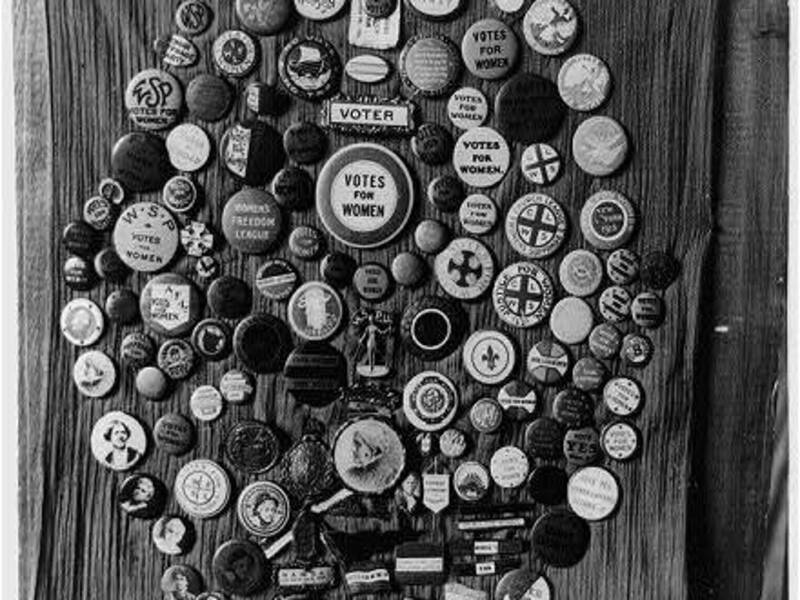
Image: Collection of “votes for women” buttons made by Mrs. Alice Park of Palo Alto, California, 1922. Source: Public Domain, via Wikimedia Commons.