The intensifying geopolitical and geoeconomic rivalry between the US and China has upended global supply chains time and again, with rare earth elements – critical to advanced technological and military manufacturing – assuming unprecedented strategic importance. The spectre of a Thucydides Trap scenario looms large: as China rises and the US seeks to maintain primacy, the relationship is increasingly defined by competition, coercion, and mutual suspicion. Sino-American relations are now locked into a structural confrontation that is likely to persist for decades. Even if kinetic warfare is avoided, the geopolitical frictions at play will shape the global economy and the industrial security of every state on Earth, including – if not especially – NATO members.
This prolonged tension has manifested itself in economic warfare, with both sides weaponizing interdependence. Beijing’s October 2025 curbs on exports of critical minerals – including rare earth elements – represent its latest retaliatory move against US technology restrictions. The message to the West is clear: China will use control over key resources to extract political and strategic concessions. For NATO, these disruptions expose a fundamental vulnerability of the Alliance’s reliance on fragile global supply chains and its lack of a coherent and unified strategy for securing the critical minerals on which its defence industries depend.
Rare earth elements comprise 17 metals with extraordinary significance for modern economies and militaries alike. Their application spans the entirety of military-industrial supply chains, ranging from jet engines and precision weapons to communications and radar. Without them, most of NATO’s advanced defence and dual-use technologies could not function. Yet, after decades of cost-driven outsourcing, NATO members now depend almost entirely on Chinese supply chains. Beijing controls roughly 70% of global rare earth element mining and 90% of processing, a dominance that endows it with outsized strategic leverage. Even the US, which once led production, now imports the majority of its refined rare earth elements from China.
Europe finds itself in an even more precarious position. The continent is nearly 100% dependent on China for heavy rare earth elements. China’s dominance extends across every stage of the supply chain: mining, refining, alloying, and manufacturing. While new deposits have been identified in Sweden, Greenland, and the Arctic, it will take years before they yield operational capacity. In effect, NATO’s defence industrial base is structurally exposed to the whims of a rival power.
This vulnerability is not theoretical. Beijing has exhibited its propensity to use economic coercion to achieve strategic objectives. The rare earth element sector offers China even greater leverage. A prolonged export restriction could delay the production of the entire spectrum of modern military equipment, with cascading effects across allied supply chains. Such exposure undermines deterrence by eroding readiness at the industrial level, which in turn compromises the very foundation of NATO’s hard power.
NATO’s rare earth dilemma is exacerbated by its strategic position between two rival great powers. China is leveraging interdependence to shape global supply flows, while the US – its traditional guarantor – has grown less reliable as an anchor of transatlantic stability. Washington’s strategic pivot to the Indo-Pacific and its domestic polarization, epitomized by the return of Trump-era unpredictability, leave non-American NATO members uncertain of long-term US commitment.
Even under more stable administrations, American attention has shifted toward the Indo-Pacific theatre. NATO itself has acknowledged that the US cannot indefinitely underwrite European defence while attempting to counter China’s rise in Asia. In a landscape typified by US strategic overextension, Europe and Canada must prepare for a future in which access to critical materials cannot depend on American industrial or diplomatic leverage.
This reality highlights the acute need for a sober reassessment: NATO cannot rely on either Beijing’s supply chains or Washington’s policy continuity. To preserve alliance cohesion and technological superiority, other NATO members must develop the means to stand independently – industrially, strategically, and operationally.
To mitigate this vulnerability, NATO should develop a collective, forward-looking industrial strategy for securing critical minerals, beginning with rare earth elements. This would reinforce the Alliance’s resilience and autonomy while complementing existing unilateral and multilateral initiatives. Four pillars could anchor such a strategy.
Firstly, NATO planners must prioritize diversification of rare earth element sources. Vigorous investment in alternative mining and processing capacities across friendly and stable jurisdictions – such as Australia, Norway, and Canada – would help to dilute Chinese coercive potential. Beyond the Alliance, Central Asian countries such as Kazakhstan and Uzbekistan – which maintain pragmatic non-alignment – could be engaged as cooperative suppliers through NATO-affiliated private sector consortia. The NATO Science for Peace and Security Programme could even support feasibility studies for sustainable extraction and governance frameworks in these regions.
Secondly, NATO must build allied processing and manufacturing capabilities. Increasing raw output is insufficient without parallel processing and refining capabilities. NATO governments should coordinate tax incentives and funding to build separation plants, refining facilities, and magnet factories on allied soil. Europe’s first separation plants in Estonia and France represent a recent start, but a full NATO-scale network would be transformative. Coordination could occur through the NATO Support and Procurement Agency (NSPA) and align with the EU’s Critical Raw Materials Act, ensuring complementarity rather than duplication. A dedicated transatlantic Critical Minerals Task Force could synchronize standards and investment flows, fostering a vertically integrated mine-to-magnet supply chain.
Thirdly, NATO should also establish strategic stockpiles of critical minerals (similar to petroleum reserves) as a buffer against short-term supply shocks. A collective reserve – possibly managed through NATO’s Defence Production Action Plan – could sustain production during supply disruptions. Simultaneously, NATO should invest in recycling technologies to recover rare earth elements from retired systems, reducing dependence on new extraction. Allied defence industries could be encouraged to design equipment for easier material reclamation.
Finally, NATO should establish an alliance-level working group to monitor rare earth element supply risks and coordinate contingency plans. This group could coordinate with the Emerging and Disruptive Technologies (EDT) division to ensure that technological innovation aligns with supply security. Regular information-sharing would prevent the fragmentation of national responses and reinforce collective resilience.
While NATO’s response must be collective, Europe is uniquely positioned to lead, and the Alliance should build upon Europe’s existing groundwork. The EU’s Critical Raw Materials Act has already laid the foundations for securing strategic resources and fostering circular economies. By linking that framework with NATO’s defence-industrial planning, European states could operationalize the long-discussed concept of strategic autonomy within an Atlantic context. In doing so, they would also alleviate American concerns about burden-sharing and demonstrate that Europe can shoulder greater responsibility for its own industrial defence base.
Furthermore, Europe’s Arctic and Nordic regions could become key nodes in a diversified supply map. Greenland’s deposits, Sweden’s Kiruna mine, and Norway’s large endowments all represent long-term opportunities for allied cooperation. If developed under unified standards and environmental safeguards, these projects could ensure that the next generation of NATO defence systems is built from secure and responsibly sourced materials.
Formulating a unified industrial strategy for rare earths is a daunting task, but the alternative – remaining at the mercy of external suppliers and extraneous shocks – is untenable. The International Energy Agency projects that global demand for rare earths could triple by 2040, intensifying competition for supply. Unless NATO acts collectively, it risks being squeezed between two giants using resources as weapons of statecraft.
By constructing resilient supply chains and institutional mechanisms now, NATO can preempt this vulnerability and anchor its technological sovereignty. This is not merely an economic necessity but a strategic imperative. The Thucydidean dynamic between Washington and Beijing will define global politics for decades to come; NATO’s best safeguard is to ensure it remains an autonomous, technologically capable pole within that competition.
Ultimately, resilience is the new deterrence. A NATO that controls its own industrial lifelines – secure in the knowledge that its weapons, technologies, and innovation ecosystems are shielded from coercion – will remain credible, unified and ready. Facing a 21st-century Thucydidean dilemma, NATO’s clearest path forward lies in transforming critical mineral vulnerability into strategic strength.
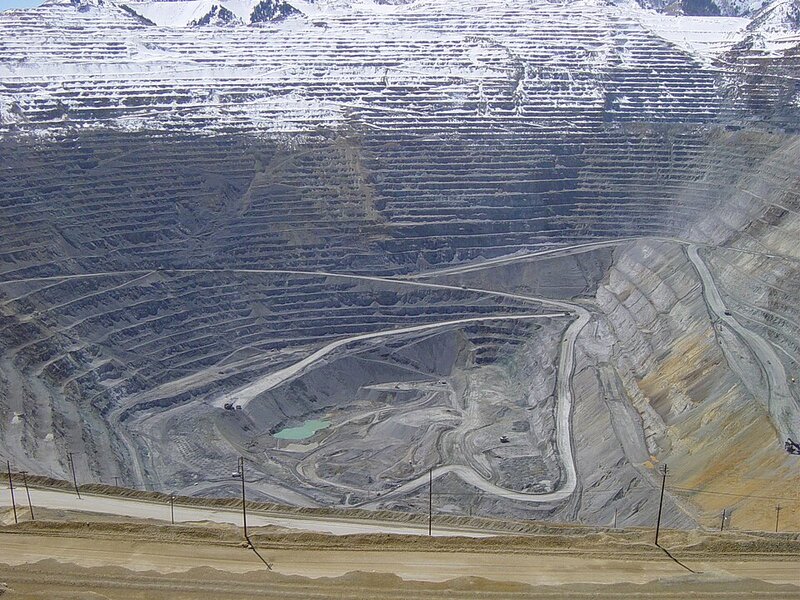
Photo: Bingham Canyon Mine. Photo by Tim Jarrett. This file is licensed under the Creative Commons Attribution-Share Alike 3.0 Unported license. Accessed via Wiki Commons
Disclaimer: Any views or opinions expressed in articles are solely those of the authors and do not necessarily represent the views of the NATO Association of Canada.