Canada is facing severe challenges. As bilateral relations deteriorate and international alliances rapidly shift, Canada must reassess defence priorities. Canada needs to start by aligning with the European Union and defence preparation in the Arctic. Long seen as an afterthought, northern borders are a key battleground for resources, trade and influence. Unaddressed global warming is leading to melting ice caps, unlocking new trade routes and exposing untapped resources, drawing the interest of powers like Russia and China. Canada has already seen adversaries’ forces gain presence in the Arctic, but it seems Ottawa just doesn’t have the bandwidth to defend the country. Despite its strategic importance, Canada’s Arctic defence remains underfunded and neglected.
Canada and the United States have had an unquestionably strong security partnership since the Second World War, and trade has been equally strong. However, recent shifts in U.S. foreign policy have made it clear that Canadians can no longer afford to depend solely on their southern neighbour. History suggests, if the Great Depression is any lesson, that tariffs cause internecine hardship, and yet Washington has imposed 25 per cent tariffs on Canadian exports to the American market. As Washington turns inward, prioritizing domestic politics over global commitments, Canada must take proactive steps to protect its wellbeing and sovereignty. One area of opportunity lies in tapping into the Arctic know-how of Europe’s newest NATO members: Finland and Sweden. These Scandinavian nations bring extensive experience operating in extreme northern conditions and have made critical contributions to NATO’s cold-climate military exercises, such as Finland’s lead role in the Nordic Response drills. A particularly promising opportunity lies in deepening Arctic cooperation with Sweden and Finland, NATO’s newest members. Both countries bring advanced cold-weather capabilities and have long prioritized northern defence. Finland, which borders Russia directly, maintains a robust conscription system and a reserve force of over 900,000 personnel — one of the largest in Europe. It has invested heavily in Arctic land operations and surveillance, particularly along its northeastern Lapland region, where it hosts annual joint exercises like Northern Forest, involving U.S. and NATO allies in sub-zero conditions. Sweden, meanwhile, has bolstered its sub-Arctic preparedness through the Swedish Armed Forces Winter Unit in Boden and through participation in multinational drills across its Norrbotten County. Most recently, both nations played leading roles in Nordic Response 2024, a NATO exercise conducted across Norway’s Finnmark County, northern Sweden, and Finnish Lapland — simulating large-scale Arctic operations including air, land, and naval manoeuvres. These exercises reflect not only their operational readiness in the far north, but their strategic alignment with NATO’s evolving northern defence architecture. For Canada, this opens the door to meaningful collaboration: joint Arctic training programs, shared early-warning systems, and integrated winter warfare exercises. Working closely with Sweden and Finland would allow Canada to build the kind of interoperability and deterrence posture that the Arctic now demands.
As a founding member of NATO, Canada already operates within the same security framework as Sweden and Finland, and has participated in several Arctic-focused exercises, such as Operation NANOOK and NORAD Arctic Edge, but these have often lacked the scale and integration seen in Nordic-led drills. What’s missing is a comprehensive, sustained partnership that allows Canada to plug into the operational expertise of its northern NATO allies and apply those lessons domestically. While EU membership is not geographically or politically feasible for Canada, a structured partnership — building on existing trade and political agreements like CETA and the Canada-EU Strategic Partnership Agreement — could formalize security cooperation in Arctic affairs. Canada could take cues from the EU’s Permanent Structured Cooperation (PESCO) model or participate as an observer in Arctic-specific working groups, aligning defence procurement, research, and joint training with EU efforts. This would position Canada not only as a transatlantic ally, but as a northern leader with stronger ties to Europe’s most capable Arctic actors. The E.U. presents a natural partner in this effort. With NATO’s renewed focus on northern security and Europe’s vested interest in Arctic stability, Canada has an opportunity to deepen cooperation with European allies.
Countries such as Norway and Denmark already play a key role in Arctic security, and expanding joint military exercises, intelligence sharing, and infrastructure investments with the E.U. would allow Canada to better defend its northern territories. Perhaps, this engagement is not as a member country of the E.U. (given the geographic challenge), but rather as an affiliated partner that trades between economies and supports mutual interests. At the same time, the European Union has quietly evolved into a more active geopolitical actor, particularly since the Russian invasion of Ukraine. Though traditionally viewed as a soft-power institution, the EU has now coordinated extensive financial and logistical support for Ukraine, demonstrating its ability to act collectively and strategically in defence matters. This shift suggests that the EU is not only a commercial partner but an emerging force in global security. For Canada, closer ties to the EU mean access to a growing architecture of shared defence priorities, decision-making influence, and reliable coordination on northern challenges.
Beyond military cooperation, economic and political alignment with the E.U. can serve as a counterweight to the unpredictability of U.S. policy. Strengthening trade ties, engaging in joint research on Arctic sustainability, and developing shared security frameworks would enhance Canada’s global standing.
Canada should immediately increase defence spending targeted at Arctic operations, including modernizing NORAD region surveillance systems, expanding its icebreaker fleet, and stationing more forces in the North. At the same time, diplomatic efforts should be ramped up to formalize deeper security ties with European allies. The Arctic Response Company Group (ARCG) must receive the support it needs to make sure Canada remains sovereign from the north (and not just the south).
For too long, Canada has relied on assumptions about its security and more specifically, the United States. Defending the Arctic and changing trade channels are not only about sovereignty — they are about securing Canada’s future in an increasingly uncertain world.
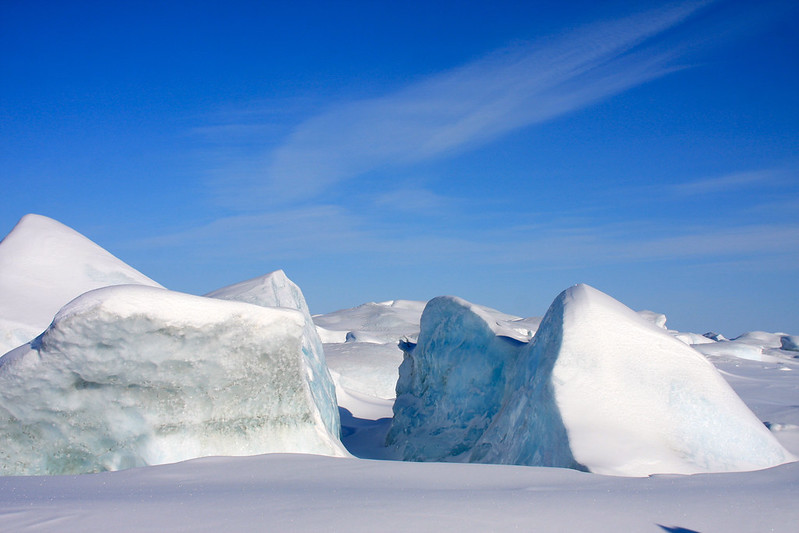
Photo: Ice, May 2, 2012, by Johannes Zielcke via Flickr. Licensed under CC BY-NC-ND 2.0
Disclaimer: Any views or opinions expressed in articles are solely those of the authors and do not necessarily represent the views of the NATO Association of Canada.