North Korea’s growing participation in Russia’s invasion of Ukraine has brought together two theatres of operation in a way rarely seen since the Second World War, carrying enormous implications for both the Atlantic alliance and security in the Indo-Pacific. As Pyongyang and Moscow forge a deeper strategic partnership, the effects are reverberating from Kyiv to the Korean Peninsula. To meet this challenge, South Korea and NATO must recognize the shared nature of the present challenge and work together to strengthen each other’s military industrial capabilities.
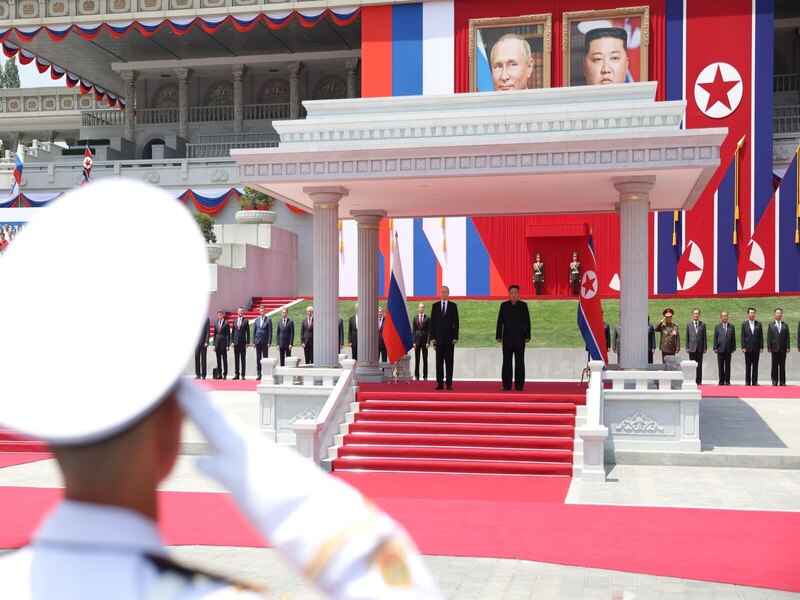
North Korea was one of only two nations to endorse Russia’s annexations of four Ukrainian regions. In turn, Russia has provided North Korea with critical food and fuel supplies, helping stabilize Kim Jong Un’s economy in the face of international sanctions. Russia’s support at the UN Security Council, including vetoing the renewal of oversight bodies tasked with overseeing sanctions against North Korea, has helped shield Pyongyang from global pressure. What began as diplomatic support has steadily evolved into direct military assistance as the conflict continued.
As Russia’s artillery-heavy military has consumed ammunition at a rate faster than it can replace, Moscow has increasingly turned to Pyongyang to keep its war machine supplied over years of attritional fighting. North Korea has obliged by committing an estimated 5 million rounds of artillery ammunition according to information revealed by South Korean intelligence. While many of these shells are defective, leading to considerable losses of both artillery pieces and gunners, their sheer quantity has proved critical in sustaining Russian operations. It has been estimated that these shells provide for half of Russia’s consumption of artillery ammunition on the Ukrainian front.
Even more stunningly, since October 2024 Pyongyang has taken the step of sending more than 10,000 North Korean soldiers to Russia’s frontline against Ukrainian forces where they proved instrumental in the 2025 Russian counter-offensive in Kursk. Though facing linguistic and operational challenges, they have proven useful as cannon fodder, consistent with Russia’s “meatwave” tactics, saturating enemy positions with expendable troops to exhaust Ukrainian defenses and create breaches in their lines. Moreover, by providing real-life battle experience to North Korean troops, Russia’s invasion of Ukraine is helping to battle harden the North Korean military. This growing disparity in operational experience presents a serious concern for Seoul as North Korean units with fresh combat experience could hold a significant tactical edge over South Korean forces largely untested in modern warfare.
In return, Russia has begun providing support to modernize North Korea’s military across a wide range of domains including fighter jets, reconnaissance satellites, ballistic missiles, and potentially even nuclear submarines. In March 2024, reports emerged concerning Russian technical support in upgrading North Korea’s air force. The May 2025 launch attempt of a liquid kerosene fueled rocket has pointed towards the use of Russian engine technology in North Korea’s satellite reconnaissance p rogram. Ukrainian intelligence has additionally reported that Russia has begun transferring “low yield tactical nuclear weapons and submarine missile launch systems.” Pyongyang’s reveal of its first nuclear powered submarine in March 2025 has fueled unconfirmed speculation of Russian technology-transfer.
This deepening cooperation between Russia and North Korea represents the most significant shift in North Korea’s military capabilities since the end of the Cold War. For a regime that has struggled under decades of sanctions and international isolation, access to Russian technical expertise is a generational leap forward that dramatically strengthens North Korea’s coercive shadow.The signing of a mutual defence pact between the two countries in June 2024 even goes so far as to commit each state to come to the other’s support in the event of an attack.
This deepening alliance has already begun to shift the balance of power on the Korean peninsula, potentially emboldening North Korea to pursue its maritime border claims against South Korea in the Yellow Sea more assertively. North Korea’s military modernization has even led some analysts to fear that Kim Jong Un could attempt to reignite a full-scale invasion of South Korea, especially if the South’s deterrence were weakened by a contemplated withdrawal of US-led forces from the peninsula or a potential Chinese invasion of Taiwan. In the worst case scenario of a Taiwan contingency, Beijing may be inclined to pin down US forces on the Korean peninsula and may urge Pyongyang to open up a second front in the event of a regional conflict.
However the implications of this partnership extend beyond East Asia. For Europe, the increased military support offered by North Korea to Russia risks turning the tide of the conflict in Ukraine towards Moscow’s favour. For Washington, the threat of simultaneous assaults on both Taiwan and South Korea complicates and weakens deterrence against Beijing by threatening to stretch thin US forces in the First Island chain across multiple fronts, in turn making it more difficult for Washington to credibly threaten counter measures against a Chinese invasion of Taiwan. If left unchecked, this multi-theatre strategic challenge threatens to upend decades of deterrence and force a dangerous reordering of both the European and Indo-Pacific security architecture.
Thankfully numerous opportunities exist to deepen cooperation between NATO and South Korea. As one of four official NATO partner in the Indo-Pacific region and possessing a large experienced military industrial base in its own right, South Korea is well-positioned to fill the gap created by the discontinuation of American arms transfers to Ukraine. Although South Korea has not directly provided Ukraine with military aid or arms sales, South Korean military equipment provided to Ukraine by European allies has proven invaluable. South Korean built K9 Thunder self-propelled 155mm howitzers supplied to Ukraine by Poland have proven their effectiveness on the battlefield and can be built two to three times faster than western equivalents and at a significantly lower cost. Fully leveraging this opportunity for NATO and South Korea to deepen cooperation would require both NATO and South Korea to take more seriously the shared nature of the threat posed by Moscow and Pyongyang’s deepening cooperation, and for South Korea in particular to reassess its policy against arms transfers to conflict zones like Ukraine.
Disclaimer: Any views or opinions expressed in articles are solely those of the authors and do not necessarily represent the views of the NATO Association of Canada