In the occupied territories of Ukraine and across Russia’s own ethnic republics, President Vladimir Putin is executing a quiet war of attrition: banning native languages, shuttering local institutions, and sending minority youth to the frontlines as cannon fodder. This systematic campaign demonstrates that modern territorial expansion relies as much on eradicating living identity as it does on conventional firepower.
While traditional NATO doctrine defines Cultural Property Protection (CPP) primarily through the safeguard of physical assets such as historical monuments, archives, and infrastructure, this narrow definition overlooks a critical vulnerability in modern conflict. Modern hybrid warfare explicitly targets intangible cultural heritage as a means to destroy a group’s cultural identity. When hostile state actors systematically ban native languages, dismantle Indigenous education systems, shatter localized governance, and rewrite historical memory, they execute a strategy of coercive assimilation. This deliberate destruction of a minority’s organizational self-sufficiency erodes its internal cohesion so thoroughly that the group ceases to exist as a distinct political or social entity, achieving territorial conquest and political pacification without firing a single shot or destroying any physical infrastructure. To effectively counter these threats, NATO must expand its Cultural Property Protection lens beyond tangible objects and integrate the protection of intangible heritage into its broader human security architecture, recognizing that defending modern societies necessitates protecting the living social fabric that holds them together.
Cultural decimation operates in an operational blind spot precisely because culture is largely intangible, tied in a group’s language, customs, social structures, historical memory, and inherited traditions. As such, the targeting and therefore defence of culture requires a far more sophisticated lens. Hostile state actors like Russia exploit the absence of concrete policy frameworks to conduct deliberate campaigns of cultural identity erasure to neutralize future political resistance and eliminate potential insurgency in contested territories.
For NATO, this reality reframes cultural destruction; it is a core driver of long-term instability that directly generates hard-security threats across the Alliance’s flanks. Within NATO’s Human Security Framework, which explicitly identifies protecting civilians and cultural property as vital to strategic stability, the systematic stripping of a community’s identity and organizational self-sufficiency acts as a major catalyst for mass displacement and severe regional instability. State-sponsored attacks on minority languages, educational systems, and local governance serve as the earliest warning indicators of escalating conflict or ethnic cleansing.
NATO can better detect, counter, and deter intangible cultural erasure by expanding its operational lens to treat it as a hybrid security threat. To do so, NATO must treat cultural suppression as a primary early warning indicator: tracking indicators such as the outlawing of Indigenous assemblies, forced linguistic homogenization, and disproportionate ethnic mobilization within its Joint Intelligence & Security (JIS) framework. This pools strategic intelligence across allies to identify and assess emerging threats before they escalate.
The abstract nature of culture means its destruction rarely takes a single shape; instead, it contorts across a dangerous spectrum of state-sponsored coercion, such as outlawing native languages and the banning of independent self-governing Indigenous bodies. Within Russia, this cultural attrition is most visibly executed in the strategic over-mobilization of Indigenous populations to the frontlines of the war in Ukraine to exhaust and target minority demographics. As former Mongolian President Tsakhiagiin Elbegdorj observed regarding Russia’s Mongolic minorities (Buryats, Tuvans, and Kalmyks), Putin purposefully uses marginalized ethnic groups as frontline “cannon fodder.” By sacrificing minority youth on the frontlines, the regime achieves a double objective: filling its military ranks while systematically eroding the demographic capacity of Indigenous populations to sustain their communities.
Another tactic of state-sponsored cultural erasure is the dismantling of a minority’s organizational self-sufficiency. Following the 2014 illegal annexation of Crimea, Russian authorities weaponized legal administrative pretexts to eliminate the Indigenous Crimean Tatar population’s capacity for political and social self-governance. The International Court of Justice (ICJ) confirmed that Russia violated international law by banning the Mejlis, the highest representative assembly of the Crimean Tatar people, and barring its leadership from public life. Rather than addressing legitimate security concerns, law enforcement measures and criminal prosecutions were deployed as a deliberate facade to neutralize Indigenous leaders who opposed Russian territorial control, effectively excluding the Crimean Tatars from civic participation and inflicting a severe, disparate adverse impact on their fundamental rights. By outlawing representative institutions, seizing community assets, and criminalizing Indigenous advocacy, the central regime successfully decapitates local leadership, leaving the population structurally unmoored and unable to defend its living heritage. This strategy is of critical concern to NATO; by attempting to erase the Crimean Tatars’ identity and governance structures, Russia seeks to alter the socio-political terrain and consolidate illegal territorial gains without having to fire a shot.
Linguistic suppression operates as another effective lever of coercive assimilation, gradually dissolving a community’s identity from within. While deployed aggressively in illegally occupied territories like Crimea, this weaponization of language is rooted in a broader, domestic policy of imperial homogenization across the Russian state. Through a series of centralized legislative reforms over the last two decades, including forcing all official languages to adopt Cyrillic scripts, eliminating native-language university entrance exams, and making regional language education voluntary, the Russian state has systematically stripped non-Russian languages of their institutional legitimacy. Recent signage regulations requiring mandatory Russian usage in public, commercial, and digital spaces further enforce a monolithic public square, marginalizing native dialects into functional irrelevance. This is a deliberate political strategy to diminish linguistic diversity; shutting minority languages out of economic mobility, higher education, and public visibility breaks intergenerational transmission, causing younger generations to view their native tongue as obsolete. For NATO, Russia’s domestic campaign of linguistic erasure serves as the baseline operational playbook; the very techniques perfected inside Russia’s borders are exported directly to occupied territories to extinguish regional identity, pacify local populations, and consolidate illegal territorial gains.
Language loss as such is a deliberate instrument of state-sponsored cultural homogenization. By forcing minority populations to adopt Russian as the sole normative standard of identity, the central state systematically absorbs Indigenous cultures and eliminates competing historical narratives that could challenge its control. Inside Russia, this campaign has driven a nearly 29% national decline in native-language proficiency and stripped over 1 million speakers from Tatar alone. For Russia this domestic erasure serves as the tactical template for its foreign aggression; once territory is seized, these exact mechanisms are exported to pacify local populations and cement illegal control. As confirmed by the UN Office of the High Commissioner for Human Rights (OHCHR), Russian occupation authorities have outright prohibited the Ukrainian language in schools, severely restricted its use in daily life, and imposed the Russian state curriculum.
Recognizing that linguistic erasure is a deliberate tool of state control, Canada possesses the unique historical insight and institutional credibility within NATO to articulate how living identity destruction functions as a tool of subjugation. By advocating for the expansion of Cultural Property Protection (CPP) to encompass intangible identity and community self-sufficiency, Canada can leverage its established middle-power leadership in NATO’s Human Security Agenda to shape forward-looking Allied doctrine and strengthen international defence policy.
Modern hybrid warfare has redefined the battlefield, transforming intangible culture into a primary target of state-sponsored aggression. As demonstrated by Russia, the destruction of native languages, local institutions, and demographic continuity serves a clear strategic objective; neutralizing political resistance and reshaping the socio-political terrain to suit authoritarian ends. NATO cannot afford to leave intangible heritage in an operational blind spot. By treating cultural suppression as a hard-security early warning indicator, NATO can effectively counter covert state hostility before it escalates.
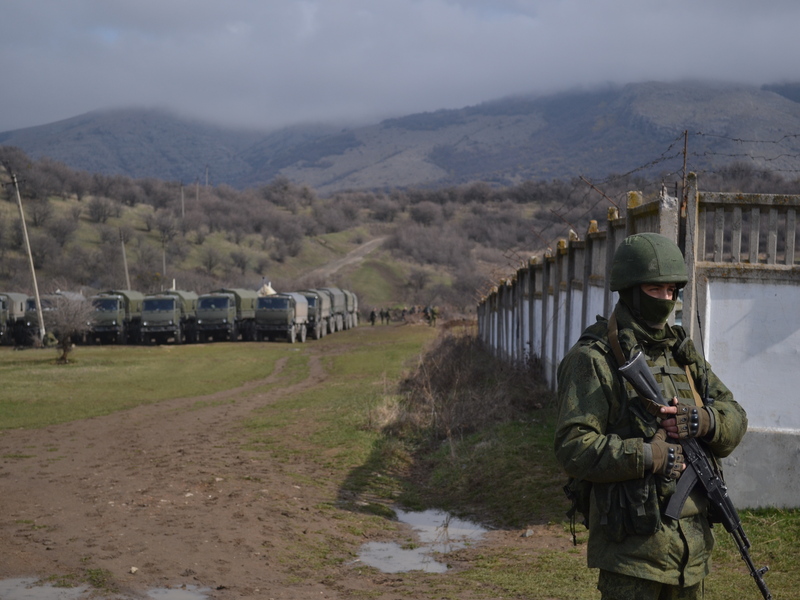
Image credit: Military base at Perevalne during the 2014 Crimean Crisis (2014) by Anton Holoborodko via Wikimedia Commons. Licensed under CC BY-SA 3.0.
Disclaimer: Any views or opinions expressed in articles are solely those of the authors and do not necessarily represent the views of the NATO Association of Canada.