Over the years, modern warfare has shifted away from conventional battlefields to urban centers, exposing civilian populations and critical infrastructure to direct risk. Critical infrastructure refers to the facilities, systems and assets that are required for countries and economies to function properly. As a result, essential systems such as healthcare, energy, water, and communication networks become susceptible to disruptions, leading to repercussions beyond the immediate conflict zone. These disruptions weaken public health capacity and societal resilience, resulting in long-term instability and slower recovery. Recent conflicts such as in Ukraine and Gaza, reflect how infrastructure should be understood in terms of a security concern with implications for state stability and NATO preparedness rather than solely collateral damage.
Infrastructure as a Battlefield
Modern conflict increasingly targets and disrupts critical civilian infrastructure that societies depend on for essential services. In urban environments, the effects of explosive weapons can extend far beyond intended military objectives, causing widespread damage to surrounding infrastructure and civilian systems. This contributes to significant civilian harm, including deaths, injuries, and psychological trauma.
According to the International Committee of the Red Cross (ICRC), urban warfare often leads to cascading system failures, where disruption to electricity, water, and healthcare spreads quickly across interconnected services. Thus, leading to hospitals and other critical services being unable to function. This portrays how infrastructure is a system of interdependence, one failure leads to another, creating greater risks to public health and people’s livelihoods.
As neighborhoods become the frontlines, the basic necessities of life such as water, food, healthcare, education, and employment become increasingly difficult to access, leading to the massive displacement of populations. But even after fighting has ceased, displacement can continue on for years, and massive destruction caused by conflict in cities can set development indicators back decades. For example, the loss of skilled workers and the closure of schools hinder long-term human capital development. Infrastructure is no longer merely collateral damage; rather, it has become part of the battlespace, as shown in recent conflicts.
Recent Conflicts That Demonstrate This Pattern
Contemporary conflicts demonstrate how attacks on critical infrastructure are no longer isolated events but rather a recurring feature of modern warfare. According to the World Health Organization (WHO), in 2025, Ukraine suffered the highest number of attacks on its healthcare since the start of the full-scale invasion in February 2022, representing around a 20% increase over 2024. However, the brunt on health systems extends beyond direct attacks on hospitals. Bombing of energy infrastructure, particularly on thermal power plants that support the country’s electricity grid, have disrupted the power supplies that hospitals, medical equipment, and other essential services depend on. These attacks demonstrate how damage to interconnected civilian infrastructure can quickly threaten the functioning of an entire health system.
The same pattern can be seen in Gaza, where attacks on hospitals and critical infrastructure have placed the health system under critical strain and produced catastrophic consequences for civilians. The WHO reports that Gaza’s health system is on the verge of collapse, as intensified hostilities exacerbate an already weakened system amid worsening mass population displacement and acute shortages of food, water, medical supplies, fuel, and shelter. The WHO further notes that “at least 94% of all hospitals in the Gaza Strip are damaged and destroyed.” As a result, many facilities are unable to function, not only due to direct damage but also because the infrastructure required to sustain them has collapsed. This once again portrays how the breakdown of essential infrastructure impairs the delivery of health services at a population-wide level.
Both examples demonstrate the same pattern, when critical infrastructure is disrupted health systems no longer operate as integrated networks. This reflects a broader feature of modern conflict in which infrastructure deterioration leads to systematic collapse, which then severely limits civilian access to essential services.
Why Infrastructure Disruption Matters Beyond The Battlefield
The destruction of critical infrastructure extends beyond immediate humanitarian impacts and becomes a broader security concern. Although the immediate impact of attacks on healthcare infrastructure includes reduced access to care, increased pressure on medical staff, and diminished service quality, the heavier consequences are revealed over time through damage to health system capacity.
In conflict settings, essential public health functions such as immunization programs and disease surveillance are significantly weakened. Prior to the war in Gaza, 54 immunization facilities were running, being among the world’s leaders in childhood vaccination coverage at a 98% rate. In 2025, 31 immunization facilities are inoperative due to the damage sustained in indiscriminate attacks, and routine vaccination coverage is under 70%. Furthermore, such system failures also generate broader societal effects. Reduced access to essential services and deteriorating living conditions will eventually lead to mass population displacement as individuals seek safety and access to care elsewhere. Not only does this reduce institutional capacity within affected states, but it also places pressure on neighbouring countries, creating cross-border humanitarian and governance challenges.
Implications for NATO and Future Preparedness
Infrastructure resilience should be treated as a core component of NATO security and preparedness planning , since infrastructure disruption directly impacts state stability and crisis capacity. In modern warfare, the capacity to resist such attacks does not only depend on military forces but also on resilient civilian systems that can withstand and recover from disruption. Resilience is already a NATO priority, as Article 3 urges allies to maintain their individual and collective capacity to resist armed attacks through preparedness and mutual aid. However, achieving infrastructure resilience is made more challenging by the fact that much of Canada’s and other NATO members’ critical infrastructure is privately owned. Protecting these systems therefore requires close cooperation between governments, the military, and private-sector operators to ensure essential services remain operational during crises.
Recent conflicts illustrate how attacks on critical infrastructure can achieve strategic effects without directly defeating military forces.Therefore, infrastructure resilience becomes a key feature in both national and allied resistance. For Canada, this means that strengthening civil preparedness and protecting critical infrastructure is just as important for national defence as military capabilities are. Ultimately, strengthening infrastructure resilience must be treated as a central pillar of NATO’s policies and security planning in an era of increasingly hybrid and infrastructure-dependent warfare.
Disclaimer: Any views or opinions expressed in articles are solely those of the authors and do not necessarily represent the views of the NATO Association of Canada.
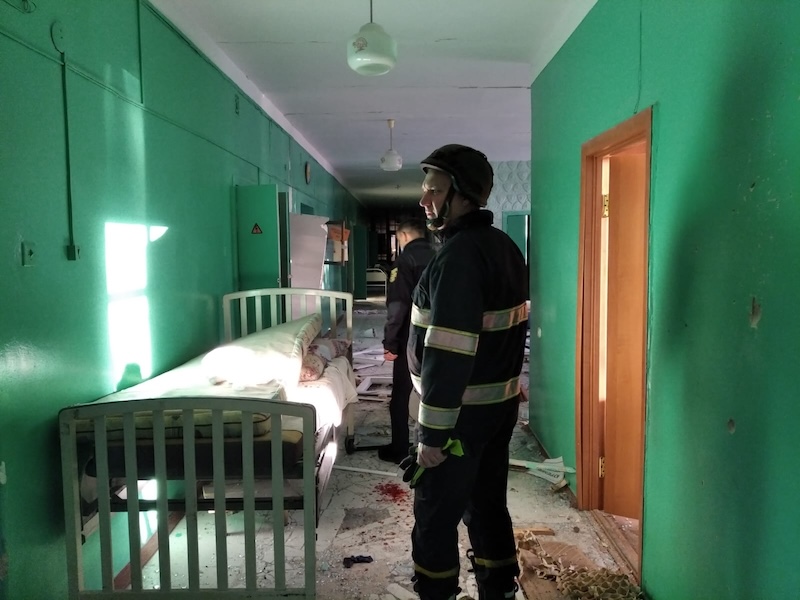
Image credit: Hospital in Kupiansk after Russian shelling, 2022-10-03 (03) (3 October 2022), depicting the Kupiansk Central City Hospital in Ukraine after Russian shelling, by Main Directorate of the State Emergency Service of Ukraine in Kharkiv Oblast via Wikimedia Commons. Licensed under CC BY 4.0