Until recently, the suggestion that the United States might acquire Greenland by purchase or coercion was widely regarded as implausible, surfacing mainly in speculative or rhetorical discourse, periodically revived by U.S. President Donald Trump since his first term in office. Yet when NATO’s leading power openly insists that it will take the territory of a fellow ally “one way or the other,” the implications cannot be dismissed.
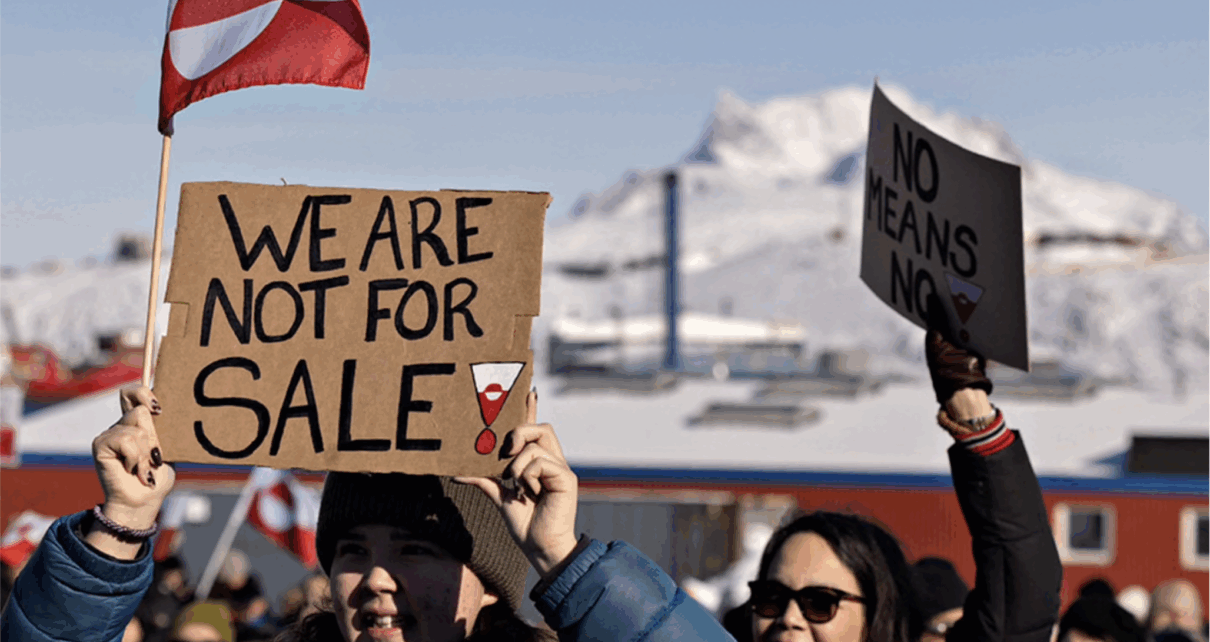
Trump has held that Greenland must be brought under U.S. control on national security grounds. Greenland, however, is a self-governing territory within the Kingdom of Denmark, whose NATO membership extends alliance security guarantees to the entire Kingdom. For Greenland, the idea of a U.S. takeover has seen unequivocal resistance. Avaaraq Olsen, the mayor of Nuuk, told CBC News that Greenland witnessed one of its largest public demonstrations in the spring, as residents mobilized against annexation. “We don’t want to be Americans,” she said. “We are Kalaallit. We are Greenlanders.”
This opposition comes despite Greenland’s long-standing security relationship with Washington. For more than eight decades, the island has hosted American military installations. Under a 1951 defence agreement between Denmark and the United States, the U.S. Department of Defense operates the Pituffik Space Base in northwestern Greenland, a critical hub for missile warning, missile defence, and space surveillance operations supporting both the United States and NATO. The issue, then, is not access or cooperation, but control.
If a NATO member can credibly threaten the territorial integrity of another member, the foundational premises of the alliance are put at risk. NATO’s collective defence commitment, enshrined in Article 5, presumes that threats originate outside the alliance, not from within it. The treaty thus offers no clear mechanism for addressing internal coercion, leaving NATO structurally unprepared for precisely the scenario Greenland now represents.
A United States annexation of Greenland would therefore be more than a bilateral dispute between Washington and Copenhagen. It would expose a contradiction at the heart of NATO, calling into question its viability as a security guarantor and demonstrating how internal power disparities can override formal commitments. As Danish Prime Minister Mette Frederiksen has warned, such an act would not merely strain NATO; it would effectively end it.
For Canada, this is not a distant European crisis. Greenland is Canada’s closest Arctic neighbour, and the logic driving U.S. pressure — strategic geography, military positioning, and access to critical resources — applies just as readily to Canadian territory. If NATO cannot restrain its most powerful member from threatening a smaller ally, Canada must confront an uncomfortable reality. The nation’s Arctic sovereignty may depend less on alliance assurances than on its own capacity to deter pressure, build partnerships, and defend its northern interests.
That reality is already being acknowledged at the highest political level. In a speech at the World Economic Forum in Davos, Prime Minister Mark Carney argued that Canada is no longer navigating a gradual adjustment but “a rupture, not a transition” in global politics. The assumptions that once underpinned middle-power security — that alliances and international institutions would reliably constrain great powers — can no longer be taken for granted. Instead, Carney described a world defined by coercion, power asymmetries, and the erosion of limits on dominant states.
Drawing on Václav Havel’s concept of “living within a lie,” Carney argued that the stability of the postwar order rested on widespread compliance with a fiction that the strongest would exercise restraint. That fiction, he suggested, has now collapsed. Canada’s response, he argued, must be greater strategic autonomy, diversification of partnerships, and a sustained strengthening of domestic economic and military capacity. Alliances remain important, but they can no longer be treated as sufficient in themselves.
This logic bears directly on Greenland. Carney reaffirmed Canada’s support for the sovereignty and territorial integrity of Denmark and Greenland while reiterating Canada’s commitment to Article 5. At the same time, his remarks implicitly acknowledged the limits of that commitment in an environment where internal power imbalances strain alliance cohesion. If NATO cannot reliably constrain its most powerful member, Canada’s response cannot remain rhetorical. Accelerated defence spending, expanded Arctic capabilities, and deeper coordination with European partners are not symbolic gestures, but necessary adaptations.
Recent developments underscore the volatility of this moment. Trump threatened to impose tariffs on countries opposing his push to annex Greenland, prompting European governments to consider retaliatory measures. Days later, he moved to de-escalate, ruling out his previous threat of military force, withdrawing tariff pressure, and announcing on Truth Social that he and NATO Secretary General Mark Rutte had agreed to the “framework of a future deal” on Greenland. No details of that framework were provided.
If the Greenland crisis has clarified anything, it is that its implications extend far beyond a single dispute. What it exposes is a misalignment between NATO’s legal architecture and contemporary power politics. The alliance was built on the assumption that shared interests and mutual constraints would make internal coercion unthinkable. Article 1 commits NATO members to refrain from the threat or use of force and to resolve disputes peacefully, embedding a principle of mutual restraint among allies. Article 2 further grounds the alliance in shared interests by obliging members to promote friendly relations, stability, economic cooperation, and the strengthening of common institutions. When that assumption fails, the issue is not NATO’s formal survival but the erosion of restraint among its members. As allies begin to act against one another, deterrence weakens, and treaties lose their force. The most serious consequence of U.S. pressure on Greenland is therefore not territorial, but normative: it legitimizes the use of power over consent within the alliance.
Canada’s response should be to move from alignment to leadership in the Arctic. A practical opening already exists. The upcoming visit of Foreign Minister Anita Anand and Governor General Mary Simon to Nuuk should be treated not as ceremonial diplomacy, but as the start of a sustained Canadian role in Greenlandic security and governance. That role should include deeper defence cooperation with Denmark and Greenland, joint Arctic surveillance and mobility capabilities, and expanded Canadian participation in regional deterrence efforts.
Canada’s geography, Arctic assets, and dense ties with Greenland place it in a unique position to act as more than a passive stakeholder in northern security. Long-standing civil, Indigenous, and institutional relationships — through the Arctic Council, search-and-rescue and fisheries agreements, scientific cooperation, and Inuit-to-Inuit diplomacy — provide a foundation that few other allies possess. Strengthening these relationships, while investing in Arctic capabilities less dependent on U.S. integration, would signal that Canadian sovereignty in the North is exercised rather than assumed. If this moment is a test, it is not only of NATO’s credibility, but of whether Canada is prepared to treat sovereignty as something exercised in practice, rather than assumed through proximity to power.
Disclaimer: Any views or opinions expressed in articles are solely those of the authors and do not necessarily represent the views of the NATO Association of Canada.